0
0
IN FEBRUARY 2006, Karachi’s Academy Bazyaft published a book titled Masnoo’ee Zahaanat. A literal translation of the English compound artificial intelligence, the title sounded a bit strange as in those days, artificial intelligence was something that common readers knew very little of, at least in this part of the world. Written by Baqar Naqvi, the book was one of the earliest works in Urdu on artificial intelligence.
Today, 20 years later, artificial intelligence has become something quite familiar and is now usually referred to as AI. It has become enormously advanced and is impacting almost every field of human endeavour, but we still have very few works on AI written in Urdu. This shows the trend that increasingly favours disseminating scientific knowledge in English rather than in our national language. Whether we read it in Urdu or English, the fact is we still don’t realise the drastic change that AI is going to bring into our lives. So much so that, according to some experts, AI could pose an existential threat to human beings in not-so-distant future.
But Punjab Arts Council, Sahiwal, realised that AI was something that could be a challenge for arts, culture and literature and it needed to be discussed. So, they organised a conference on the topic of ‘Artificial Intelligence, Literature and Culture: Issues, Perils and Possibilities’. Scholars and academics were invited to Sahiwal to deliberate on AI and its impact, especially on literature, languages, economy and culture. The aims and objectives of the conference were, among other things, to have a global perspective on Urdu literature, to see literature against the backdrop of folk culture and to strengthen local cultural identities in the wake of cultural imperialism unleashed through AI.
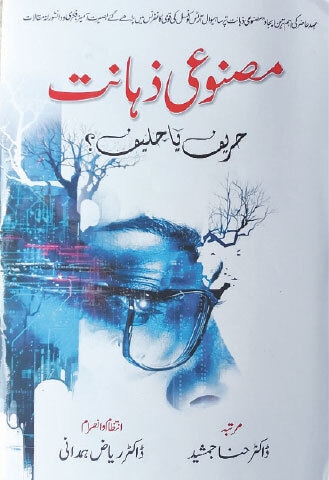
The papers read out during the conference have now been published in a book form. Titled Masnoo’ee Zahaanat: Hareef Ya Haleef? (artificial intelligence: rival or ally?), it is compiled by Dr Hina Jamshed and published by Misaal Publishers, Faisalabad.
The book contains over 30 papers on various topics concerning AI and its impact on society vis-à-vis teaching of literature and language, translation, creative writing, feminism, digital fiction and the perils posed by AI to literature. Dr Riaz Hamdani, the director of Arts Council, in his intro writes that AI indeed opens up new vistas of human knowledge, literature and aesthetics, but at the same time one feels that in the new scheme of things only those nations will survive that have a vision to see knowledge in the light of culture and civilisation and put knowledge before economy, not the other way round. The use of AI involves not only data, algorithms and machine learning but concerns human feelings, too, which seeks meaningfulness as well as utility, adds Hamdani.
The topic of Nasir Abbas Nayyar’s keynote address was AI and the creation of literature, deliberating on the perils and prospects of literature to be created in future. It raised some thought-provoking questions, too. Briefly narrating the history, Nayyar said since 1950’s, when it began with machine learning, AI has come a long way and has transformed itself into a truly revolutionary invention. Coming to the literature created by AI, Nayyar said we have two choices: either we accept the literature created by AI as part and parcel of our literature or we differentiate the literature written by human beings from literature created through AI.
In the first case, says Nayyar, we would have to give up whatever little creativity we have. This would be the death of the author and the death of human beings as the name of the concerned chatbot would replace the name of the author on books and articles. But if we decide to differentiate the actual literary works created by humans from the ones made up by AI, we will have to establish a quantitative measure, though reckoning that measure is not easy.
Dr Anwaar Ahmed said AI is an extended, mechanical intelligence, which cannot produce another Mir or Ghalib, neither Majeed Amjad nor Manto. Dr Najeeb Jamal said with the help of AI it would be easy to read and understand Urdu’s classical literature preserved in the form of manuscripts and this would profoundly affect textual criticism. Other papers read out during the conference included ones by Aurangzeb Niazi, M. Khalid Fayyaz, Ashraf Kamal, Hina Jamshed and many others. One feels some ethical questions, too, should have been raised in this age of misinformation and fake news.
It is heartening that Sahiwal Arts Council has been organising conferences on literary and cultural issues. One hopes they will keep it up.
Published in Dawn, January 19th, 2026