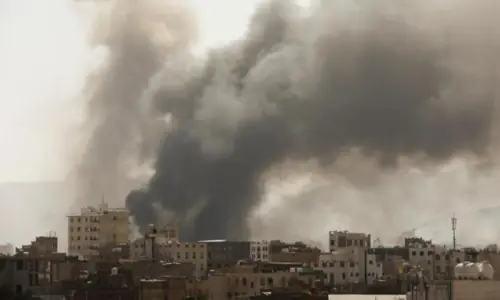
“WE feel like the living dead…” This is how children in Gaza describe their lives, according to a new study, Palestinian Education Still Under Attack,on the effects of attacks on education in Gaza and the West Bank. When asked about their hopes for the future, children no longer speak of school, work or aspirations. Their only wish, the report finds, is to live another day.
For people in Pakistan, whose collective memory is marked by colonial violence and its aftermath, this language is chillingly familiar. Imperialism has never worked through conquest and control alone. It has always attacked identity and dignity, most brutally in the lives of children and the most vulnerable.
What is happening in Gaza today is not simply the destruction of schools or the interruption of education. It is the systematic dismantling of childhood as a protective mechanism. Hunger now governs daily life in Gaza. The report depicts how parents are actively stopping their children from playing since play makes them hungry; hunger that families can no longer afford. Children are fainting in the few available learning spaces. Some children expressed how they do not want to attend school (or whatever alternative is available) since they lack shoes, clean clothes or even a single sheet of paper. This is how dignity is stripped away. Imperialism does not need to declare that certain lives matter less (though in this instance it has), it simply creates conditions where that conclusion becomes unavoidable.
Colonial subcontinent offers painful parallels. Under British rule, repeated famines were treated as unfortunate but acceptable outcomes of governance. Children stopped going to school not because education was formally banned, but because hunger, labour and violence made learning irrelevant. Children learned early that their bodies existed to endure, not to flourish.
In Gaza, bedwetting, mutism, panic attacks and withdrawal are widespread amongst children. Some children have stopped speaking altogether. Others speak only of death. Trauma is so unprecedented and pervasive; it has become life. Colonial power has always understood this. A population that cannot imagine a future is easier to manage than one that can.
The assault on dignity extends also to the body. Children have been acquiring life-altering injuries at an alarming rate; while rehabilitation services have collapsed and assistive devices are unavailable. Girls are experiencing lack of water, privacy and menstrual supplies, which silently pushes them out of education. Early marriage pressures have increased as families seek protection or economic relief. Boys have been pushed into labour, exposed to violence while searching for food, all the while absorbing anger that has nowhere to go. Rising aggression among boys is framed as a behavioural problem, rather than as a predictable response to humiliation, hunger and abandonment. This is the systematic erosion of identity.
Children are fainting in the few available learning spaces.
Pakistan’s history shows us what happens next when childhood is shaped by mass violence and deprivation. Partition did not end when borders were drawn. It lived on in families who taught their children to stay quiet, to expect loss, and to treat instability as normal. Millions of children grew up in households where the trauma of displacement, hunger and death was never addressed, yet omnipresent.
Families celebrated endurance while unresolved grief hardened into silence. Violence was absorbed into everyday life rather than named and addressed. Over time, this produced generations who learned to lower expectations, distrust institutions and accept inequality as fate rather than injustice. The costs of colonisation were not confined to one historical moment; they reproduced themselves through trauma, poverty and unequal access to education.
This is how damage and trauma is normalised. When accountability and recognition is deferred, suffering is inherited. Children learn what the world expects of them long before they learn what they might want from it. This is why the dismantling of childhood matters. What is unfolding is not a temporary humanitarian emergency that can be solved by reopening schools alone. It is the systematic loss of childhood and, with it, the erosion of collective dignity and identity. When children say they feel like the living dead, they are not exaggerating. They are naming the collective trauma imposed on them.
For societies shaped by colonialism, this should not feel distant. We know what it means when generations grow up believing that tomorrow is not something to dream about, but something to endure. The real question is whether we recognise the machinery of imperialism while it is still operating, or only once its damage has already become history.
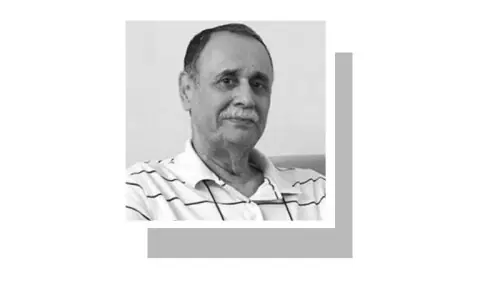
The writer is an assistant research professor at the University of Cambridge.
Published in Dawn, January 17th, 2026