Bilawal touts Sindh govt performance to dispel ‘negative impression’
• PPP chairman says service delivery improved, institutions strengthened during party’s rule
• Says health sector allocations increased to nearly 10pc from 2.9pc in 2008; wind farms producing 1,845MW
• Recalls how province rebuilt 2.1 million flood-hit homes on climate-resilient lines
ISLAMABAD: A day after claiming that ‘some powers’ wanted to deprive Sindh of its rights, PPP chief Bilawal Bhutto-Zardari on Thursday said the province had been consistently strengthening its institutions and improving service delivery, as he went on to list the achievements of the PPP government.
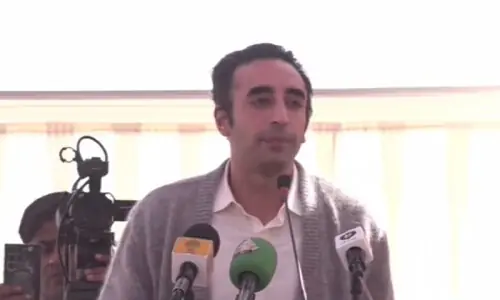
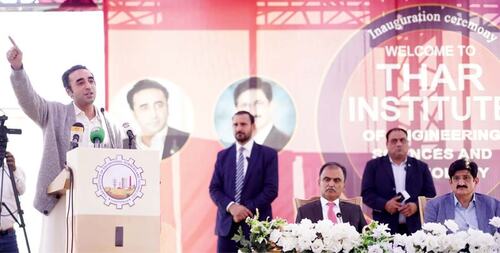
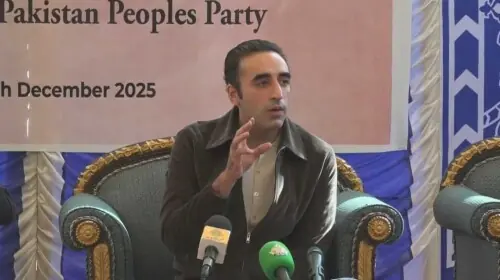
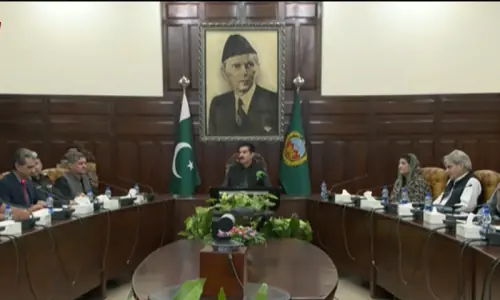
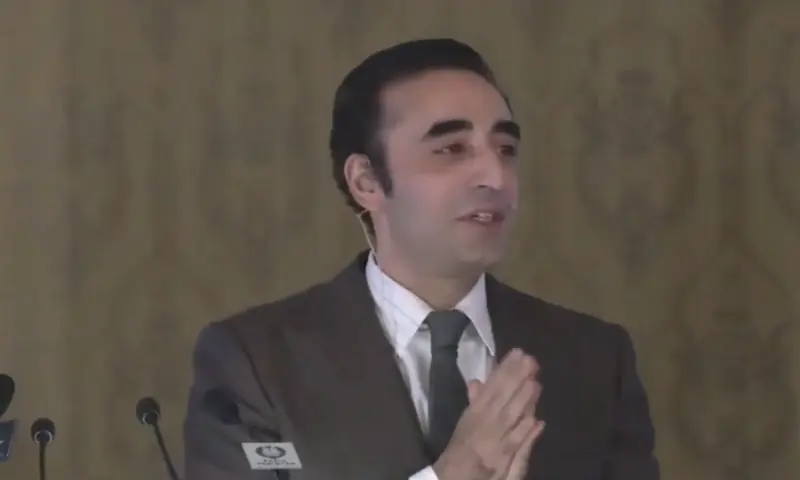
The PPP leader made these comments at an event at the President’s House in the federal capital, where he gave a detailed presentation, while negating the impression that Sindh lagged behind other provinces in terms of progress.
Sindh is often portrayed as a “glass half empty” province, he said, adding that the PPP-led government had steadily strengthened institutions and expanded service delivery. In his speech, the PPP chief highlighted the Sindh government’s performance since 2008 in the fields of healthcare, education, poverty alleviation, infrastructure, industry, agriculture and revenue generation.
Focusing on healthcare, Mr Bhutto-Zardari said Sindh had increased health sector allocations from 2.9 per cent of the provincial budget in 2008 to nearly 10pc. He also highlighted the expansion of major public hospitals, including the Jinnah Postgraduate Medical Centre (JPMC), where bed capacity had doubled from 1,100 to 2,200 by 2025, with a target of 3,100 beds by 2028.
He said that the National Institute of Cardiovascular Diseases (NICVD) operated 11 specialised hospitals and 30 chest pain units across the province. Referring to the Sindh Institute of Urology and Transplantation (SIUT), he said more than 35 million patients had benefited from its services since 2008, while its bed capacity had increased from 760 to 1,926.
About the education sector, the PPP chairman said that the number of public universities in Sindh had increased from 10 in 2008 to 30, along with 18 additional university campuses across the province.
On poverty alleviation, he said that the Sindh Rural Support Organisation (SRSO) helped lift 1.4 million women out of poverty through soft loans, with a recovery rate of 98 per cent.
Recalling the devastating floods of 2022, Mr Bhutto-Zardari said around 2.1 million houses were destroyed across the province. In response, the Sindh government launched a massive housing initiative to build 2.1 million climate-resilient homes. Of these, 750,000 had been completed, while around 1.5 million were under construction. He said the project had created nearly one million jobs.
In the agriculture sector, he said the provincial government distributed wheat seed worth over Rs2.1 billion to 215,000 farmers following the floods, leading to a harvest of 4.5 million tonnes the following season.
He claimed that public transport was virtually absent in the province before 2008, but PPP-led initiatives now facilitated daily travel for over 200,000 passengers, including through the introduction of electric buses.
Energy sector
On energy, he said Sindh had the potential to generate 50,000 megawatts of wind energy, alongside vast solar capacity. Currently, 1,845MW is being produced from wind projects. He said 200,000 solar home systems had already been provided to households, with another 275,000 homes set to be solarised.
The PPP chairman also highlighted environmental gains, saying mangrove forest cover in Sindh had expanded from 270,000 acres to a record 675,000 acres.
Addressing revenue generation, he said the Sindh Revenue Board (SRB) had collected Rs28 billion in 2011, compared to Rs10 billion collected by the Federal Board of Revenue in 2010, a 68 per cent increase over federal collections at the time. He said the SRB’s average annual growth rate of 19 per cent far exceeded the Federal Board of Revenue’s 10 per cent.
Calling for fiscal reforms, Mr Bhutto-Zardari proposed devolving the collection of sales tax on goods to provinces, arguing that provincial revenue authorities had consistently outperformed the FBR.
Meanwhile, political circles criticised him for using the platform of the Presidency to outline the performance of the Sindh government. The event took place when Mr Bhutto-Zardari’s father, President Asif Ali Zardari, was on an official visit to Bahrain. PM Adviser Rana Sanaullah said in a private TV show: “Bilawal should not have advocated the case of Sindh in the Presidency.”
Published in Dawn, January 16th, 2026