0
0

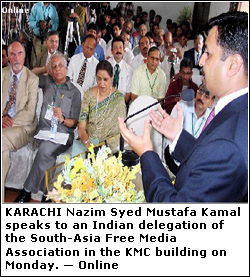 KARACHI, June 12: City Nazim Syed Mustafa Kamal on Monday said disputes between Pakistan and India could be resolved by improving economic ties between the two countries.
Addressing to a ceremony organised at Naib Nazim Secretariat in the honour of an Indian delegation from Mumbai, who is currently on a visit here in Karachi on an exchange programme of South Asian Free Media Association, he said that Karachi was the revenue engine of Pakistan as it generated 68 per cent revenue for the country.
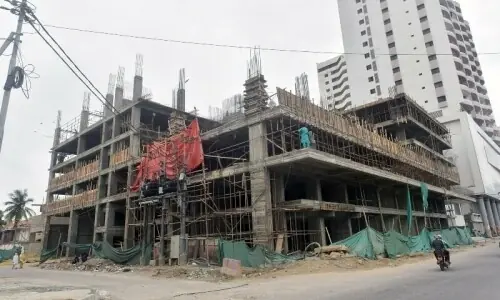
Briefing the delegation on the development activities in Karachi, he said that foreign investment component of these uplift projects was $900 million. “A call centre with capacity of 10,000 seats has been planned in the city, which would generate about 30,000 employment opportunities,” he said. He said that this call centre would be set up in the biggest building of the country.
The nazim said that no differences existed between the people of Pakistan and India at any level. There were disputes on some issues between the two governments, he said, adding that business and public delegations can play an important role in resolving these disputes.
In the era of globalization, he said that the whole world had become a global village. The modern technology had undone the boundaries between the countries and, therefore, friendly relations between Pakistan and India were need of the hour. He expressed hope that the frequent exchange of delegations between India and Pakistan would help in understanding culture, traditions and aspirations of the people of the two countries. He stressed for relaxation of visa conditions for the citizens of both countries.
Mustafa Kamal said that for the first time a development process had been launched on a fast track for which neither banners were displayed nor any publicity campaign were launched.
In order to bring changes in the lifestyle of common man, basic work had been started. For the last six months, he said, the issues pending for the past 40 years had been resolved with particular focus on water, sewerage, health, education, transport and development of industrial zones.
He said that all town nazims without considering their party affiliation had been released funds on equal basis.
Mustafa Kamal also informed the delegation that some 28,000 families of Lyari Expressway had been shifted to their new settlements in a peaceful manner where they had been provided far better facilities of life. He said action was taken against encroachments without any discrimination. Besides, he said that the city government was working on project under which a sewerage treatment plant would be installed in Karachi.
At present, he stated, federal, provincial and district governments were working under the vision of President Musharraf which had helped in improving the country’s economy.
Briefings about development plans of the city government of Karachi were given by EDO Transport Iftikhar Qaimkhani, Karachi Master Plan Project Director Malik Zaheerul Islam and Lyari Expressway Project Director Shafiqur Rehman Paracha.
Sanjay Deshmukh of Mumbai delegation told the gathering about economic and geographic importance of Mumbai. He said Mumbai was a city with an area of 642 square-miles and population of 13 million. He apprised that more than 300 families migrated to Mumbai everyday while 55 per cent of Mumbai people lived in shanty areas, occupying only eight per cent of total area of the metropolis.
Sulakshana Mahajan, a renowned Indian architect, talked about the Mumbai Vision Plan Document and pointed out some of its major features.
She said the economic growth of Mumbai was less than economic growth of other parts of India. Mentioning that quality of life in Mumbai was on the decline she said: “There should be an elected 'City Chief' in Mumbai rather than a selected one by the government”.
Naib Nazim Nasreen Jalil made a proposal for declaring Karachi and Mumbai as sister cities. She urged that the two countries should open visa offices in Karachi and Mumbai.
Like the Lahore-Amritsar bus service, which reduced distances between the people, the Khokhrapar-Monabo rail link too reduced the distance between two countries, she said.
Referring to various sports events in Karachi, she said the Indian players themselves admitted that Karachiites were very good hosts.
Nasreen Jalil said in the present local government system women representation had been increased from 10 to 33 per cent and thus 178 union councils had 712 women members.
She said the present provincial and city governments were striving hard to rebuild Karachi as a city of lights. The city government was executing 552 projects at a cost of Rs50 billion in the regard, she said.
Information Adviser Salahuddin Haider, Sindh Ombudsman Yusuf Jamal and a large number of Pakistani intellectuals and people belonging to media were also present. —PPI/APP