0
0

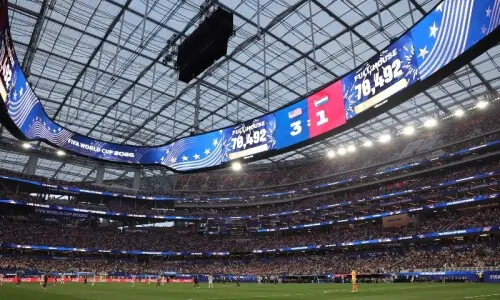
UNITED NATIONS: The Football World Cup makes us at the UN green with envy. As the pinnacle of the only truly global game, played in every country by every race and religion, it is one of the few phenomena as universal as the UN. You could say it’s more universal. Fifa has 207 members; we have only 191. But there are better reasons for our envy.
This is an event in which everybody knows where their team stands, and what it did to get there. They know who scored and how and in what minute of the game; they know who saved the penalty. I wish we had more of that sort of competition in the family of nations. Countries vying for the best standing in the table of respect for human rights, and trying to outdo one another in child survival rates or enrolment in secondary education. States parading their performance for all the world to see. Governments being held accountable.
Millions of people around the planet love talking about the World Cup. In Paraguay fans will be picking over that own goal; in Japan they will be debating strategies for contest with Australia. Everywhere people are dissecting the games, revealing an intimate knowledge of their own teams and many others.
Tongue-tied teenagers suddenly become eloquent and dazzlingly analytical. I wish we had more of that sort of conversation in the world at large: citizens consumed by the topic of how their country could do better on the Human Development Index, or exercised about how to reduce carbon emissions or HIV infections.
The competition takes place on a level playing field, where every country has a chance to participate on equal terms. Only two commodities matter: talent and teamwork. I wish we had more levellers like that in the global arena. Free and fair exchanges without the interference of subsidies, barriers or tariffs. Every country getting a real chance to field its strengths on the world stage. The World Cup illustrates the benefits of cross-pollination between peoples and countries. More and more national teams now welcome coaches from other countries, who bring new ways of thinking and playing. The same goes for the players who represent clubs away from home. They inject fresh qualities into their new team and are able to contribute more to their home side when they return. In the process, they often become heroes in their adopted countries — helping to open hearts and minds.
I wish it were equally plain for all to see that human migration in general can create triple wins — for migrants, for their countries of origin, and for the societies that receive them. Migrants not only build better lives for themselves and their families, but are also agents of development — economic, social, and cultural — in the countries they go and work in, while they inspire with new-won ideas and knowhow when they return.
Playing in the World Cup brings profound national pride. For countries qualifying for the first time — such as my native Ghana — it is a badge of honour. For those doing so after years of adversity — such as Angola — it provides a sense of national renewal. And for those who are currently riven by conflict, but whose World Cup team is a unique and powerful symbol of national unity — such as Ivory Coast — it inspires nothing less than the hope of national rebirth.
Which brings me to what is perhaps most enviable of all for us in the UN: the World Cup is an event in which we see goals being reached. I’m not talking only about the goals a country scores; I also mean the most important goal of all — being there, part of the family of nations and peoples, celebrating our common humanity.—Dawn/The Guardian News Service
(Kofi Annan is secretary general of the United Nations inquiries@un.org)