Beijing, Moscow lead critical chorus
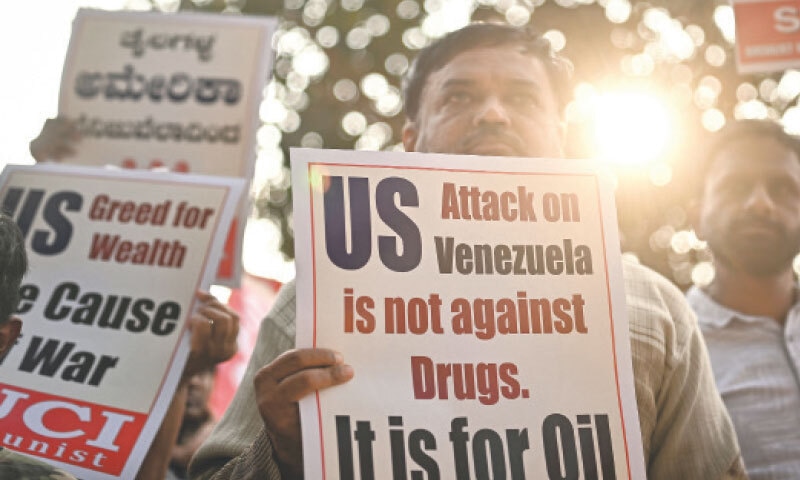

WASHINGTON: The US seizure of Venezuelan President Nicolás Maduro sparked international alarm and drew sharp condemnation from global powers China and Russia, while American allies in Europe offered a more timid, fractured response to the unilateral action.
US President Donald Trump characterised the operation as a decisive blow against narco-terrorism. However, critics at home and abroad accused Washington of conducting a “reckless” war for oil and regime change.
Beijing and Moscow, who have longstanding ties with Caracas, were quick to denounce the operation.
China’s foreign ministry expressed “grave concern” over what it called a “clear violation of international law and the basic norms of international relations”, demanding Washington release Maduro immediately.
Lat-Am leaders slam move as breach of sovereignty, European bloc offers muted criticism
Russia went further, with foreign minister Sergei Lavrov condemning the operation as “an act of armed aggression” and calling for the immediate release of “the legitimately elected president”.
In remarks that underscored the potential geopolitical ramifications, Dmitry Medvedev, deputy chairman of Russia’s security council, warned the incident demonstrated that “the only real guarantee for protecting sovereignty is having a nuclear arsenal”.
Iran described the raid as “a textbook example of an act of aggression”, warning that such violations of the UN charter expose the global order to “erosion and destruction”.
The UN secretary general, António Guterres, was also “deeply alarmed”, with a spokesperson stating the developments constituted a “dangerous precedent” and expressing concern that international law had not been respected.
Fury in Latin America
The response across South America was swift and largely hostile. Brazil, Chile, Colombia, Mexico and Uruguay issued a joint statement rejecting and slamming Washington’s “unilateral” military action.
Brazilian President Luiz Inácio Lula da Silva said the bombing and abduction “crossed an unacceptable line”. He termed the act a “grave affront to Venezuela’s sovereignty” that recalls the “worst moments of interference” in the region.
Cuban President Miguel Díaz-Canel denounced the attack as “state terrorism”, asserting it was not about fighting drugs but destroying a sovereign project.
Conversely, Ecuador President Daniel Noboa welcomed the news, posting on X that the “narco-Chavista” structure would finally collapse.
EU on diplomatic tightrope
European leaders found themselves in an awkward position, attempting to distance themselves from the operation’s methods while stopping short of outright condemnation of the US.
The European Union urged respect for legal norms, though it noted Maduro “lacks legitimacy.”
“Following very closely the situation in Venezuela. We stand by the people of Venezuela and support a peaceful and democratic transition. Any solution must respect international law and the UN Charter,” European Commission President Ursula Von Der Leyen said.
French President Emmanuel Macron expressed happiness that “Venezuelan people are free from Maduro’s dictatorship” but said that the “transition to come must be peaceful” and cannot be imposed externally.
UK PM Keir Starmer said London would “shed no tears” for the end of Maduro’s regime but stressed the need to uphold international law.
Germany’s reaction was measured, with Chancellor Friedrich Merz calling the legal assessment “complex”.
The outlier was Italian Prime Minister Giorgia Meloni, a key Trump ally, who supported the raid as a “defensive intervention” against criminal state entities.
Spain, however, stated it would not recognise an intervention that “violates international law”.
Published in Dawn, January 5th, 2026