• Army chief Munir warns ‘hostile designs’ will be foiled ‘through firm action’
• Says Pakistan ‘committed to regional peace’ but will ‘defend’ territorial integrity
ISLAMABAD: Army chief and Chief of Defence Forces (CDF) Field Marshal Asim Munir on Wednesday warned India over its continued involvement in fomenting unrest in Balochistan, saying that any direct or indirect threat to the Pakistan’s territorial integrity would be met with a stern and decisive response.
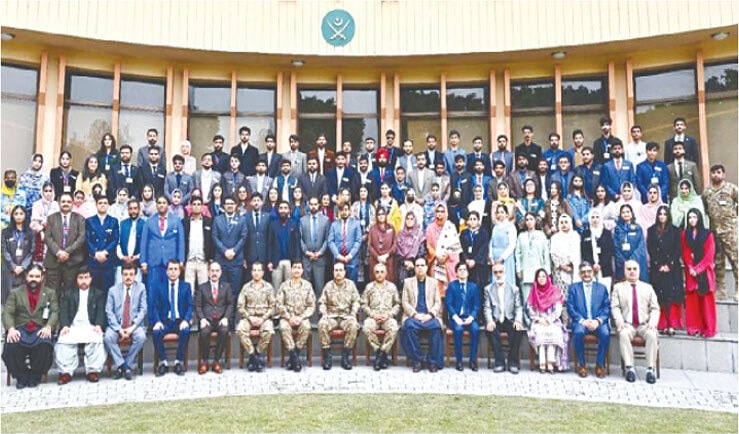
Addressing the participants of the 18th National Workshop on Balochistan at the General Headquarters (GHQ) in Rawalpindi, Field Marshal Munir said Indian-sponsored proxies were actively fuelling violence in the province with the clear intent of destabilising the country and sabotaging its economic progress.
“Indian-sponsored proxies continue to propagate violence and disrupt development in Balochistan,” the army chief said, according to an Inter-Services Public Relations (ISPR) statement.
He reaffirmed that such hostile designs would be thwarted through “firm action” by the security forces to rid the province of terrorism and unrest.
Balochistan continued to witness sustained violence throughout 2025, with at least 252 terrorist attacks claiming 419 lives, according to the Pakistan Institute of Peace Studies database, as the insurgency intensified in scale and sophistication.
The year saw a series of audacious attacks, most notably the March 11 hijacking of the Jaffar Express passenger train.
Other major incidents involved coordinated bombings targeting security convoys and passenger buses, suicide attacks, including the use of female bombers, brief militant takeovers of areas such as Mangochar and Zehri, and repeated acts of sabotage against infrastructure associated with the China-Pakistan Economic Corridor (CPEC).
The aggravation in the security situation in Balochistan, besides being a law and order issue rooted in local grievances, is part of a broader pattern of state-sponsored terrorism directed from India for undermining peace and security, as well as targeting strategic projects such as CPEC and weakening Pakistan’s sovereignty.
‘Committed to peace’
The CDF underscored that while Pakistan remains committed to regional peace and stability, restraint should not be mistaken for weakness.
He emphasised that any violation of Pakistan’s territorial integrity, “whether direct or indirect”, would draw a firm response — a phrase widely understood in Islamabad as a reference to India’s alleged use of proxy terrorist groups.
India’s intelligence agency, Research Analysis Wing (RAW), has been providing financial, logistical and training support to Baloch insurgent outfits, particularly the Balochistan Liberation Army (BLA).
In 2025, the military re-designated such outfits as “Fitna al-Hindustan”, explicitly framing them as instruments of Indian hybrid warfare rather than a legitimate movement.
Field Marshal Munir said the armed forces remained fully committed to protecting the lives and well-being of citizens, adding that security operations in Balochistan were being conducted alongside efforts to safeguard development projects and civilian populations.
Under a multipronged counterterrorism strategy, including the “Azm-e-Istehkam” framework, security forces have carried out intelligence-based operations across several districts of the province over the past few years, dismantling militant networks, seizing weapons and eliminating insurgents.
Alongside military action, the government has pursued diplomatic efforts to expose India’s destabilising role in Balochistan, sharing evidence with the United Nations and friendly countries.
Islamabad views recent international steps, including the designation of the BLA as a terrorist organisation by the United States in 2025, as strengthening its narrative.
The army chief’s remarks also come in the context of heightened regional tensions following the brief India-Pakistan military confrontation in May 2025.
Published in Dawn, January 1st, 2026