Bondi Beach attack hero says wanted to protect ‘innocent people’

Bondi Beach shooting hero Ahmed al Ahmed recalled the moment he ran towards one of the attackers and wrestled the gun from him, saying in an interview published Monday with a US outlet he wanted to protect “innocent people”.
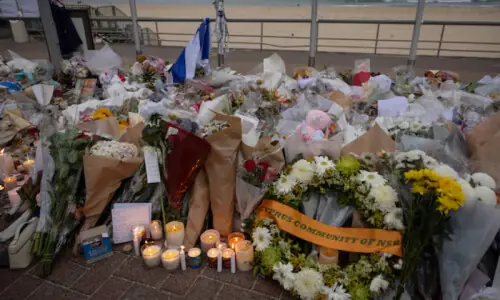
Father and son Sajid and Naveed Akram are accused of targeting a Hanukkah event on Sydney’s Bondi Beach on December 14, killing 15 people and wounding dozens in what authorities have described as an anti-Semitic terrorist attack.
Despite the tragedy, tales of heroism emerged of those who tried to stop the two gunmen during their deadly rampage.
Among them was Ahmed al Ahmed, a fruit seller, who went viral for ducking between parked cars as the shooting unfolded and then wresting a gun from one of the assailants.
“My target was just to take the gun from him, and to stop him from killing a human being’s life and not killing innocent people,” he told CBS News in an interview that airs on Monday.
“I know I saved lots, but I feel sorry for the lost.”
Ahmed was shot several times in the shoulder after tussling with one of the gunmen and underwent several rounds of surgery.
He recalled the moment he “jumped” on the gunman’s back, holding him with his right hand and said: “Drop your gun, stop doing what you’re doing”.
“I don’t want to see people killed in front of me, I don’t want to see blood, I don’t want to hear his gun, I don’t want to see people screaming and begging, asking for help,” Ahmed told the television network.
Ahmed was at the beach getting a cup of coffee when the shooting occurred.
The father of two emigrated to Australia from Syria in 2007; his uncle Mohammed, a farmer, had told AFP in Ahmed’s hometown of Al-Nayrab days after the shooting.
“His act is a source of pride for us and for Syria,” Mohammed said.
The Australian government has fast-tracked and granted a number of visas for Ahmed’s family, local media reported.
“Ahmed has shown the courage and values we want in Australia,” Home Affairs Minister Tony Burke said in a statement.
One of the gunmen, Sajid Akram, 50, was shot and killed by police during the attack. An Indian national, he entered Australia on a visa in 1998.
His 24-year-old son, Naveed, an Australian-born citizen, remains in custody on charges including terrorism and 15 murders, as well as committing a “terrorist act” and planting a bomb with intent to harm. He has yet to enter a plea.