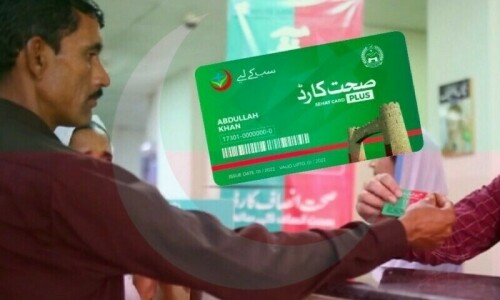
PESHAWAR: Around 300,000 residents of Khyber Pakhtunkhwa have availed themselves of free treatment in hospitals of Punjab, Sindh, Balochistan and Islamabad under the Sehat Card Plus health insurance programme, reveal official documents.
They showed that more than five million people had undergone Rs150 billion free treatment under the SCP scheme since its launch in 2016.
According to the documents, there are 700 empanelled hospitals where the patients with Khyber Pakhtunkhwa national identity cards can avail cashless diagnostic and treatment services.
Of the total SCP beneficiaries, 294,287 sought free treatment outside the Khyber Pakhtunkhwa. Most of them went to different cities of Punjab followed by Islamabad, Karachi and Balochistan.
Official documents show provincial govt paid Rs1.229bn to hospitals empanelled for the purpose
A few beneficiaries were treated in Gilgit-Baltistan and Azad Jammu and Kashmir regions. Khyber Pakhtunkhwa paid a total of Rs1.229 billion to the designated SCP hospitals in lieu of their treatment.
Officials in the health department said that the majority of those getting free health services outside the province lived in other cities in connection with their jobs, while some proceeded for treatment that wasn’t available here.
They said the programme also offered free transplants to patients.
The officials said 235 patients had availed themselves of free renal transplants, 80 of liver and 71 cochlear transplants, costing Rs1.9 million, Rs6.2 million and Rs2.3 million per case, respectively, to the provincial government.
They said for liver transplants, the residents went outside the province as the facility wasn’t available locally.
The officials said renal transplants were carried out in the province but a few underwent the procedure either in Islamabad or in Punjab and Sindh.
They said the health insurance programme began in 2015 covering only the poor population in four districts but was later extended to the entire population in phases.
The officials said 11 million families comprising 33.2 million people from the province were entitled to free treatment anywhere in the country.
They added that a family was allowed to get free treatment of up to Rs1 million annually.
The officials said as the programme became popular, the government began empanelling hospitals in other provinces, too, in 2020 to facilitate residents.
They said that before the empanelment of hospitals in other provinces, the people with identity cards from Khyber Pakhtunkhwa used to come here for treatment, affecting their families back home but now, they were free to get treatment where they lived.
The officials said the State Life Insurance Corporation (SLIC), which is executing the Sehat Card Plus programme, had been facilitating patients throughout the country. It has listed hospitals in other provinces, too, for Khyber Pakhtunkhwa residents only.
They said patients and their families were now not required to come to Khyber Pakhtunkhwa, saving them both money and time.
The officials said the 54pc of the health insurance programme’s beneficiaries were women. Most people sought treatment for cardiac problems followed by general surgery and gynaecological, medical, neurosurgical, oncological, orthopaedic and urological care.
The officials said the KP government had been spending Rs37 billion for SCP which included Rs28 billion for Khyber Pakhtunkhwa and Rs9 billion for the residents of merged tribal districts.
They said not only did residents receive care under the programme outside Khyber Pakhtunkhwa but also many people who worked abroad went to their native districts to get treatment before returning.
The officials said some of them required renal or liver transplants, but as the procedures were too expensive for them to afford, they came for the same.
They said the programme offered free treatment to people for diseases requiring hospitalisation.
Published in Dawn, December 24th, 2025