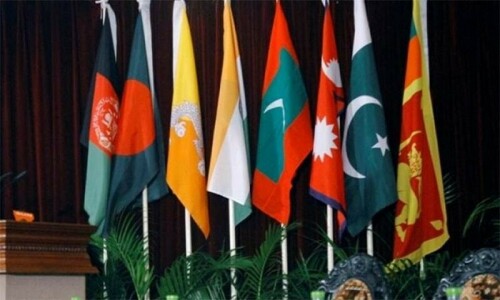
FOUR decades ago, the leaders of seven states came together in Dhaka to sign the charter of the South Asian Association for Regional Cooperation. But 40 years after the fact, Saarc remains an unfulfilled dream, marked more by lost potential than any significant achievement in improving regional integration. What could have been an EU- or Asean-like grouping has largely failed to deliver on its promise of promoting the “welfare of the peoples of South Asia”.
Both President Asif Zardari and Prime Minister Shehbaz Sharif, to mark Saarc Charter Day on Dec 8, reiterated Pakistan’s commitment to Saarc and to work with “all willing states” to improve regional trade. But the fact remains that the Pakistan-India rivalry has been and remains the biggest obstacle in transforming Saarc into a dynamic regional body. This has been the case despite the Saarc Charter clearly stating that “bilateral and contentious issues shall be excluded”.
At one time, hawks in Pakistan vetoed moves to improve ties with India. For the past many years, it has been India which has blocked all attempts to break the ice with Pakistan. Indian influence to isolate Pakistan has resulted in the paralysis of Saarc. For example, the last Saarc summit was held in Kathmandu in 2014. The 2016 summit in Islamabad was ‘indefinitely postponed’ after India engineered a boycott of the event, along with a few other members.
In this context, Foreign Minister Ishaq Dar is not wrong when he says that multilateralism is “under assault” in South Asia. It is a fact that no multilateral body can function when one or more members seek to assert their hegemony over smaller states, or attempt to isolate other members. And with the Pakistan-India relationship at a historic low, any revival of Saarc at this point seems remote.
So, should Saarc’s requiem be written? Should South Asian states look at other formations — SCO, BRICS etc — to enhance trade and connectivity, as well as improve bilateral ties? Arguably, while bilateral relations should be pursued, and other multilateral partnerships explored further, the South Asian dream of harmony and peace should not be buried in such haste. Without intra-regional trade, countries in close proximity cannot prosper.
South Asian trade is currently in the dismal territory of around 5pc. Perhaps another attempt can be made to revive Saarc, so that — while respecting each state’s sovereignty — a regional community can be built around the principles of trade, peace and people-to-people contacts. But for this, India must stop behaving like a hegemon, and especially shed its animosity towards Pakistan. Ultimately, the Saarc Charter’s aim of improving “the quality of life of the peoples of the region” is a goal still worth pursuing.
Published in Dawn, December 15th, 2025