HRCP seeks withdrawal of constitutional tweaks, end to ‘enforced disappearances’
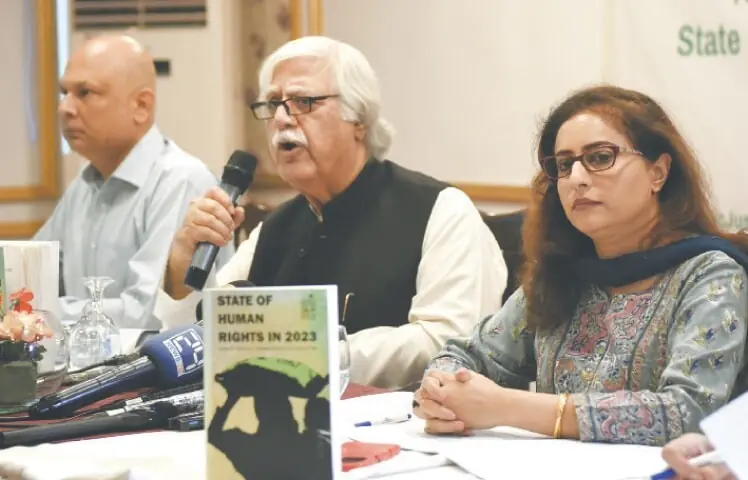
• At seminar to mark Human Rights Day, speakers hold ruling elite responsible for ‘widespread violations’
• Activist claims 2025 saw drop in reported cases of missing persons
KARACHI: The Human Rights Commission of Pakistan on Wednesday sought the withdrawal of the 26th and 27th amendments, an end to what they described as “enforced disappearances” and the release of all political prisoners across the country.
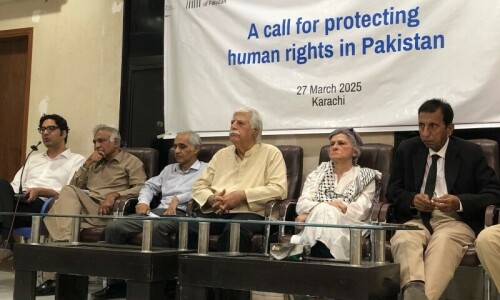
The demands were made by HRCP chairman Asad Iqbal Butt while speaking at a seminar titled ‘Every Right is Essential’ to mark International Day of Human Rights here at the Karachi Press Club.
Mr Butt said “the ruling elite” bears direct responsibility for the “widespread human rights violations” across the country.
He claimed that the “elite class” were backed by powerful capitalist interests. “They have transformed political authority into an organised system of exploitation, rendering democratic institutions ineffective and paralysed.”
He urged the country’s rulers not to repeat the mistakes that led to the tragedy of 1971.
The HRCP chairperson also demanded restoration of media freedom, fixing of Rs50,000 as minimum wage, abolition of anti-worker laws and protection of trade unions.
The other demands included halt to land-grabbing and corporate farming, restoration of student unions and equitable access to education for all.
‘Reported cases of enforced disappearance decline’
Reported cases of ‘enforced disappearances’ have come down in outgoing year of 2025 as compared to 2024 because of “resistance put up by the civil society organisations” and a perceived shift in the state’s policy that occurred last year, said veteran journalist and rights activist Sohail Sangi.
Tracing the phenomenon of enforced disappearances since imposition of One-Unit and martial law of General Ayub Khan when prominent activist Hasan Nasir was picked up and subsequently tortured to death in custody, he claimed that the “disappearances” took worst form during the era of General Pervez Musharraf.
However, he said, “recently the cases of disappearances have reduced”.
Without sharing the exact number of such cases, Mr Sangi added that as per the HRCP data, the reported cases of the enforced disappearances had declined in the outgoing year as compared to the last year.
Mr Sangi claimed that now instead of enforced disappearances, there was a ‘reign of terror’ in order to prevent the public from coming out on streets to protest against government policies.
He said in Karachi the people could protest from Regal Chowk in Saddar to the Karachi Press Club, but even this freedom was not available to the people in Islamabad, adding that for allowing such activity, the KPC faced “extreme pressure”.
He called for collective efforts by all civil society organisations to stop enforced disappearances because majority of victims were youths whose disappearances adversely affected their whole families.
“Enforced disappearances is an important issue of the youth, if we strengthen our resistance, this may be reduced further,” said the senior journalist.
Academic Dr Riaz Shaikh referred to his speech to a United Nations meeting in Geneva on human rights where, according to him, 294 speakers spoke.
“All were saying that over the past 25 years, human rights violations have increased globally because of a shift in global politics.”
He said human rights violations are a global phenomenon, not a Pakistan specific issue as the countries no longer face global pressure over rights abuse.
Mr Shaikh said without ‘economic independence’, political and cultural freedoms would become meaningless.
He said last year, only 50 rich people had earned five trillion dollars, an amount which was equal to ending poverty of three billion people.
“It shows inequality and economic exploitation at massive scale at global level while job security has ended.”
He wondered what would be the state of media freedom in countries like Pakistan where media houses did not even provide salary to their employees for six months.
He apprehended that the issue of job insecurity may become more acute in this month when the PIA could be privatised.
Lawyer Shazia Nizamani claimed 21,000 women and children have faced domestic violence in the past six years in the country.
She lamented “negligible” conviction rate in gender-based violence cases as there was a lengthy process in courts which needed to be reformed.
Rights activist Dr Tauseef Ahmed Khan said that former chief justice of Pakistan Tassaduq Hussain Jillani had given directions of setting up a commission for protection of minorities but the Parliament by approving recent amendments had “weakened” the commission as its powers had been curtailed.
He called for provision of relief to Junaid Hafeez and 800 other persons who were “suffering because of misuse of blasphemy laws”.
Advocate Ayesha Dharijo said there were reported 15-20 Hindu girls ‘missing’ in Sindh.
Prominent rights activist Mehnaz Rehman moderated the seminar.
Published in Dawn, December 11th, 2025