• Exhaustive PAQI study terms poor air quality ‘series of distinct local emergencies’, not just an urban phenomenon
• Karachi’s problem is ‘overwhelmingly industrial’; Lahore caught in industry, kiln and transport-generated haze
• Rawalpindi and Islamabad face crisis of ‘urban design’; transit trade and industry adds to toxic air trapped in Peshawar valley
LAHORE: While the mainstream discourse on air quality has remained focused on Lahore and Karachi, a recent report by the Pakistan Air Quality Initiative (PAQI) has described the phenomenon as being equally stark in Islamabad-Rawalpindi and Peshawar, as well as peri-urban and rural areas.
PAQI’s comprehensive Unveiling Pakistan’s Air Pollution: A National Landscape Report on Health Risks, Sources and Solutions provides multi-sectoral emissions inventories, concluding that urban smog is overwhelmingly generated within Pakistan’s own airsheds.
As it focused on four major cities of Karachi, Lahore, Peshawar and Islamabad-Rawalpindi, the report said Pakistan’s air pollution was not a single, monolithic problem, but a series of distinct local emergencies.
“Each city’s economic DNA creates a unique emissions fingerprint, demanding a tailored response,” it said, adding even the rural areas were not immune from this crisis, but remained under-researched.
“From Karachi’s port corridors to Peshawar’s valley basin, the air we inhale contains concentrations of pollutants far above levels considered safe for health,” it added.
Day after day, Pakistan’s cities and many rural districts live with particle and gas concentrations that breed disease, shorten lives, reduce productivity, and sap community energy, it said.
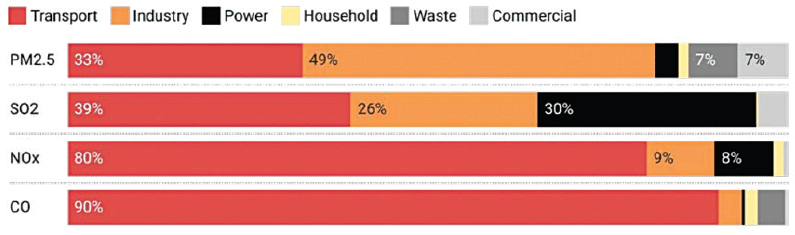
For its inventory, PAQI draws on satellite-derived aerosol datasets, chemical transport modelling, and PAQI’s real-time monitoring network to map the sources, scale, and health impacts of PM2.5 (fine particulate matter) across Karachi, Lahore, Islamabad-Rawalpindi and Peshawar.
“Lahore is a complex, three-front battle against a toxic blend of emissions from transportation (35%), heavy industry (28%), and a dense ring of brick kilns (17%),” the report said.
It referred to Karachi’s crisis as overwhelmingly industrial. “Nearly half of its health-damaging fine particulate matter (49% of PM2.5) originates from its industrial sector and port activities.”
In the twin cities of Rawalpindi and Islamabad, it’s a crisis driven by urban design, with transportation accounting for 53pc of the emissions.
Peshawar, trapped in a valley, is poisoned by a mix of transit trade and traditional industry, resulting in the country’s highest per-capita pollution burden, it said, adding that 51pc emissions are due to the transport sector while 18pc is attributed to brick kilns.
“The data exposes a stark heterogeneity. Lahore’s smog stems mainly from transport (35%), heavy industry (28%), and kilns (17%); Karachi’s air is dominated by maritime and industrial emissions; Islamabad-Rawalpindi suffers from congestion and dust; and Peshawar endures atmospheric trapping worsened by two-stroke engines. Yet, as I have argued repeatedly, national responses still rely on uniform bans and seasonal theatrics,” one of the authors noted in the report.
The PAQI study also called for focusing on under-researched and unregulated contributing sources for a complete picture of Pakistan’s air quality crisis, including crop-residue burning, household air pollution, and open burning of waste. Household air pollution from biomass fuels is a leading cause of death in Pakistan, with PM2.5 levels in rural kitchens measured at up to 600 times higher than those using gas, it added.
The lack of effective rural air quality monitoring remains a critical knowledge gap, hindering the development of policies that promote sustainable agricultural practices and provide farmers with viable alternatives to burning, it noted.
PAQI founder Abid Omar said, “This inventory ends the era of speculation.” “For the first time, Pakistan has a rigorous, data-driven map of where its pollution comes from. The science is clear: our crisis is overwhelmingly local and structural. We now have the evidence. What Pakistan needs next is implementation,” he added.
The report offered evidence-based interventions, such as empowering the public with information, closing the governance gap, and targeting super-emitters, such as transitioning to cleaner fuels and electrifying the 30 million two- and three-wheelers that form the backbone of urban mobility. “The solutions are at hand. The barrier is no longer a lack of evidence but a lack of will. It is time to act,” it stressed.
Punjab EPA response
The Punjab government, however, contested the data published in the report. Punjab Environment Protection Agency (EPA) spokesperson Sajid Bashir “rejected” the report about local factors causing pollution and told Dawn that PAQI “did not have data to develop a report”. He said that the government was spending billions of rupees to control emissions and more than 80 per cent of industry in Lahore has installed equipment to control emissions.
He also claimed that PAQI did not have accurate data about LTV, HTV, motorcycles, rickshaws and the number of brick kilns operating in the country. He instead blamed India for pollution in Lahore and asked PAQI to “reveal its resources and from where it was registered to get satellite data and images and in which laboratory they were analysing all the data”. It may be noted that a 2024 study by the Urban Unit had identified transport as a key polluter.
Published in Dawn, December 10th, 2025