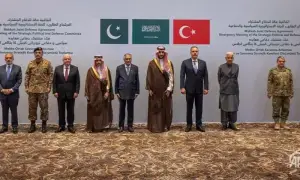
The United States’ recent push for a Gaza ceasefire has drawn measured yet meaningful engagement from eight key Muslim-majority nations — Egypt, Jordan, Saudi Arabia, the United Arab Emirates (UAE), Qatar, Turkiye, Indonesia and Pakistan. In a joint statement issued after consultations, these countries welcomed what they described as “sincere efforts” to halt the war, ensure unhindered humanitarian access, and restore a pathway toward a two-state solution. Their collective endorsement has given Washington’s proposal early diplomatic weight at a moment when the region searches for a structured exit from the cycle of bombardment, displacement and political stalemate.
Yet, support has not translated into unconditional approval. While these states back an immediate ceasefire and relief measures, several have signalled that they do not fully own the contours of the US plan.
Beneath the diplomatic language lies a shared strategy — avoid premature commitments while keeping room open for constructive engagement if a viable political horizon finally emerges.
However, the eight abovementioned states can deepen their economic and political ties to become more relevant peacemakers in the future.
The challenge is not the absence of willing partners, but the ability to sustain reforms long enough to translate diplomatic goodwill into enduring economic gains
Pakistan’s most immediate opportunity lies in revitalising its government-to-government economic frameworks with the Gulf states — particularly Saudi Arabia, the UAE and Qatar. In FY25, workers’ remittances reached a record $38.3 billion, with Saudi Arabia contributing $9.3bn and the UAE $7.8bn.
Bilateral trade with the UAE surged to $10.1bn, comprising roughly $2.1bn in Pakistan’s exports and $8bn in imports. Exports to Saudi Arabia were close to $734 million, while trade with Qatar — though smaller — remains an essential component of Pakistan’s Gulf-focused economic corridor.
These economies underpin Pakistan’s largest inflows of remittances, trade and investment commitments. What Islamabad now requires is a set of fast-track mechanisms enabling Gulf sovereign funds and private investors to execute projects without being bogged down by domestic bureaucratic bottlenecks.
With well-structured facilitation platforms and transparent governance, Pakistan can convert long-pending pledges in mining, agriculture, energy and fintech into visible, confidence-building investments — transforming inflows into durable economic dividends.
Turkiye represents another promising yet underutilised opportunity. Despite political warmth and complementary industrial strengths, bilateral trade remains below potential.
Upgrading the existing Preferential Trade Agreement into a full Free Trade Agreement could unlock substantial space for joint ventures across textiles, household appliances and food processing. Turkiye’s expanding manufacturing ecosystem also stands to benefit from Pakistan’s strategic geography, enabling production geared toward Central Asia and western China through the broader China-Pakistan Economic Corridor connectivity network.
Last week, Pakistan and Turkiye signed five memorandum of understanding (MoU) and deeds of assignment for oil and gas exploration and agreed to expand cooperation in mining and equity participation in the power sector, according to a Dawn report.
The documents were concluded during a visit by a Turkish delegation led by Minister for Energy and Natural Resources Alparslan Bayraktar, which held meetings with Prime Minister Shehbaz Sharif and Chief of Army Staff Field Marshal Asim Munir, among others.
Earlier, in June 2022, Prime Minister Shehbaz Sharif and President Recep Tayyip Erdogan had agreed to raise bilateral trade from $1.1bn in 2021 to $5bn within three years. Trade had risen to $1.4bn by 2024 but remained short of the target; 2025 data is awaited.
Indonesia, one of Pakistan’s closest partners in Southeast Asia, now makes an even stronger case for deeper economic engagement. Bilateral trade has risen sharply to $4.7bn in FY25. While palm oil continues to dominate, both countries have significant space to expand cooperation in rice, pharmaceuticals, processed foods and light engineering goods.
Targeted tariff concessions and a dedicated Karachi-Jakarta shipping corridor could reduce logistics costs, shorten timelines and lift Pakistan’s exports into a large consumer market it has only recently begun to penetrate.
Pakistan must also widen its outreach to Egypt and Jordan, two markets often overshadowed by larger regional economies. Restoring direct air links with Cairo and Amman can revive commercial activity, strengthen tourism flows and energise business-to-business exchanges.
Egypt’s experience in maritime and port management, and Jordan’s growing tech-driven services sector, offer specialised avenues for collaboration for Pakistan seeking to diversify its economic partnerships.
During the mid-November visit of King Abdullah II of Jordan to Islamabad, Pakistan and Jordan signed several MoUs to enhance bilateral engagement and collaboration in the fields of media, culture and education. The two countries can make this a precursor of deeper economic ties.
Given shared concerns around food and energy security, Pakistan can position itself as a meaningful contributor to a cooperative regional architecture. Many Gulf and Middle Eastern economies are food-import dependent, while Pakistan is a producer struggling with value addition and logistics. Contract farming, renewable-energy partnerships and regional research networks can transform this asymmetry into a mutually beneficial system, especially if tied to long-term procurement guarantees.
For Pakistan, the challenge is not the absence of willing partners, but the ability to sustain reforms long enough to translate diplomatic goodwill into enduring, measurable economic gains.
Published in Dawn, The Business and Finance Weekly, December 8th, 2025