Hassanabdal revives royal sport as tent-pegging thunders back to life


 0
0

The dust rises, drums roll and hooves hammer the earth as Hassanabdal hosts a striking revival of tent-pegging, an equestrian spectacle rooted in ancient cavalry traditions.
Despite modern challenges, the royal sport continues to captivate riders and crowds in rural Punjab with its blend of heritage and heroism.
On the windswept outskirts of Hassanabdal, the rhythmic beat of dhols mingles with the piercing notes of the shahnai, soon overpowered by the thunder of galloping horses. This is the soundscape of tent-pegging, a centuries-old cavalry sport that still stirs the soul of equestrian enthusiasts across Punjab.
Riders streak down a sun-baked track at breakneck speed, lances lowered with precision as they attempt to hook and lift a small wooden peg half-buried in the ground.
Dust clouds trail behind them, blurring the view for the next challenger and heightening suspense for spectators lining the field.
Crowds arrive in large numbers from nearby towns and cities, applauding daring horsemen clad in white tunics, embroidered waistcoats and colourful turbans. Their horses, manes groomed and saddles gleaming, cut a regal silhouette that harks back to the discipline’s royal origins.
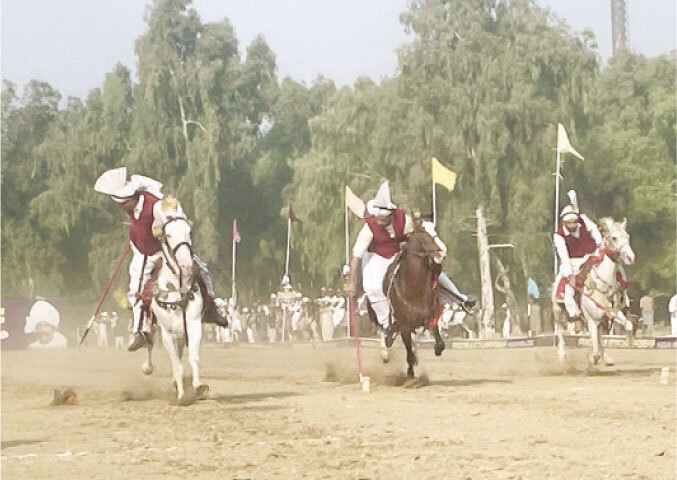
During the competition, riders showcased exceptional horsemanship, lifting pegs with remarkable accuracy at full gallop. The colours of their turbans distinguished their teams, while a renowned drummer and dhol group enthralled both horsemen and spectators.
Riders demonstrated strong performance in individual and arm-horse joint categories, executing controlled strikes, synchronised gallops and split-second manoeuvres that drew loud applause from the crowd.
The event was organised by well-known tent-pegging player Khawaja Hamza Khan to pay tribute to Malik Atta Muhammad Khan, one of Pakistan’s legendary horsemen, who worked tirelessly to create space for international teams to compete with Pakistan on national grounds.
He said tent-pegging remains one of the most thrilling and adventurous folk sports. “This is truly the sport of young lions,” Mr Khan remarked. “You need a courageous rider and a well-trained horse. Neither can succeed without the other.”
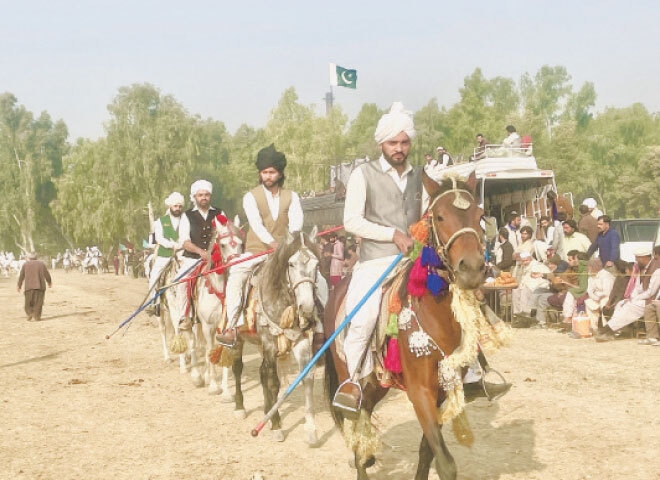
Muhammad Rizwan, who runs his own riders’ club, said the sport traces its lineage to ancient Asian cavalry units that used the skill in swift raids, cutting tent ropes to throw enemy camps into chaos. Over time, the combat technique evolved into an equestrian art form, celebrated for its precision and bravado. He said the sport, often described as “equestrian skill-at-arms”, now includes several disciplines, such as ring jousting, lemon sticking, quintain tilting and Parthian shooting, performed individually or in teams.
Raja Shahab Sikandar, a prominent tent-pegging champion from Hazara, said that although the sport’s roots lie in cavalry tactics meant to terrorise enemy camps, it grew in popularity and was eventually adopted as a formal equestrian competition.
He noted that tent-pegging remains one of the most popular ancient equestrian sports, involving a mounted rider using an edged weapon to strike ground targets at full gallop, hence its interchangeable description as “equestrian skill-at-arms.”
For many who gather at fields like Hassanabdal, tent-pegging is more than a sport. It is a living fragment of cultural memory, a reminder of cavalry valour, horsemanship and rural pride.
The event concluded with tributes and trophy presentations in honour of Malik Atta Muhammad Khan, whose lifelong dedication to horsemanship continues to inspire new riders across the country. As dusk settled over Hassanabdal, the thunder of hooves faded, but the celebration of a centuries-old royal sport, rooted in courage and precision, echoed among spectators who witnessed a living tradition carried proudly into the future.
Published in Dawn, December 8th, 2025