Pakistan to sell excess gas in international markets from January 1: petroleum minister


 3
3


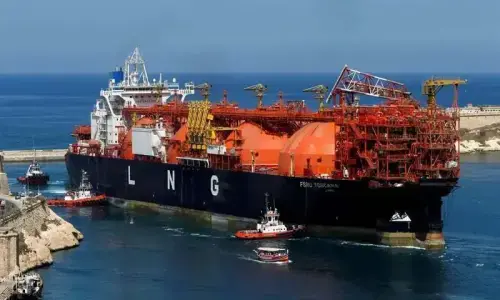
Petroleum Minister Ali Pervaiz Malik said on Sunday that Pakistan would begin selling excess liquefied natural gas (LNG) in international markets from January 1.
Malik’s statement during a press conference in Lahore came months after it was reported that Pakistan was exploring ways to sell excess LNG cargoes amid a gas supply glut that could cost domestic producers millions in annual losses.
He noted that Pakistan had been importing gas from “our friend” Qatar and Italian energy company Eni. But, he continued, there was an excess of this imported gas as the use of this fuel for power generation had reduced in the country during the past few months.
Resultantly, “we were compelled to divert it to domestic consumers, due to which circular debt was increasing in the gas sector”, he said, adding that it also caused a loss of around Rs1,000 billion to Pakistan from 2018-19 till now.
“From January 1, we will sell this excess fuel in international markets and reduce our burden while limiting the loss caused by it,” he added.
Moreover, he said, the measure would also allow Pakistan’s state-owned enterprises in the sector to operate on their full capacity and generate profit.
Last month, it was reported that Pakistan had struck a deal to cancel 21 LNG cargoes under its long-term contract with Eni as part of a plan to curb excess imports that have flooded its gas network. Meanwhile, sources also said that Pakistan was in talks with Qatar about gas supplies from the Gulf state, with options including deferring some cargoes or reselling them under existing contract clauses.
Foreign investment
During his press conference, Malik also outlined the expected investment in the petroleum sector by foreign companies.
He recalled that Turkiye’s energy minister had visited Pakistan recently and “after 20 years, Turkish Petroleum, in collaboration with Pakistani companies”, would be taking part in onshore and offshore exploration activities.
“Turkish Petroleum will also open its office in Islamabad, where 10 to 15 Turkish nationals will be working,” he said, adding that Pakistanis would also get employment there.
“We are moving towards decreasing our reliance on imported oil and gas,” the minister further stated.
He said a delegation of the State Oil Company of Azerbaijan Republic (SOCAR) would be visiting Pakistan in the coming week, adding that it was also expected to collaborate with local companies for oil and gas exploration.
The minister said SOCAR was also opening its office in Pakistan. “It will also invest millions of dollars in the construction of an oil pipeline from Machike to Thalian in collaboration with the PSO (Pakistan State Oil) and FWO (Frontier Works Organisation).”
He said the pipeline’s construction would begin in a month or month and a half.
Malik said private fundraising of $3.5 billion for the Reko Diq project had been finalised, and now the banks were finalising the agreements. In addition, he said, local companies and Canadian mining giant Barrick Gold would invest more than $3.5bn in the project.
In total, $6-7bn would be invested in the first phase of the project, following which “you will see the face of Chaghi (the site of the project) changing”, he added.
The minister said Reko Diq’s signing ceremony was expected to take place in a month or two at the Prime Minister’s House.
Additional input from Reuters