Russian drones, missiles hit Ukraine’s power, transport sectors
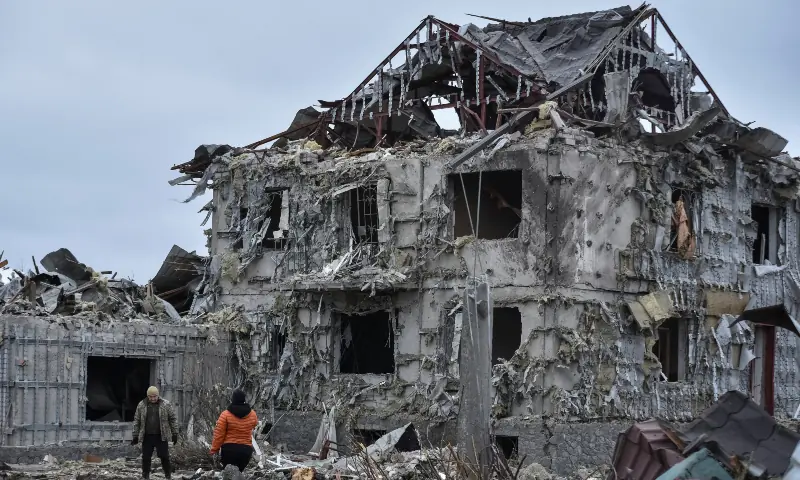

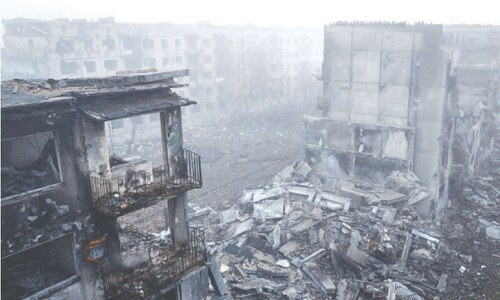
KYIV: A large-scale Russian drone and missile attack damaged power facilities in eight Ukrainian regions, causing blackouts and forcing nuclear power plants to cut power output, the International Atomic Energy Agency (IAEA) said on Saturday.
Russia has intensified its attacks on Ukraine’s energy sector and infrastructure in recent weeks, targeting power stations and railway hubs as winter deepens and the war approaches its fourth anniversary.
There was no breakthrough in US-brokered talks this week aimed at ending the conflict.
Ukraine operates three nuclear power plants which produce more than half of the country’s electricity and IAEA said the plants cut production due to “widespread military activities”.
The Ukrainian military said Russia had launched 653 drones and 51 missiles on Ukraine in two days. Ukrainian forces claimed downing 585 drones and 30 missiles.
Power and heat generation facilities in Chernihiv, Zaporizhzhia, Lviv, and Dnipropetrovsk regions were targeted in the attack, the Kyiv government said.
It said on Telegram that 9,500 customers remained without heat and 34,000 without water supply in the southern Odesa region.
“Port facilities in Odesa have also been attacked: part of the infrastructure has been de-energised, and operators have switched to backup power from generators,” the ministry said.
“Emergency repair work is already underway where safety conditions permit. Energy companies are doing everything possible to restore power to all customers as quickly as possible,” the energy ministry added.
Railways under attack
Among the sites hit on Friday night was a railway hub near Kyiv, where the depot and railway carriages were damaged.
“Russia continues to disregard any peace efforts and instead strikes critical civilian infrastructure, including our energy system and railways,” Ukrainian Foreign Minister Andrii Sybiha said on X.
“This shows that no decisions to strengthen Ukraine and raise pressure on Russia can be delayed. And especially not under the pretext of peace process,” he added.
Ukrzaliznytsia said on the Telegram messaging app that it was forced to cancel several suburban trains near the capital and the city of Chernihiv, in northeastern Ukraine.
The Russian defence ministry said its forces launched a “massive strike” in response to what it called Ukrainian attacks on civilian targets.
The ministry said the strike used high-precision, long-range air- and ground-based weapons, including Kinzhal hypersonic missiles and long-range drones.
It targeted Ukraine’s military-industrial enterprises, energy facilities supporting their operations, and port infrastructure used for military purposes, the ministry added.
Poland scrambles jets
In Poland, sirens sounded early on Saturday in Lubartow, in the country’s east, private broadcaster RMF FM reported.
It quoted an official as saying the warning was activated due to the situation in Ukraine.
Poland scrambled jets overnight due to the Russian attacks on Ukraine, but the armed forces said there were no airspace violations.
Published in Dawn, December 7th, 2025