ISLAMABAD: Describing Pakistan’s foreign policy at a crossroads amid shifting global alignments, former Senator Mushahid Hussain Sayed on Thursday said the country’s relations with major powers continued to evolve in response to global political shifts.
He urged policymakers to focus on clear national interests rather than personal agendas.
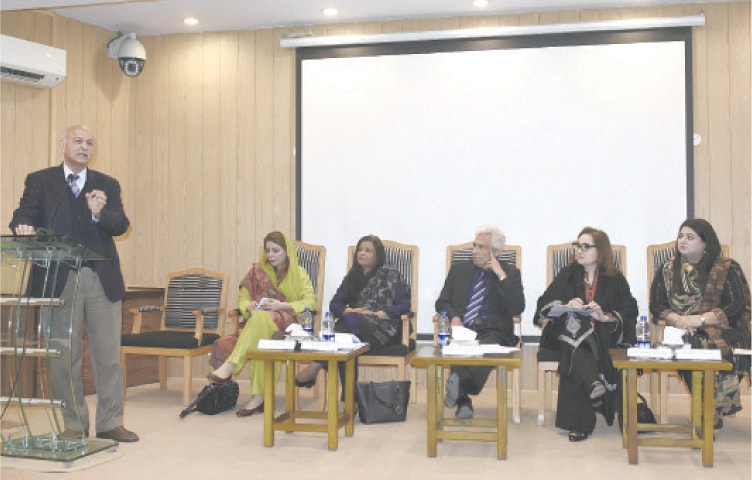
Speaking at a discussion here on Pakistan-USA relations, he contrasted Islamabad’s long-term strategic partnership with China to what he termed ‘seasonal’ friendship with United States, shaped repeatedly by geopolitical needs.
He noted that Beijing remained Pakistan’s most reliable partner with both countries depending on each other for strategic and economic reasons. In contrast, he argued that Pakistan’s relationship with Washington had historically been crisis-driven, from Cold War alignments in the 1950s to the Afghan conflict in the 1980s and post-9/11 cooperation. Each time, he said, the partnership intensified only when the US required Pakistan’s support and faded as circumstances changed.
Says current phase of Pakistan-US engagement tied largely to President Trump’s priorities of ‘crypto, critical minerals and counterterrorism’
The speaker highlighted several moments when the US played what he called a positive role for Pakistan, including preventing India from pursuing further military action in 1971, supporting constitutional consensus in the 1970s and issuing early warnings about regional threats in the 1980s. He also referenced diplomatic interventions during political transitions in the late 1980s and 1999.
He said the current phase of Pakistan-US engagement was tied largely to President Donald Trump’s priorities, which he summarised as “crypto, critical minerals, and counterterrorism.” He described Trump as an unconventional leader who preferred transactional dealings and had reshaped traditional American foreign policy.
Despite this opening, he warned that Pakistan had historically bargained poorly, often focusing on personal gains rather than national interests. With China facing economic pressures, regional tensions rising, and the US seeking new alignments, he urged Islamabad to negotiate more confidently.
He said that Pakistan now had an opportunity to recalibrate its diplomacy, strengthen partnerships and learn from past mistakes, particularly in Afghanistan, where previous assumptions had collapsed.
Speaking on the occasion, MNA Nafisa Shah called for a reset in Pakistan-US relations. She said Pakistan and the US continued to experience a “pendulum” relationship, shifting between strategic cooperation and deep mistrust. She argued that Washington had often treated Pakistan as a geopolitical tool rather than a long-term partner, while Islamabad’s own establishment repeatedly entered US-led conflicts that harmed national security and weakened democratic institutions.
Dr Shah urged the US to engage Pakistan as a sovereign state with legitimate security concerns, particularly regarding India and its close ties with China. She called for a shift from a security-heavy agenda to broader cooperation in trade, investment, technology, education and climate change, along with stronger congressional engagement and support for democratic institutions.
MNA Naz Baloch underscored the long-standing ties between Pakistan and the US, noting that Washington was among the first countries to recognise Pakistan in 1947.
She said the relationship extended beyond diplomacy to education, humanitarian support and strong people-to-people links. She cited US Fulbright scholarships, American assistance during major disasters, and the delivery of over 70 million Covid-19 vaccine doses as examples of continued cooperation.
Mehnaz Akbar Aziz, former parliamentarian, reflected on her seven years of experience in NGO work, noting early positive interactions with American entities, including scholarships and community projects in Pakistan during the mid-1990s.
Wadana Gul, President Institute of Peace and Development, stressed the need for Pakistan and the United States to redefine their relationship from a security-centric model to a consistent strategic partnership based on clarity, respect, and shared interests amid shifting global geopolitics.
Published in Dawn, December 5th, 2025