0
0

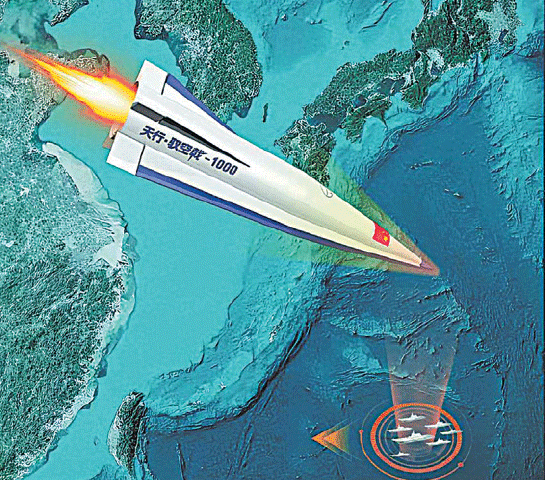
CHINA’S state-owned defence contractors are known for their expertise in ultrafast weapons such as the DF-17 and the YJ-21. Now, a private sector firm has stepped into this cutting-edge sector, developing a system that can launch a missile with a top speed of Mach 7.
Lingkong Tianxing Technology, a Beijing-based aerospace company, announced earlier this week that it has developed a hypersonic missile system — the YKJ-1000.
According to the company, the YKJ-1000 missile consists of two parts — a booster rocket and a hypersonic glide vehicle, which is equipped with two additional engines.
It has a top hit range of 1,300 kilometres, a maximum speed of Mach 7, or 8,575 km per hour, and a powered cruise time of six minutes. Each YKJ-1000 unit can independently conduct the missile’s launch without relying on other facilities’ support.
Lingkong Tianxing published a video clip on its WeChat account showing an actual launch of the missile.
In the clip, a YKJ-1000 missile emerges from a white shipping container-like launch cabin before soaring skyward. The firing scenes are followed by animated footage showing the missile locking on to a carrier strike group sailing toward an island, navigating autonomously and adjusting trajectory mid-flight. The footage also shows the hypersonic glide vehicle, which carries the warhead, evading defence measures used by the carrier fleet.
Another real-world clip shows a steep terminal dive and a confirmed hit on a target inside a desert testing range.
According to the company, the baseline version of the YKJ-1000 has begun to enter mass production, while an “intelligent” version incorporating artificial intelligence-enabled decision-making and swarm collaboration capabilities is under development.
Wu Peixin, a defence industry observer, said the biggest advantage of “less advanced hypersonic missile systems” like the YKJ-1000 is that they can be manufactured and deployed on a large scale, effectively covering the flight of “really sophisticated, mighty missiles like the DF-17”, and also greatly consuming the enemy’s costly missile interceptors.
Lingkong Tianxing announced in January that it is developing a supersonic technology demonstrator called Cuantianhou, or Soaring Monkey, and plans its first test flight in 2026.
The prototype will be 7 metres long, weigh 1.5 metric tons and be propelled by a state-of-the-art system called a ram-rotor detonation engine, which combines a rotary detonation engine, rotor compressor and ramjet technology.
Published in Dawn, December 1st, 2025