Explorers claim discovery of ‘ancient skeletons’ at Banbhore ruins
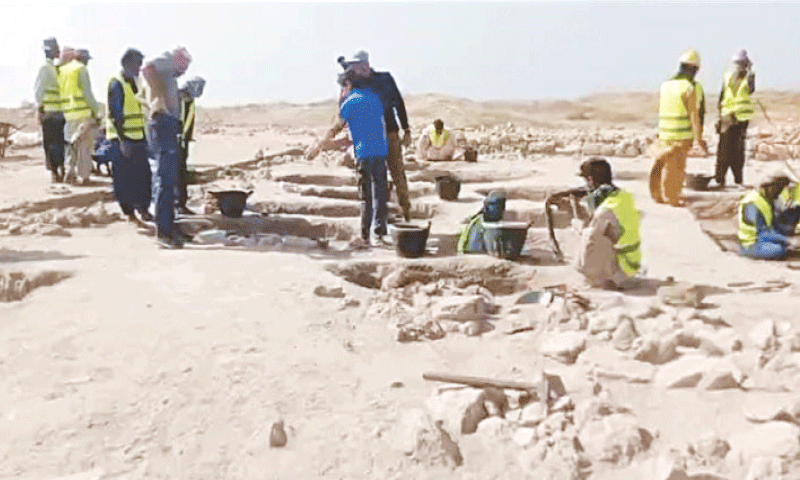

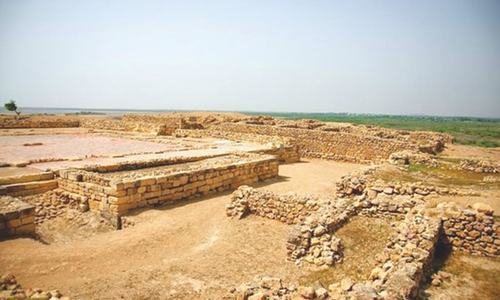
THATTA: Significant discoveries have emerged in the ongoing exploration at the historical site of Banbhore. They include more than a dozen human skeletons.
The exploration is a joint effort involving local university students, officials from the Sindh Archaeology Department and a team of archaeologists from Italy.
The international team includes experts in pottery, photography, topography, bone studies, glasswork and archaeology. Its members included Dr Agnese Fusaro, Quaggio Sara, Furno Luca, Damiano Daniele and Marco Vilory.
The experts suggest that this season’s discoveries may surpass those of previous years, owing to the size and depth of the man-made mounds (bhits in local parlance) formed as the ancient city had collapsed over many centuries.
Site in-charge at Banbhore Saleem Palijo has said that alongside the skeletal remains, the team also unearthed pottery vessels and other antiquities. All these objects have been handed over to the Archaeology Department for analysis to determine their age, origin and historical context.
He added that during the 2024 season, researchers uncovered human bones, pottery shards and a pair of elephant tusks, possibly from India or Africa. Other findings included animal bones and horns, brass coins, clay toys and an 80kg metallic drum filled with old ivory which are undergoing scientific examination.
All previous artifacts have been deposited with the Archaeology Department for preservation and further study, contributing to efforts to determine the true antiquity and cultural significance of Banbhore.
Mr Palijo told the media that archaeologists believe the elevated mounds still keep deeper and richer layers of the ancient settlement. Since the collapsed city’s debris lies far below the surface, experts anticipate further discoveries that could reshape the understanding of Banbhore’s historical timeline.
He said the team will continue excavation for a few more months.
Banbhore is widely regarded as one of Sindh’s most significant archaeological sites, believed to date back to the 1st century BCE. Often associated with early Islamic settlements in South Asia, the city is thought by some scholars to be linked to the port of Debal, where Arab general Mohammad bin Qasim is said to have landed in 711 CE.
Over the centuries, repeated natural and structural collapses buried the city under layers of silt and debris, forming the massive mounds that continue to attract archaeologists from around the world.
Published in Dawn, December 1st, 2025