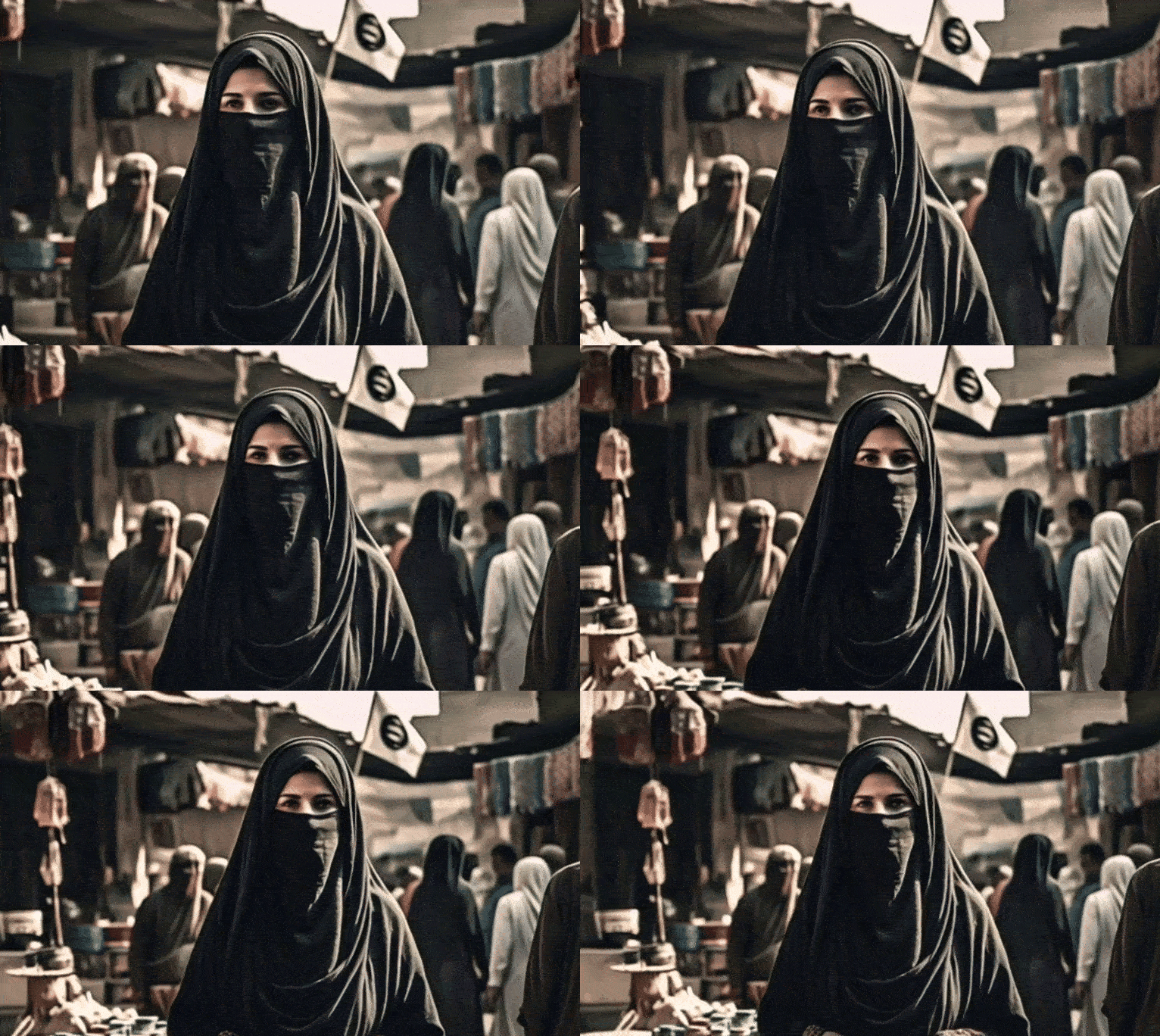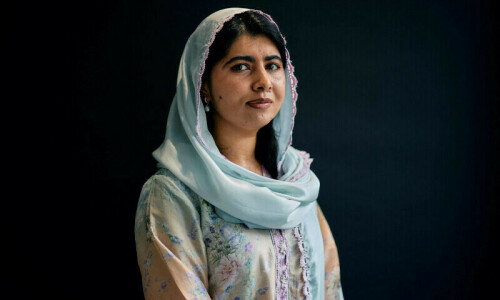
WHY are Pakistanis so triggered by Malala? An ordinary girl from Swat who, at 15, was shot by the Taliban for advocating for girls’ education, went on to become the global face of courage — a Nobel Peace Prize winner and a poster girl for education. Now, with the release of her new memoir, her story is back in the spotlight. Yet in Pakistan she is dismissed as a ‘puppet’, criticised for being ‘too Western’, or condemned for ‘not doing enough’. It is a paradox worth examining using economic theories, forcing us to confront what her story reveals about ourselves.
Economists George Akerlof and Rachel Kranton, in their theory of ‘economics of identity’, argue that people obtain satisfaction from belonging to social groups: nation, religion, gender and feel loss when someone from their group seems to violate its norms. In Pakistan, national identity is often defined in contrast to the West. When a girl from Swat became a fixture in Western media, her success was misread as defection, a signal that she now ‘belonged’ to another group. The conspiracy theories that followed were, in economic terms, society’s way of restoring identity balance: re-labelling her as an outsider to protect the in-group’s sense of coherence.
There is also a theory of fairness and relative comparison at play. Human beings judge success not in absolutes but through comparison. Economists Ernst Fehr and Klaus Schmidt call this ‘inequity aversion’: we dislike outcomes that feel unearned, even if they don’t harm us directly. Many Pakistanis viewed Malala’s sudden global fame as disproportionate to her age and actions. She became a Nobel laureate before she could vote or graduate while millions of girls were struggling to find their way into schools. Instead of being proud of her, people felt deprived — as if the world had rewarded one girl and ignored the rest.
Yet this instinct to doubt or diminish her says more about us than about Malala. Economic theory explains our discomfort but it also shows why changing the narrative can yield better outcomes. If identity and fairness shape behaviour, then reshaping those perceptions can reshape incentives. Instead of treating Malala’s success as alien, Pakistan can treat it as ‘collective capital’ — proof of what is possible when a girl from an ordinary background is allowed to speak and learn.
The suspicion surrounding Malala is not unique.
Economists call this the ‘role-model effect’: when girls see people like them succeed, they start to believe they can too, and that belief changes what they aim for and how hard they try. Bell et al. (2019) find that girls in the US growing up in regions with more female inventors were significantly more likely to become inventors themselves. The mechanism is simple but powerful: visibility expands the ‘aspiration window’. Malala’s story can do the same for Pakistan’s daughters, not because she is flawless, but because she is recognisably human. Her very ordinariness makes ambition feel reachable.
Her light-hearted Instagram reels reflect how she has grown into a confident young woman: founding the Malala Fund, finishing a degree at Oxford, and continuing to speak for children denied schooling. Malala has done far more than most Pakistanis care to acknowledge. When the attack happened, she was just a child, still figuring out who she was. But instead of standing by her side, we turned our doubt into judgement. In doing so, we taught our own children that speaking up leads to punishment — that curiosity and confidence will be met with doubt.
The suspicion surrounding Malala is not unique. It is the tale of nearly every woman who chooses to stand out. Economists term this ‘statistical discrimination’. It occurs when individuals do not have enough information, leading them to rely on stereotypes to bridge the gaps. A different woman is not seen in terms of her own effort or worth, she’s seen in terms of what society believes she ought to be — “too outspoken”, “too different”. And if she does succeed, it’s discounted as an exception, not an example. This scepticism is like a hidden tax on women’s progress, causing every woman who dares to rise to first prove, time and again, that she deserves it.
Pakistan cannot keep doubting its daughters. They deserve better — girls who feel free to question, to learn and lead. Each time we tell a girl to stay quiet or fade into the background, we shrink our own future. When women grow, the nation grows. Celebrating Malala is not about idolising one person; it’s about showing our daughters what’s possible. Let’s teach them that strength, curiosity, and ambition are not flaws to hide, but values to nurture — for their sake, and for Pakistan’s. Because in the end, the real question isn’t why Pakistanis are triggered by Malala, but why we fear the strength she represents.
The writer is an assistant professor of economics at St Olaf College.
Published in Dawn, November 26th, 2025