Experts warn of AI’s use in warfare at Margalla Dialogue
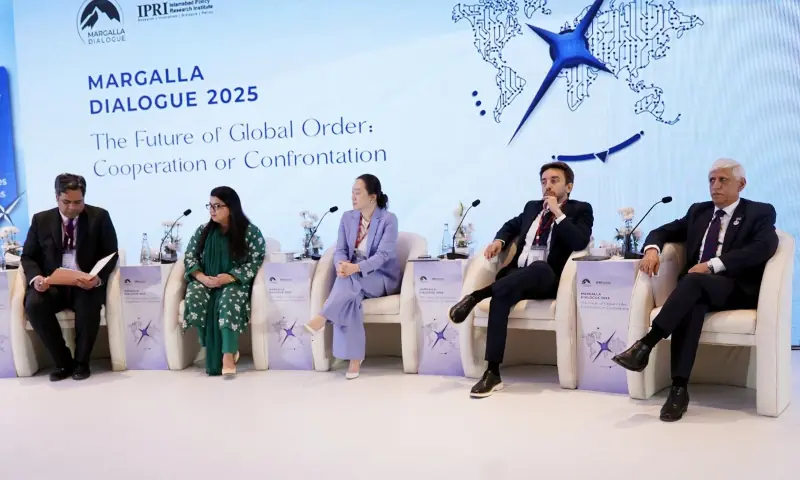
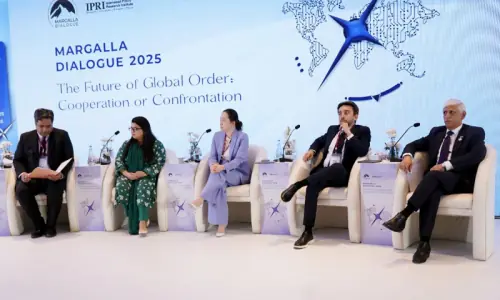
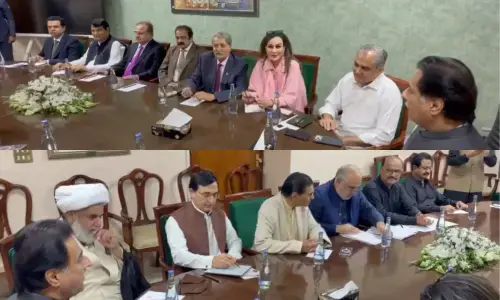
ISLAMABAD: The second day of the Margalla Dialogue saw intellectuals and policymakers expressing concern over the widespread use of AI in modern warfare and emphasising the need for regional integration and connectivity.
The keynote speaker at the event, Federal Minister for IT and Telecom Shaza Fatima Khawaja, said technology has brought about a revolution in the world, and AI has attained an inevitable status.
She said the nature of warfare is shifting toward computing power, data and algorithms, and Pakistan cannot afford to lag behind in this race for modernisation. She recalled how Pakistan was coping with the emerging realities of AI and its advancements and informed the audience about the country’s roadmap to deal with the changing dynamics of new inventions.
She said there are vast opportunities, and Pakistan has all the necessary ingredients in the form of technical experts, start-ups and strong government support.
“We are promoting production in both software and hardware sectors, and in the battle for truth, the situation has been handled effectively,” Ms Khawaja remarked.
Kazakhstan’s Ambassador to Pakistan, Yerzhan Kistafin, said his country shares more than 7,000 kilometres of border with Russia, a distance equal to that from London to New York, and is the largest landlocked country in the region.
He called for a collective strategy to deal with issues such as drug trafficking, terrorism and connectivity, apart from investment.
He pointed out that Pakistan and Kazakhstan possess a trade potential of more than $14 billion.
Speakers noted that Afghanistan’s biggest dilemma was the lack of recognition from the international community, yet regional states continue to support the war-torn country through transit trade, commercial interaction and by hosting refugees.
They remarked that only a multilateral approach can help overcome this situation and foster trust and tranquility.
Former chairman joint chiefs of staff committee (CJCSC) retired Lt Gen Ehsanul Haq said Pakistan wants to move forward on connectivity, but certain elements hinder progress, referring to Afghanistan.
He said that more than four years of dialogue with the Taliban had proven futile, forcing Pakistan to take action against terrorist sanctuaries there, while it continued to provide trade and humanitarian assistance.
He added that regional initiatives like the Moscow Format and Tashkent Dialogue should bear fruit in nudging the Taliban government towards peace.
Idrees Zaman, former Afghan diplomat, noted that peace in the region cannot be achieved without a stable Afghanistan and that regional coherence is essential for stability.
He also said peace in Afghanistan cannot be outsourced, and it was time to move from uncertainty to predictability.
Director Research IPRI retired Brig Dr Raashid Wali Janjua highlighted that AI is redefining warfare just as it is redefining human existence, and for the first time in human history, nature, grammar and character are all changing together due to the weaponisation of AI.
Published in Dawn, November 13th, 2025