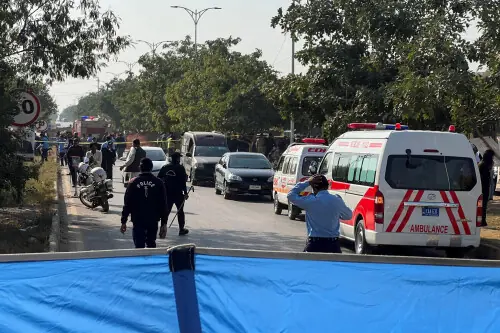
AFTER a long pause, terrorism has returned to the federal capital, with at least 12 people losing their lives in Tuesday’s suicide bombing outside the district court building in Islamabad. While the so-called peripheries — KP and Balochistan — had long been experiencing a deadly wave of militant violence, yesterday terrorists struck what is supposed to be one of the most secure cities in this country. And while in the ongoing wave of terrorism mostly security personnel and law enforcers have been targeted, in the latest tragedy a clearly civilian target was hit.
The Islamabad bombing brings back painful memories of the last wave of militant violence that took a heavy toll of both security men and civilians before the monster of terrorism was neutralised. Tuesday also saw a clearance operation underway at the Cadet College Wana, another soft target, which had been stormed by militants on Monday.
Speaking of both the Islamabad and Wana attacks, the prime minister said they bore the hallmarks of “Indian state terrorism in the region”, while linking Afghanistan to the incidents. Shehbaz Sharif further mentioned that ‘khawarij’ linked to the banned TTP and Baloch separatists were involved. Meanwhile, the defence minister sounded an ominous warning, saying that “we are in a state of war”.
It is obvious that a full investigation is required to uncover the forces behind both acts of terrorism, and to bring the perpetrators of these heinous crimes to justice. And if any evidence is found of the involvement of India and the Afghan Taliban in these attacks, the issue must be taken up immediately with both New Delhi and Kabul.
But while possible foreign links to acts of terrorism must be probed, and those involved beyond our borders confronted, the state’s primary duty right now is to shore up the home front, and re-examine its counterterrorism strategy in the wake of the resurgence of militancy. For long, Pakistan’s major cities have been immune to mass-level terrorist attacks. The fact that a suicide bomber was able to strike in Islamabad indicates a major security lapse.
Moreover, if we are indeed in a war-like situation, as the defence minister has claimed, then dealing with this crisis requires a national response. All stakeholders — the opposition, security experts, civil society — need to be taken on board to formulate a cohesive response to the threat of terrorist violence. Petty politicking and targeting of the opposition and all critical voices must stop. All shades of opinion must be heard so that Pakistan can emerge from this crisis stronger and defeat terrorism and extremism. The current strategy is not working, and has resulted in a high number of losses of men in uniform as well as civilians. Statesmanship and democratic buy-in are required to emerge victorious from this dark moment.
Published in Dawn, November 12th, 2025