

Month-long Torkham border closure inflicts $45 million trade losses

An earlier version of this story erroneously stated the volume of monthly losses as $4.5 billion. The error was due to a typing mistake and has since been rectified.
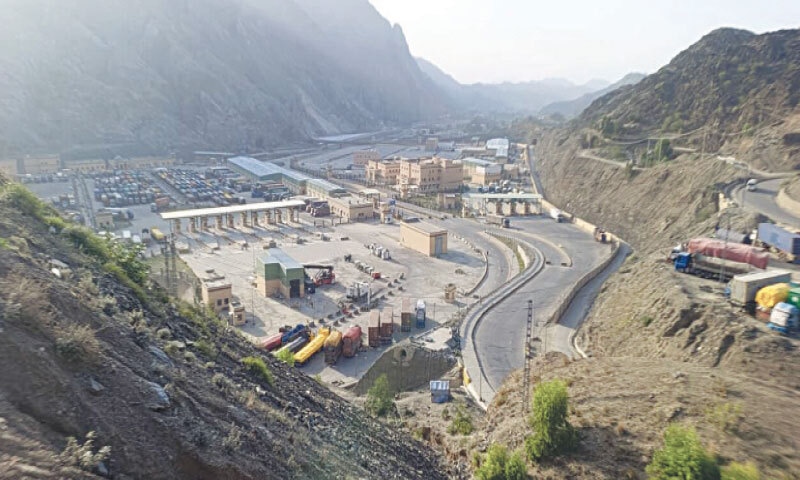
KHYBER: The month-long closure of Torkham border crossing has caused a cumulative loss of over $45 million and another Rs16.5 billion in terms of exports and imports respectively through Pakistan’s trade with Afghanistan.
Sources among official and trading circles told Dawn that Pakistan had already lost over 65 per cent of the Afghan market to Iran, some Central Asian States, Turkiye and even India due to hostile and aggressive trade policies dictated by security issues since the installation of the Taliban regime in Kabul in August 2021.
They said that while big time Pakistan and Afghan exporters had lifted their capital from the export-import business between the two neighbouring countries due to the repeated border closure and a hostile environment for traders and investors, the month-long closure of all border points had seriously dented the confidence of remaining “bunch” of small traders.
The sources said that while the uncertain situation had also dealt a severe blow to the burgeoning local manufacturing industry in Khyber Pakhtunkhwa, the border closure had seriously impacted manufacture of hundreds of daily items in Punjab and Sindh, which were exported to Afghanistan under the head of the miscellaneous items daily prior to the closure of the border.
They said that Afghanistan was currently importing cement, garments, shoes and slippers, a variety of edibles including different vegetables, fresh fruits, fish, chicken and other poultry items, animal feed and confectionery items.
The sources said that the prolonged border closure had negatively impacted the potato and banana exports, while the kinnow export was also in doldrums if immediate steps were not taken to ease border tensions.
Qari Nazeem Gul, an exporter and clearing agent, told Dawn that even before the border tensions began, at least markets in Kabul and Jalalabad were flooded with Iranian, Turkish and Central Asian products with Iran grabbing the major share of its exports to Afghanistan.
He said that Afghan traders were more interested and comfortable in doing trade with Iran instead of Pakistan as Iran was offering them more relaxations in acquisition of visas and custom duties.
“We are now hugely disheartened with the current pattern of complicated business with Afghanistan with most of the local traders now developing a hatred for the said trade due to continuous security and political issues between the two neighbouring countries,” he said.
Equally concerned was Mujeebullah Shinwari, who heads the Torkham customs clearing agents association.
“We’ve long been advocating for a trader-friendly policy by the government with special focus on alienating bilateral trade from security and political issues with Afghanistan,” he said.
Mr Shinwari said that the volume of Pakistan’s trade with Afghanistan had dropped from $2.5 billion in the years from 2012 to 2016 to a mere $800 to 900 million dollars on an annual basis.
“Gone are the times when 1000-1200 shipping containers loaded with multiple export items would cross over to Afghanistan on a daily basis, as we now have 250-300 containers left in the export field on a daily basis,” he said.
The customs clearing agents’ leader said that the suspension of bilateral trade was also harming revenue generation through tax collection under various heads that was up till now a handsome amount for the national exchequer.
He said that the current volatile and uncertain situation had deeply affected the small-time businessmen, traders and even shopkeepers in local markets as a large number of people affiliated with different trading fields had lost their legitimate earnings.
Mr Shinwari said that the local trading and transport community had never experienced such a long closure of the border with a majority of the vehicle owners who got stranded due to sudden closure of Torkham on October 12 were now contemplating to switch over to other less profitable business venture in order to cover for the month-long financial loses.
He suggested the formation of an all-powerful jirga of leading tribal elders, politicians and traders to hold meaningful dialogue with officials of both the countries to find a mutually agreed formula for reopening of all borders points for trading and thus, saving business communities of both countries from further financial losses.
Meanwhile, Israr Shinwari, head of a local youth organisation, has demanded the immediate reopening of the Torkham border through a powerful jirga mediating between the two countries.
During a meeting in Landi Kotal on Monday, he said that the Pak-Afghan border points should be kept open in all circumstances, with a special focus on promoting trade between the two countries.
Mr Shinwari, however, warned a series of protest demonstrations would be staged if their legitimate demands weren’t met.
Published in Dawn, November 11th, 2025




























