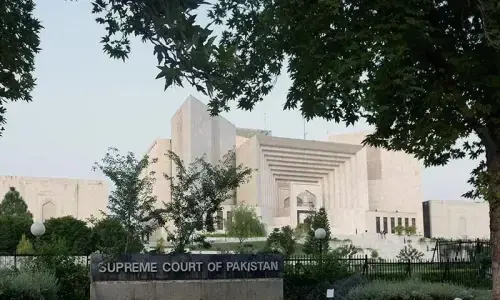
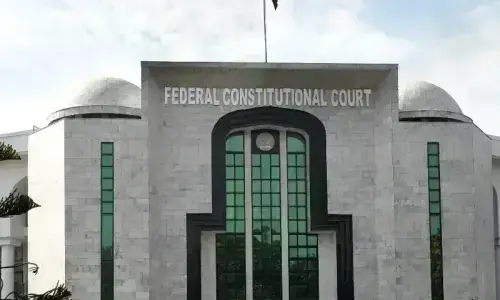
• Constitutional Bench head Justice Aminuddin Khan among leading candidates for top slot
• Federal court will have exclusive jurisdiction over constitutional matters
ISLAMABAD: With the 27th Constitutional Amendment progressing smoothly through parliament, the government has begun restructuring the superior judiciary, shortlisting seven judges for appointment to the proposed Federal Constitutional Court (FCC) — an institution designed to deal with constitutional interpretation and intergovernmental disputes.
Official sources said the government has initiated consultations on the composition of the new court, and Justice Aminuddin Khan, who presently heads the Supreme Court’s Constitutional Bench, is being considered for appointment as the chief justice of the FCC.
The names of Justice Syed Hasan Azhar Rizvi, Justice Musarrat Hilali, Justice Aamer Farooq, and Justice Ali Baqar Najafi from the Supreme Court, along with Justice K.K. Agha of the Sindh High Court and Justice Rozi Khan Barrech, the incumbent chief justice of the Balochistan High Court, are also being discussed for inclusion in the initial composition of the new court.
Sources said that the initial strength of the FCC would be determined through a Presidential Order, while any subsequent increase in the number of judges would require an Act of Parliament.
Officials at the law ministry confirmed that the president, on the prime minister’s advice, will appoint judges to the new court under the proposed amendment.
The FCC proposal has been revived in the 27th Constitutional Amendment Bill to streamline the Supreme Court’s jurisdiction and improve efficiency in constitutional adjudication.
The government believes this initiative will ease the SC’s workload, speed up constitutional rulings, and enhance judicial independence and credibility.
The idea of a separate constitutional court was first introduced in the 2006 Charter of Democracy signed by the PPP and PML-N. The CoD proposed a specialised court for constitutional matters to let the SC focus on final appeals. The idea reappeared in the 26th Amendment draft but was dropped due to opposition from JUI-F and others.
The proposal sets the Constitutional Court judges’ retirement age at 68, three years beyond the Supreme Court’s 65, to ensure continuity and attract experienced jurists.
The new court will be housed in the Federal Shariat Court building in Islamabad, while the Federal Shariat Court moves to the Islamabad High Court. This will symbolically and administratively separate the FCC from the Supreme Court and other superior courts.
The FCC will have exclusive jurisdiction over constitutional interpretation, intergovernmental disputes between the federation and provinces, and matters arising directly from constitutional provisions. It will also be empowered to examine the legality of presidential orders, constitutional amendments, and questions referred to it by the president or the Parliament.
Judges’ profiles
Justice Aminuddin Khan, the likely nominee for chief justice of the FCC, was born in Multan in 1960. A second-generation lawyer, he earned his LL.B from University Law College, Multan, in 1984 and began practice under his father, Khan Sadiq Muhammad Ahsan.
He became an advocate of the LHC in 1987 and of the Supreme Court in 2001, later rising to the LHC bench in 2011 and the SC in 2019. He has authored several landmark judgements in civil and constitutional law.
Justice Syed Hasan Azhar Rizvi, born in Karachi in 1962, began practicing law in 1988 and was elevated to the SC in 2023. He is known for his integrity and expertise in constitutional and administrative law.
Justice Musarrat Hilali, the first woman chief justice of the Peshawar High Court, was elevated to the SC in 2023. She has a distinguished legal career and has served as Additional Advocate General of Khyber Pakhtunkhwa and Federal Ombudsman for Protection against Harassment of Women.
Justice Aamer Farooq, former IHC chief justice, was elevated to the SC in February 2025. Educated in London and at Lincoln’s Inn, he specialises in constitutional and commercial law.
Justice Ali Baqar Najafi of the LHC has vast experience in civil, criminal, and constitutional law. He has decided over 37,000 cases and led key inquiries, including the 2014 Model Town investigation.
Justice Rozi Khan Barrech, chief justice of the Balochistan High Court, joined the judiciary in 1998, was elevated to the High Court in 2019, and became chief justice in July 2025.
Justice K.K. Agha of the Sindh High Court has an extensive international career, having served as prosecutor at the UN tribunal for the former Yugoslavia and as senior counsel at the Special Court for Sierra Leone.
Published in Dawn, November 10th, 2025