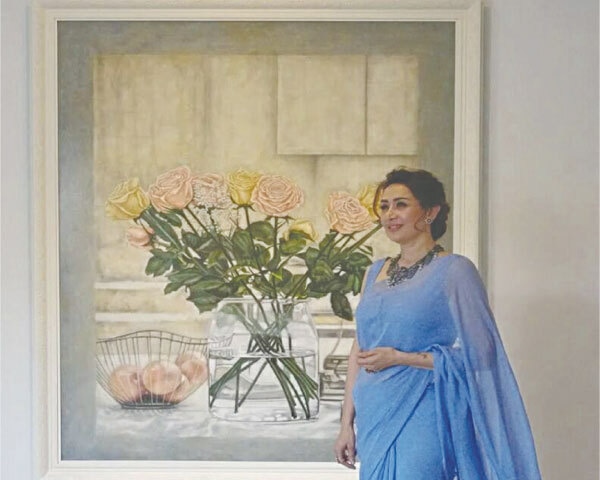
Nazia Ejaz’s ‘Borderlands’ arrives as a quiet yet resonant milestone in an artistic journey shaped by movement, memory and belonging.
Her practice has long negotiated intimacy and expanse — between the domestic and the cosmic, figuration and abstraction, and the layered histories of the places she has inhabited. This new body of work situates itself, by title and tenor, within the liminal — thresholds where identities meet and the small inventories of life carry memory across geography.
In her 2017 exhibition ‘The Green Room’, Ejaz combined laser-cut mirror acrylics with oil and gold leaf on linen to explore identity, belonging and migration. These works, at once introspective and universal, reflected on displacement and home through material contrasts — reflection and opacity, brilliance and shadow.
Central to her practice is the grid, a device long valued for its order and clarity in both design and art. Ejaz has reinterpreted it as both compositional scaffold and conceptual metaphor. In ‘Borderlands’, this structure reappears, though softened and submerged within veils of pigment. It becomes a quiet rhythm rather than a visible frame — a means to locate meaning within fragmentation.
Nazia Ejaz’s latest solo exhibition does not simply revisit her earlier artistic vocabulary — it deepens it
Her earlier canvases favoured saturated, jewel-like colours, layered surfaces, and cellular motifs that felt simultaneously microscopic and cosmic. There was a melancholic luminosity to her work, achieved through glazing and polished finishes. ‘Borderlands’, by contrast, feels like an inward turn. The works here focus less on expansive colour-fields and more on thresholds: floral arrangements, interiors glimpsed through uncertain light, and objects that function as repositories of personal and collective memory. The shift is not a rupture but a reorientation.
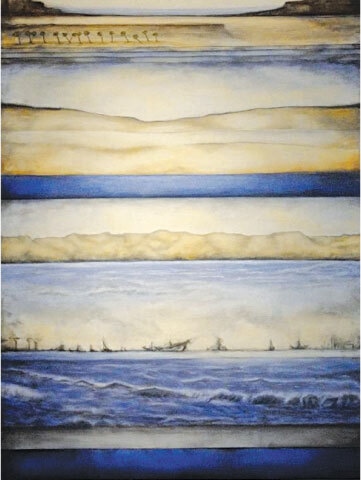
Ejaz’s formal strengths — her refined chromatic control, sculptural surfaces, and sensitive draughtsmanship — are now directed toward quieter meditations on return, and the fragile economies of home.
Educated at the National College of Art (NCA), Lahore and the Slade School of Fine Art in London, and having lived and worked across the UK, Australia and Pakistan, Ejaz’s practice bears the imprint of multiple geographies. The technical assurance and material fluency she brings to each surface reflect this mobility. Yet ‘Borderlands’ is not about geography in the cartographic sense — it is about the emotional landscapes of migration. Her painted objects serve as witnesses — a flower carries the weight of remembrance and looking into scenes of Lahore’s old city becomes a frame for a life in motion.
Ejaz’s life between cities and continents gives her work its quiet tension. Her works are freighted with the small economies of migration: what one carries, what one leaves behind. Her borders are not geopolitical but psychological and domestic, revealing how belonging is always both proximate and displaced. There is also an ethical undertone to ‘Borderlands’, which is a reflection on what it means to choose amid constraint.
‘Borderlands’ contemplates containment. It reframes Ejaz’s longstanding concerns with structure and pattern into a meditation on home and impermanence. Her landscapes are meditative spaces where memory, identity and geography converge. Translucent washes and textured brushwork allow fragments of the grid to emerge and recede, like fading maps or blurred recollections. These are emotional terrains: porous, shifting and alive with the tension between belonging and loss. Ejaz’s palette here is gentler.
Her several small My City canvases explore Lahore’s inner city and, in her Sandstone Sunflowers I and II, the atmosphere is contemplative, silence is charged, absence becomes presence. Through her delicate balance of control and spontaneity, she constructs visual fields in Borderlands (I to IV), The Breath Between the Two and Thresholds We Inhabit, holding the tension between order and chaos, much like the experience of living between histories and homelands.
‘Borderlands’ does not simply revisit Ejaz’s earlier vocabulary — it deepens it. The interiors of thought and feeling that persist despite distance result in a moving exhibition that asks viewers to slow down, to see the ordinary as luminous and to recognise that the border is not merely a line of division, but a space of becoming.
‘Borderlands’ was on display at Canvas Gallery in Karachi from October 28-November 6, 2025
Rumana Husain is a writer, artist and educator. She is the author of two coffee-table books on Karachi, and has authored and illustrated 90 children’s books
Published in Dawn, EOS, November 9th, 2025