Finmin Aurangzeb sees Pakistan’s economy in a ‘good spot’


 3
3
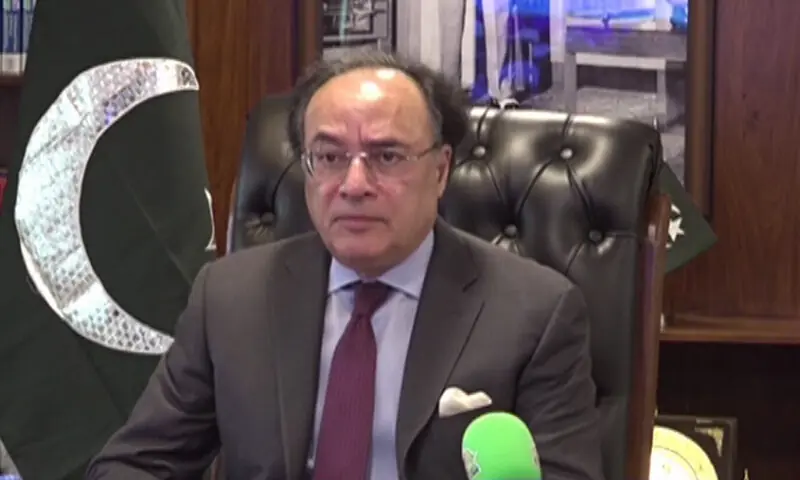

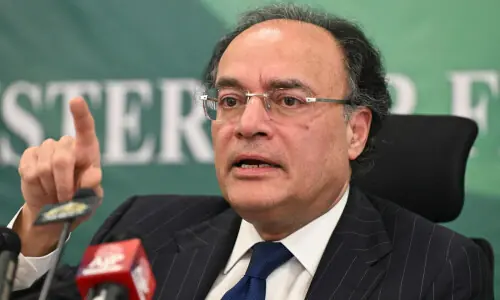
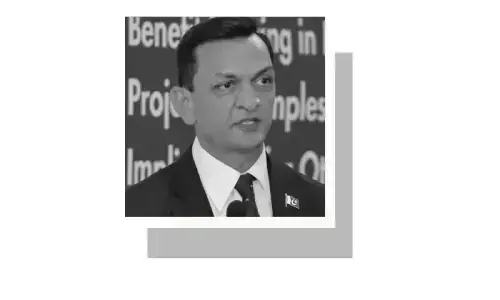
Finance Minister Muhammad Aurangzeb said on Tuesday that Pakistan’s economy was in a “good spot”, attributing this to macroeconomic stability and “geopolitical tailwinds”.
“Where we are as a country, we find ourselves in a good spot at this point and time because there is a confluence of factors,” he said, adding that macroeconomic stability combined with “geopolitical tailwinds” had boosted the economy.
The finance minister made these remarks in a virtual address at the second edition of the Pakistan International Maritime Expo and Conference 2025 (PIMEC-25), which is being held in Karachi.
“Our traditional partners, who have helped us through thick and thin … we find ourselves in a spot that we can now leverage, and we should leverage — in terms of these relationships which have been strong for the longest time — to move from government-to-government (G2G) discussions to trade and investment flows into the country,” he said.
In his address, the finance minister described blue economy as a game changer for Pakistan’s future growth. He also went on to say that Pakistan had received “external validation” for its economic policies.
“After a hiatus of two to three years, we have three global rating agencies which are fully aligned, not only in terms of the upgrades we have seen over the course of this year but also [in terms of] their outlook, which is stable for Pakistan’s economy,” he said.
He noted that Pakistan was currently part of an International Monetary Fund (IMF) programme. Stating that a staff-level agreement was announced last month, he said that this pointed to the confidence being reposed in Pakistani authorities.
He said that improved trade and investment flows which were expected in the coming months would help the country in moving toward sustainable growth.
Talking about blue economies, he said that Pakistan had a “modest starting point”.
“We are hovering at about 0.4 to 0.5 per cent of the national gross domestic product (GDP) which equates to roughly $1 billion,” he said. He said that the current GDP was $411bn, adding that Pakistan’s “real potential” was $3 trillion.
“It is very heartening and encouraging to see that the Ministry of Maritime Affairs has also put a marker in the ground, which is ambitious but very reachable,” he said.
He said that the government’s aim of becoming a $100bn blue economy by 2047 was “transformational and the right ambition”.
He said that the broad pillars of getting to that number were “robust”, adding that it started with achieving excellence in fisheries and aquaculture. Aurangzeb said that Pakistan’s seafood exports were currently $500 million, saying that getting that to $2bn over the next three to four years was a “very achievable milestone”.
“As the finance minister, I would like to assure you … that we are going to ensure that there is policy consistency. Whatever we say, we see it through the cycle. So I think that is going to be a very important part of how we are going to take this discussion forward,” he said.
He went on to say that another pillar was the modernisation of ports and logistics, and digitisation of the country’s ports. He said that another was renewable energy which included looking at “innovative financing” for projects.
“We have done green bonds in the past,” he said, highlighting the need for issuing blue bonds and blended financing mechanisms to fund conservation and sustainable development initiatives.
He added that marine biotechnology and regional collaboration presented further avenues for growth, with the ultimate objective of integrating blue economy principles into Pakistan’s national economic transformation agenda.
He concluded his remarks by wishing all panelists and delegations participating in PIMEC a “fruitful and constructive discussion”, adding that he looked forward to receiving feedback at the end of the conference.