WITH so much murder and mayhem in the world, so much turmoil and intolerance, a genocide (now paused) in the name of ‘self-defence’ and with twisted ideologies and terrorism taking so many lives of our people in the prime of their youth, with bigotry and narcissism defining many influential leaders around the globe, is it a surprise that each one of us seems forever to be tense and in a state of crisis?
Against the backdrop of this upheaval, I was seeking some temporary respite from the uncertain, often ugly and violent world, and surfing the net for content that could serve as a mild analgesic, even anaesthetic, and got lucky. And you’d be hard-pressed to realise how very lucky.
What I found on a video-streaming social media platform was a window to a Pakistan that was uplifting, life-affirming and reassuring. I don’t watch much of our TV channels for the simple reason that it is largely a case of more of the same.
News and current-affairs programmes (NCA, as we media people call this genre) are anything but NCA. These are mostly designed to either serve as homage to the ego of the ‘anchor’ or are entertainment with politicians from across the political divide, socking it to each other.
These offer near-zero insights and are often as pleasant as a cockfight that leaves the poor birds bloody and debilitated. One learns nothing. And if watching two (or more) people talking over one another in a pointless, escalating shouting match does not do anything for you, as is the case with me, sitting in front of the idiot box becomes an exercise in futility.
One man’s love for music made a difference because that is the upside of authoritarianism.
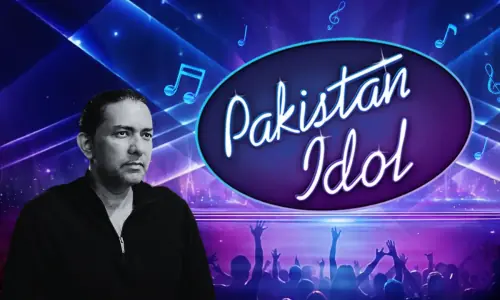
But back to more pleasant things. So, on the video-streaming platform I found some clips from a talent hunt show called Pakistan Idol. Having lived through the Zia years as a young college and then university student and then as a journalist in the nascent years of my professional life, I was sure that the culturally barren society that the dictator sought to create would remain so.
Of course, the democratic interludes did resuscitate the ‘cultural scene’ somewhat, but it was left to another authoritarian leader, a proponent of ‘enlightened moderation’, to revive it in a bit more structured manner. Yes, one man’s love for music made a difference because that is the upside of authoritarianism. It suddenly became kosher for high civil and military officials to be seen enjoying a musical evening and patronising art and artistes.
Once an interviewer, half mockingly, asked Malakah-i-Mouseeqi Roshan Ara Begum if those who showed up in large numbers to her live events understood the classical music that was her forte. The indomitable classical artiste par excellence smiled and said: “Mere sunnay walay do qism ke hein. Ek woh jo raag jaantay aur samajhtay hein aur doosray woh jo kan rasiya hein. Mere liye donon qabile ehtaram hein.” (Those who listen to me are of two kinds: first, those who understand classical music; and second, those whose ‘ear’ is discerning and can tell when they hear good music. I value both).
Although my soldier-father could sing classical music and could tell apart one raag from another with consummate ease, I count myself in the ‘kan-rasiya’ category. I wish I could have learnt the intricacies of each raag and its defining characteristics but remain grateful for a discerning ‘ear’.
Having read criticism of some of the Pakistan Idol judges and their alleged lack of nous to be able to ‘judge’ others, it was easy to see in the worst of cases, they were ‘kan rasiya’. Almost all of them were able to tell what was good singing.
Some of the songs (ghazal, geet, nazm) chosen by the contestants took me to back to my childhood, as I grew up in a household where artistes, singers and musicians were held in high esteem and musical evenings were the norm. How else other than a privilege can you describe watching as a child in awe maestros of the calibre of Ustad Umrao Bundu Khan and Muneer Khatoon performing in our drawing room, emptied of all its furniture for a ‘farshi nishist’.
For Ms Khatoon, I recall my father telling me years later that he needed to get special permission from the GHQ to invite the ‘Indian classical artiste’ to our home whilst she was on a visit to Pakistan. I remember him telling me how what was possible in the first half of the 1960s would be impossible after the 1965 war — and perhaps even more so today.
In my formative years, whether it was a ghazal evening in an army mess, the Services Club or the Karachi Press Club, literally a one-minute walk from where we lived on Ingle Road in the mid-1960s up to 1966-67, I always accompanied my parents. Annu (Bhai) Uncle (Dawn journalist Anwer Husain), my father’s university classmate, would always invite us.
I was thus able to listen to my heart’s content Farida Khanum, Iqbal Bano and Mehdi Hasan among others. Much later, after my parents’ passing, during the 1983 MRD movement, I watched a defiant Abida Parveen singing up a near-revolution at the KPC.
Because the Pakistan Idol had some of the contestants singing songs of so many of the asataza including Melody Queen Nur Jahan, it was but understandable that I was flooded with memories, nostalgia. The quality of the singing whether it was a ghazal, thumri, nazm or geet was so good. Pakistan is abundant in talent. It is bursting at the seams actually. Its flaws lie elsewhere.
Pakistan Idol performances triggered a desire to indulge in a listening session lasting long hours over several days, on headphones. I wonder what it was like for my wife who had to hear pretty loud cries out of nowhere of ‘wahwahwah … kiya kehnay … bohot khoob’. As for me, at least for now I feel rejuvenated and prepared to face the cruel world.
The writer is a former editor of Dawn.
Published in Dawn, November 2nd, 2025