0
0

Stepping into the group show ‘Geometry of Canopies’ — curated by Muhammad Zeeshan at Lahore’s Ejaz Art Gallery — one was immediately struck by the silence that inhabited the images on the walls and the sculptures resting on the ground.
But, the longer you looked, the louder the silences began to speak — compelling the viewer to discover or construct their own interpretations. Surreal, unsettling, grotesque, eerie, silent, melancholic, mischievous — these are the words that best defined this exhibition. There was an undeniable sense of bizarreness, yet also a strange, sympathetic pity that lingered long after.
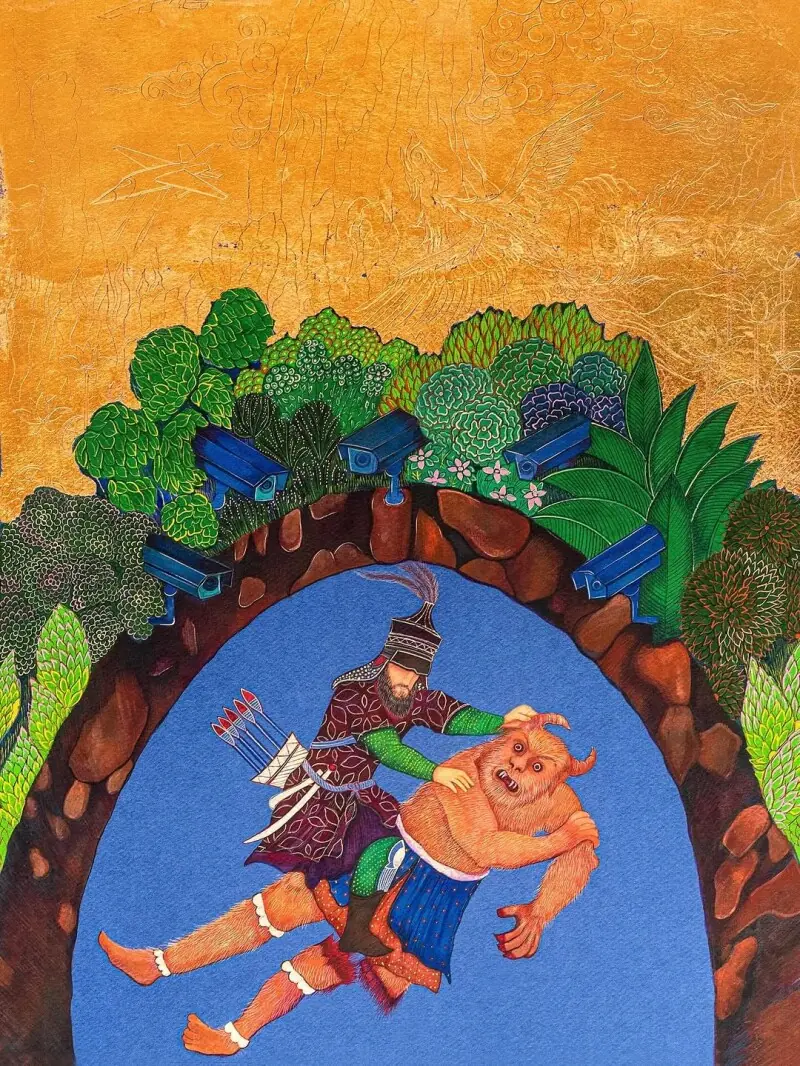
In Fatima Khalid’s Lords of the Lens, surveillance cameras appear as recurring motifs — questioning how heroism, truth and power are reframed in the age of constant security. Inspired by the Shahnameh, the Persian epic chronicling the mystical struggle between heroes and demons, Khalid reinterprets this traditional imagery through a contemporary lens.
At first glance, the central combat scene recalls the valour of Rustom subduing a demon. However, the surrounding details reveal a subtle yet profound shift in the narrative of power. Ironically, the ‘lords’ of our time are no longer mythical heroes but unseen watchers — those who define and control us through their relentless gaze. These entities observe, record and monitor — rewriting narratives through data and image. Khalid’s work doesn’t offer a clear interpretation, instead inviting viewers to engage intuitively and form their own understandings. The discomfort it stirs is intentional — a reflection of our times.
A group show in Lahore explored how beauty and discomfort can coexist beneath the same canopy
Jawad Ahmad Jan’s Mirror Silhouette 22 evokes a quiet and introspective atmosphere. A sharply rendered portrait — showing closed eyes and a tilted head — stands in stark contrast against ghost-like silhouettes in the background. One wonders if this is a moment of contemplation, detachment, peace or helplessness. A feeling of deception subtly pervades the piece — what is visible on the outside may not reflect the inner reality. A central vertical line divides the composition, forming both a literal and metaphorical mirror. It suggests reflection, duality and the multiplicity of identity. Jan’s restricted palette — dominated by muted reds and pinks — further enhances the meditative tone.
Sculptures by Jawad Hassan offer a fascinating exploration of childhood, surface illusion and emotional complexity. Made using fibreglass and lustrous industrial paint — gold and white — these works capture the contrast between polished exteriors and inner vulnerability. In Fragile Gleam, a boy is captured mid-gesture — his mouth appears to be shouting, laughing, or perhaps calling. His raised hands, as if praying or begging, provoke curiosity and demand the viewer’s attention. There’s a touch of irony in the setting — an emotional cry masked by a sheen of gold.
In Golden Void, a child is seated with folded arms and a knowing smile. The gold finish transforms an ordinary pose into one of timeless permanence. But beneath the surface lies a darker commentary — this child represents the children beggars we often see on the roadside painted and polished to resemble statues. Their cries are hidden beneath a forced smile and golden gloss, exposing society’s hypocrisy: glorifying innocence while ignoring its exploitation.
Nazar Ul Islam’s work touches on race and class systems, and particularly the internalised preference for ‘fair skin.’ In Together, executed masterfully in watercolour on vasli, the trauma and agony of living with an inferiority complex are brought to light. Yet, the artwork’s strength lies in its subtlety — depicting children playing together, free from notions of caste, class or colour. In childhood, differences don’t divide. But these pure bonds slowly erode as we grow older and are shaped by the biases and discriminations embedded in societal systems.
‘Geometry of Canopies’ was on display at Ejaz Art Gallery in Lahore from October 7-14, 2025
The writer is an art critic, fine artist and educationist based in Lahore. She can be reached at ayeshamajeed2015@gmail.com
Published in Dawn, EOS, November 2nd, 2025