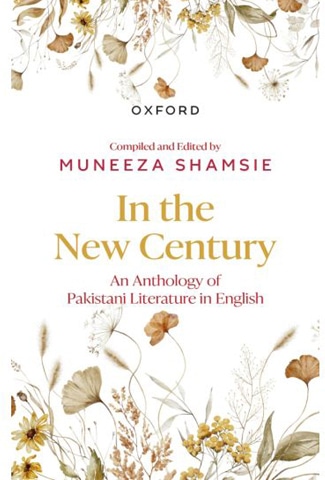
In the New Century: An Anthology of Pakistani Literature in English
Compiled and edited by Muneeza Shamsie
Oxford University Press
ISBN: 978-0-19-906091-7
566pp + index
Muneeza Shamsie’s recently published book, In the New Century: An Anthology of Pakistani Literature in English, builds on the strength of her previous work.
The first of the prior works, A Dragonfly in the Sun, was published in 1997, with English language poetry and prose written over 50 years of the country’s existence by Pakistani authors. Leaving Home: Towards a New Millenium followed in 2002, a selection of fiction and non-fiction works focusing on migration, its displacements and the formation of changed identities. Shamsie’s third anthology, in 2005, was titled And The World Changed: Contemporary Stories by Pakistani Women. There were 50 Pakistani women writers featured in this award-winning volume.
Having researched extensively for her anthologies, Shamsie took another step forward in 2017 with the publication of Hybrid Tapestries: The Development of Pakistani Literature in English. Muneeza continued to map developments in Pakistani English literature, becoming the bibliographic representative of the Journal of Commonwealth Literature, and a guest editor for other literary journals.
In the New Century has been published by the Oxford University Press in 2025. It traces the work of 86 Pakistani writers at home and in the diaspora, many straddling both worlds as they move from one place to the other. The work of some is firmly rooted in the culture of the Subcontinent, others of the new generation feel free to roam the world. The contrast between the two viewpoints is marked in fiction and memoir, less so in the poetry, much of it echoing the realm of emotion that is universal to a great degree.
Muneeza Shamsie’s latest anthology of Pakistani English language literature provides access to work that may now be hard to access and reconnects readers with old favourites
Anglophone writers were better known for poetry in the early years of post-Partition Pakistan. Their contribution to Pakistani English literature was acknowledged by the Oxford University Press with the publication of a couple of anthologies. Later, individual volumes were published for the major poets.
Works of fiction were few and far between at the time; writing in English was considered a rather dubious activity and consigned to the margins of ‘Pakistani Literature’. Writing in Urdu was recognised and appreciated, while other languages took a back seat. The English language poets, however, persevered, although platforms for the dissemination of their work were strictly limited.
In the New Century opens with the work of the consummate poet Taufiq Rafat, who would go on to influence a whole generation of younger poets. Rafat’s work was path-breaking in more ways than one. He broke with convention in terms of style and content, making way for a ‘Pakistani’ idiom — the freedom to use the English language as one’s own.
Read half a century later, his style is still contemporary. There’s an acerbic wit at play. In a poem about Karachi, the Lahore-based Rafat says:
Well, here it is,
and here am I
circling each other again.
The question is: who’s
going to get to spit first
in the other’s eye.
Rafat was a mentor for younger poets in Lahore, including Waqas Khwaja and Athar Tahir. In Karachi, Adrian Husain and Salman Tarik Qureshi brought a group of English language poets together. Shamsie acknowledges the contribution of writers in the diaspora in bringing about a change in the literary landscape. Some of these writers lived between Pakistan and the West, straddling both worlds; others had been educated in the West and had come back home to stay.
Most of the 86 writers identified by Shamsie for the anthology do not restrict themselves to a single genre, publishing prose as well as poetry, sometimes exploring memoir and ‘life writing’ as well.
The expat Zulfiqar Ghose was one of the earliest writers of Pakistani origin to publish significant works of fiction in English. Bapsi Sidhwa’s early works of fiction included The Crow Eaters, a novel about the Parsi community. Later, with Ice-Candy Man, Sidhwa reached out to an international audience.
As the new century approached, a generation of fiction writers emerged, garnering major international awards. Among them were Kamila Shamsie, Nadeem Aslam and Uzma Aslam Khan. The 9/11 attacks and their aftermath provided the impetus for H.M. Naqvi’s Home Boy as well as Mohsin Hamid’s The Reluctant Fundamentalist.
The anthology adds the category of ‘Life Writing’ to Memoir in the non-fiction category. Here we find Bapsi Sidhwa’s ‘Watching My Novel Become Deepa Mehta’s Film’, as Ice-Candy Man inspires Mehta’s film Earth 1947. In another case of crossing genres, Rukhsana Ahmad’s ‘Experiments in Theatre from the Margins’ examines the process of adapting text to performance. Observing the synergy between narrative and theatre elements, Ahmad goes from adapting texts for avant garde theatre to an adaptation of her own work.
Extracts from novels in the anthology range from Abdullah Hussain’s Émigré Journeys and Nadeem Aslam’s The Golden Legend to Mohammed Hanif’s A Case of Exploding Mangoes and Omar Shahid Hamid’s The Party Worker. Shamsie’s selected extracts give the reader a glimpse of the author’s style while they reflect the drift of the narrative.
Among short stories, the anthology invites one to revisit Daniyal Mueenuddin’s ‘Nawabdin Electrician’, a piece from the award-winning book Other Rooms, Other Wonders. Mueenuddin places his story in a milieu that he is familiar with, having kept in touch with a family farm in the Punjab. His Nawabdin is an idiosyncratic character, and the nuanced writing builds up to an unexpected climax.
The poet Moniza Alvi was born in Lahore and grew up in England. She has built up a substantial body of work, winning several awards. The poem ‘Crossing Back’ is in a series about Partition, and ponders:
The line between birth and non-being.
The line between what happened
and the imagining.
A line so delicate a sparrow might have
picked it up in its beak.
A line of writing.
A line so definite —
And so blurred.
Among the new generation, Shadab Zeest Hashmi uses traditional forms, the ghazal and the qasida:
Qasida of Urdu Bazaar
Between the mosque and Moonlight
Square or Chandni Chowk is the market where my language landed a name. I drank the map as milk, meandering
more than one hundred years after the market charred
on the watch of golden poets
Black lace trailing on volcanic ash — ancestral thunder
where the Black sea meets the Jamuna
I turn my back to the mulch of master
sing Language is its own empire
Among the new voices represented in the anthology is fiction writer Sarvat Hasin. A piece of short fiction by Hasin, ‘Dumplings’, is a light-hearted yet poignant piece about a close friendship between two women that does not stand the test of time.
The anthology provides readers the opportunity to discover work that may now be out of print or otherwise hard to access. At the same time, it reconnects the reader with old favourites. As such, it is a welcome addition to the genre of Pakistani English language literature.
The reviewer is a journalist, editor and documentary filmmaker
Published in Dawn, Books & Authors, October 5th, 2025