

More rain expected across Punjab till Oct 7 as flood survey underway: PDMA

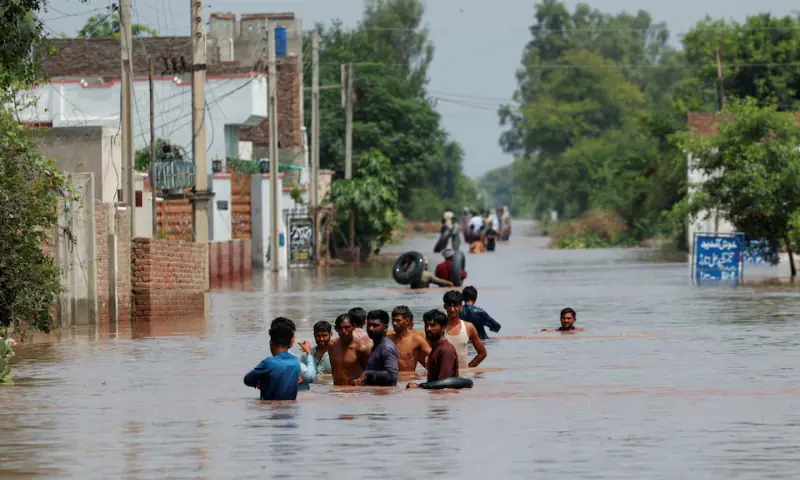

More rain is expected in the coming days across Punjab as surveys to assess the losses and damages from the recent floods are underway, Provincial Disaster Management Authority (PDMA) Director General Irfan Ali Kathia said on Saturday.
Since June, monsoon rains across Pakistan have killed at least 1,037 people, swelling major rivers and devastating rural communities along their banks. In Punjab only, over 4.7 million people have been affected across 4,700 villages, according to the PDMA.
Addressing a media briefing in Lahore today, DG Kathia said showers were expected to begin early tomorrow morning across Punjab, and continue till October 7 (Tuesday) in the northern parts.
The PDMA chief said the north and northeastern regions from Rawalpindi to Lahore were likely to receive 30 to 35 millimetres of rainfall on average, while the province’s southern parts could see 5 to 10mm.
He warned that the intensity of the showers would increase on October 6 and 7, with 50 to 70mm of rain anticipated in northern and northeastern Punjab, extending into central districts as well.
The shift in weather is already impacting river flows, as per DG Kathia, who detailed that the Chenab river recorded inflows of 20,000 cusecs at Head Marala.
However, citing “unofficial Indian sources”, Kathia said that in the next 48 hours, inflows could surge to 100,000 to 150,000 cusecs due to rainfall and silt flushing at the Dul Hasti hydropower project, located 210 kilometres upstream in occupied Kashmir.
The twin cities of Rawalpindi and Islamabad yesterday morning received light to heavy rain, which created a slushy mess in the low-lying areas.
According to an alert issued by the Pakistan Meteorological Department on Wednesday, a Western Disturbance (WD) was likely to intensify from October 3 (Friday) and may persist until October 7 (Tuesday).
Survey in 27 districts to be completed by end of Oct
Moreover, the PDMA DG said loss and damage assessments were being carried out in 27 flood-affected districts across Punjab after the Chenab, Ravi, and Sutlej rivers breached their banks.
Around 4.7m people across 4,700 villages were impacted, with 2.63m people and 2.11m livestock evacuated to safety. The death toll has reached 134, though the final figures may be higher, as the full-scale survey was only initiated in late September.
“The survey began on September 27 and is expected to be completed within a month, covering all 27 districts and 69 tehsils of Punjab,” the PDMA DG stated.
“On the directives of Punjab’s chief minister, 11,500 survey workers across 27 districts are on the field, with 2,213 teams in total, ensuring enumeration is done transparently,” he noted.
“The joint survey teams include the Pakistan Army, the Urban Unit, the agriculture and livestock departments, and a representative from the [relevant] district administration.”
However, Kathia highlighted that the teams continued to face challenges in reaching areas still inundated with water. He asserted that all involved authorities, including Punjab CM Maryam Nawaz, were monitoring the survey in real-time, with data being sent to the Provincial Emergency Operation Centre (PEOC) as soon as it was enumerated.
The PDMA chief detailed that once data was received by the joint survey teams, it was sent to a tehsil flood relief committee working under an assistant commissioner for counter-checking, where it was verified and scrutinised before being forwarded to the district flood relief committee.
On the district level, the data was then sent to the Urban Unit, which verified and forwarded it to the Punjab Information Technology Board (PITB).
At PITB, the data undergoes several layers of verification, DG Kathia pointed out.
He explained that the first step involves checks by the National Database and Registration Authority (NADRA), including Computerised National Identity Card (CNIC) authentication, expiry status and out-of-province registration. The data is then cross-matched with livestock vaccination records to ensure accuracy, with vaccination details verified before finalising livestock cases.
In parallel, the Punjab Land Record Authority (PLRA) database was consulted to identify if any non-owners had been included or if any genuine owners had been left out. The PITB also runs its own internal data cross-checks to validate the process.
Only after these checks is the verified information forwarded to the Bank of Punjab (BOP), the PDMA DG added.
BOP counters will be set up for beneficiaries, with transportation arranged to facilitate access, according to Kathia. Beneficiaries will also receive messages notifying them of the date and centre they need to visit to collect compensation.




























