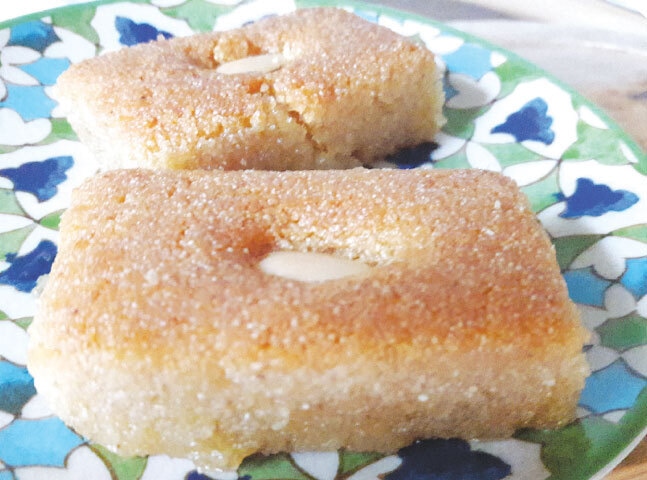
Think of basbousa as suji ka halwa [semolina halwa] but in cake form. Made from suji [semolina], topped with almonds or pistachios and traditionally soaked in honey or fragrant syrup, basbousa is the Middle East in a slice. While the semolina cake originated in Egypt, variations of basbousa can be found in Arab, Balkan and North African countries across the region: from Yemen to Lebanon and Albania to Turkey.
A popular dessert in the Arab world, basbousa is often made on special occasions, such as Ramazan, Eid and Easter. While some food historians speculate the cake was first made in the 1500s to celebrate the Ottoman Empire’s conquest of Armenia, others point out earlier origins — it is possible a version of basbousa was made in Ancient Egypt while under pharaoh rule.
Some point out, however, that the dessert could have evolved from ma’mounia, a semolina pudding that can be traced back to the 10th century. Regardless of its origins, basbousa has been around for at least hundreds of years, so give this fragrant, history-in-every-bite cake a try.
Basbousa
This cake is sure to be your new favourite for tea parties or as an afternoon sweet treat with chai. Made with suji and soaked in rose-flavoured syrup, this dessert may be bite-sized but it packs a sugary punch. Don’t have a sweet tooth? Skip the syrup and simply enjoy the almond and coconut-infused flavour of basbousa. Short on time? Drizzle the cake with honey instead of syrup.
The origins of a Middle-Eastern twist on the classic tea cake can be traced back to hundreds of years
For a softer texture, replace the two cups of coarse semolina flour with one cup fine semolina and one cup coarse suji. For a more dramatic presentation, bake the cake in a 9×9 round tray and top generously with rose petals, shredded coconut and flaked almonds or pistachios.
Ingredients
For the cake
2 cups coarse suji [semolina flour]
¾ cup shredded coconut
1/3 cup sugar
1 ½ teaspoons baking powder
1 tablespoon elaichi [green cardamom]
1 cup plain yoghurt
½ cup melted ghee [can be substituted with butter]
1 cup whole almonds or pistachios
For the syrup
2 cups water 2 cups sugar 1 cinnamon stick 1 teaspoon lemon juice 1 teaspoon rose water
For the toppings (optional)
½ cup shredded, desiccated coconut 2-3 tablespoons dried edible rose petals ½ cup flaked almonds or pistachios
Method
Preheat the oven to 180 degrees Celsius. Grease a 9×13-inch baking tray. Spread oil or butter on the pan and sprinkle with flour. Alternatively, you can line the tray with baking paper.
In a large bowl, mix the dry ingredients. Add the semolina flour, sugar, baking powder and desiccated coconut. Remove seeds from the cardamom pods and crush them. Add to the mixture. Stir well until combined.
Fold in the yoghurt and ghee (or melted butter). Mix well.
Pour the cake batter into the pan. Using a butter knife, make slight indentations on the batter in a grid pattern with each rectangle around an inch wide and a little more than an inch in length. Place a whole almond or pistachio at the centre of each of the marked pieces. The cake can also be cut in a diamond pattern if desired.
Bake at 180 degrees Celsius for 35 minutes or until done (the cake should take on a golden-brown hue).
Make the syrup. In a saucepan, pour the water and then add the sugar. Add the cinnamon stick. Boil the sugar on medium heat, stirring frequently until it melts. Reduce heat. Add the lemon juice and stir again. Then, add the rose water. Continue stirring for a few minutes more until a thick, fragrant syrup forms.
Take the basbousa out of the oven. Pour the syrup on the still-hot cake. Let the basbousa soak in the syrup for at least two hours before serving. Slice the cake into smaller pieces by cutting along the diamond pattern. If desired, sprinkle dried rose petals, flaked almonds (or pistachios) and shredded coconut on each piece.
Serve hot with tea or Arabic coffee.
Published in Dawn, EOS, September 28th, 2025