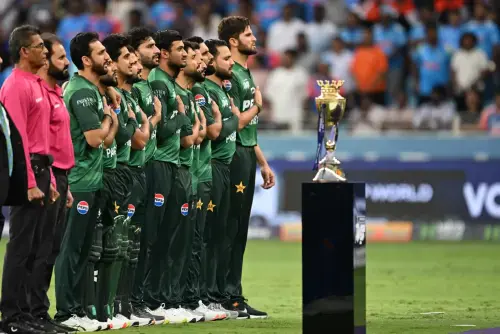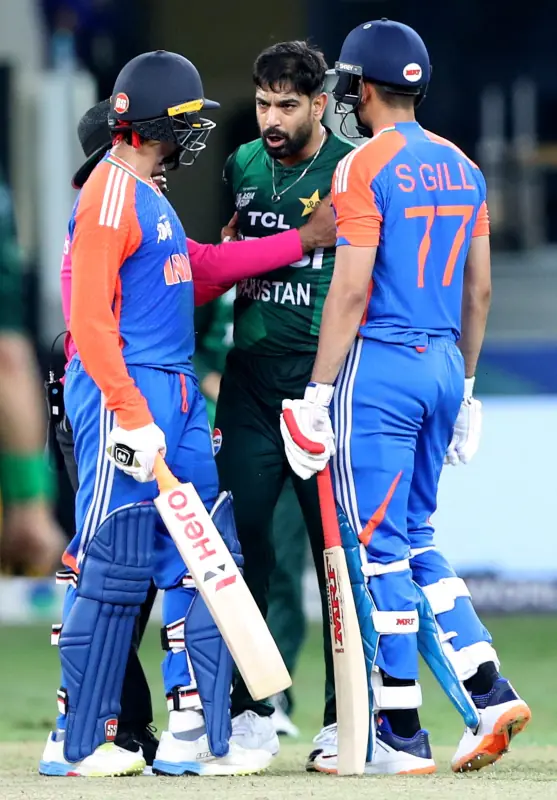
FOLLOWING a week of political mudslinging, the cricketers of India and Pakistan resumed the unequal music of their rivalry on Sunday.
Pakistan’s only chance was posting a total that could pressurise India’s formidable batting line-up. Encouragingly, they took that chance in the first half of their innings and at the end, but a baffling seven overs of lethargy in the middle terminally damaged the team’s prospects.
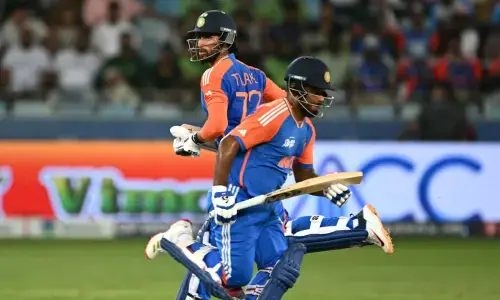
India’s openers, Abhishek Sharma and Shubman Gill, thrashed Pakistan’s bowling all around the Dubai International Stadium. By the 10th over, India had full control of the game and had lost no wickets.
This shows that India produces batsmen while Pakistan unearths hitters. The latter also selects too many nudgers and blockers, so when the best teams in the world go hard at the opposition throughout an innings, it’s hard to understand why Pakistan persist with a bygone strategy.
Fakhar’s dismissal was just the latest example of the unwritten laws of cricket, which state that Team India — not the batsman — should receive the benefit of the doubt
The PCB might respond by saying that these are among the best players available. However, what the PCB must ask itself is why it oversees a system that fails to produce batsmen of sufficient quality to perform consistently in international cricket.
It must also ask itself why it fails to produce batsmen capable of executing the aggressive approach that today’s white ball cricket demands. And it must ask itself why Pakistan’s players are so inept at playing spin bowling.
But on the bright side, the version of Pakistan that we saw in the Super 4 contest was to some degree a different and welcome one. The hitters attacked from the beginning; granted they were aided by a pitch that — although a little on the slow side — offered no help to bowlers.
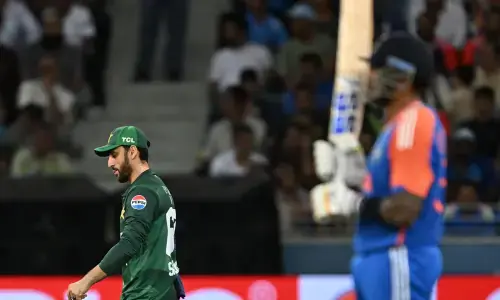
Fakhar Zaman set the example. He came not to play; he came to attack and seize the initiative. Disappointingly, just as he was beginning to force the issue, he was wrongly dismissed by the third umpire, who somehow believed that a ball bouncing on the grass before nestling in the wicketkeeper’s gloves was out.
It was just the latest example of the unwritten laws of cricket, which state that Team India — not the batsman — should receive the benefit of the doubt.
Fakhar’s gusto was enough to light the fire in Sahibzada Farhan. Pakistan had made a wise decision in dropping Saim Ayub to number three, and Farhan laid a solid foundation for Pakistan’s innings.
Farhan continued his domination of the world’s premiere fast bowler following a historic six last week. This was something of a second humbling for Jasprit Bumrah, who other than his precision yorker, wasn’t quite sure how to respond.
When Saim joined Farhan, Pakistan’s pinch-hitter-turned-indispensable-bowler played a steady hand. Between them they took Pakistan to the dizzy heights of 93 from the first 10 overs. Unfortunately, the innings unravelled after the traditional break in play.
Pakistan lost momentum, firstly through Saim rediscovering his trademark no-look flick off the hips, which led to his dismissal. It is probably a shot that Saim needs to put away for a while.
Next, India’s spinners and back up bowlers becalmed Pakistan for no other reason than a lack of ambition from the Pakistani ‘nudgers and blockers’.
Part of the problem was that the Pakistan thinktank has become obsessed with the strategy of maintaining a left-and-right-hand combination. This led to Mohammad Nawaz, in particular, getting a promotion up the order, which backfired.
It was in those seven overs after the halfway mark that Pakistan shot themselves in the foot. Farhan became frustrated, fatigued, and partly succumbed to his hand injury. Salman Ali Agha, the captain, alongside Nawaz, wrongly chose to stabilise the innings.
Stability is one thing, but failing to score a boundary in 40 balls is a crime against cricketing logic.
The sad truth for Pakistan is that, however noble he is as a cricketer, Salman is not fit for the T-20 team. Equally, it’s unclear how often Nawaz must demonstrate his unsuitability for international cricket. These mistakes must be corrected when the next T-20 squad is picked.
Still, Pakistan recovered to a par score of 171. This was largely thanks to the witless approach of Nawaz, who was run out dawdling back to the crease in a homage to the great Inzamam-ul-Haq.
Pakistan were fortunate that Faheem Ashraf, who came in next, was in the mood to smite 20 runs off eight deliveries. Faheem’s success was in his willingness to take the attack to the Indian bowling, something that Salman and Nawaz were incapable of doing.
Through this mixture of calculated and fearless aggression — as demonstrated by Fakhar, Farhan, and Faheem — and dozy cricket — best exemplified by Salman and Nawaz — Pakistan reached a respectable total. However, it was 20 runs short of where it should have been given Pakistan’s start and given the opposition.
It didn’t make any sense that the hitting power of Mohammad Harris and Shaheen Shah Afridi was left sitting in the pavilion as the nudgers and blockers invited India back into the game. Let’s not forget that India gave Pakistan an unexpected helping hand by shelling four catches.
This may be a Pakistan side in transition, but the reality is that the problems in the batting order and tactics have made Pakistan a second rank side.
The bowling needs work too but it’s hard to evaluate properly because of the chronic failure of these hitters and the permanent indulgence of nudgers and blockers. Pakistan can still qualify for the final, but it would be a major surprise, and, at the moment, fully undeserved.
Published in Dawn, September 22nd, 2025