Hydrologist terms Indus treaty a ‘bane’ for Pakistan
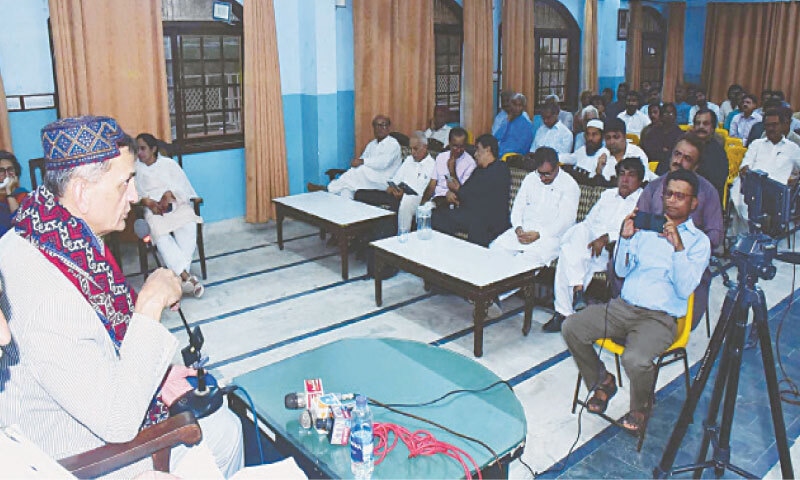

HYDERABAD: Noted hydrologist Dr Hassan Abbas has said that time has come now after 65 years to ‘demystify’ the Indus Water Treaty (IWT). He wondered what had prompted those at the helm of affairs at that time to go for this treaty. He said the treaty allows the upper riparian to do whatever would be in its interest at the cost of lower riparian’s rights.
He was speaking at a programme titled: ‘Indus river system; floods of 2025 reasons & lessons’ organised by the Hyderabad Roshan Khayal Forum in the local press club on Sunday.
Dr Abbas said that IWT allows flow of polluted floodwater through four drains and gives unbridled powers to divert unlimited quantum of water anywhere, instead of safeguarding legitimate interests of the lower riparian.
“We [Pakistan] excluded three sweet water rivers from the treaty and, instead, included drains of filthy water in it,” he said, and pointed out that India had built dams over its rivers. He claimed that no court or judge in the world would say this was done correctly under the treaty which allowed flow of pollution as well.
Dr Hassan Abbas argues the treaty allows upper riparian to trample over lower riparian’s rights, unleash polluted water into Pakistan
He said that “a treaty always protects lower riparian because upper riparian can do everything”. He termed the IWT detrimental to Pakistan’s interests, and observed it had caused ‘ecocide’ of mangroves, palla fish, shrimps, Indus dolphin, crabs, etc in the Indus.
“The Indus has now knocked at our doors telling us to behave,” he remarked.
Dr Abbas stated that dams would always break natural rhythm of water. It is the only treaty that allows the upper riparian to divert unlimited quantum of water by closing its three rivers and flush pollution into the river which remains unaccounted.
The treaty also binds down the lower riparian to maintain the rain data at its own expenses. The upper riparian does commit that it would provide money whenever these drains are required to be widened and deepened.
He said that he once spoke during a TV channel show in Washington in the presence of an expert, who appeared not aware of the four drains mentioned in the IWT.
Dr Abbas was of the view that it was time that civil and social scientists, activists and political leadership should take up this IWT issue now. He said that since Indian PM Modi has provided this opportunity by unilaterally suspending the IWT, we should take the injustices, committed to us under the treaty, to the international court. He asked why we are not doing work on it. India had included 16 more drains under the garb of these four drains, he said, and added that any lawyer who understood geography could understand that upper riparian could throw unclean water into rivers. He said people who were consuming this dirty water didn’t know it was ‘a gift of the IWT’.
The hydrologist said that consequences of this water were seen in south Punjab, but beyond Panjnad, where it meets the Indus, it gets diluted to great extent. The Indus does have such consequences but not on that scale which was seen in south Punjab.
He mentioned that institutes of kidney transplant had become a thriving business and it was consequence of this pollution directly entering the Indus.
He said that dams over Ravi, Sutlej and Bias rivers remained helpless and could not prevent floods and this had been proved during this flood season.
He said it was time that rivers’ course should be opened. These floods have given us one lesson that we should let rivers flow, failing which the river will open its course quite violently.
Technically, he said, the river did not cross its course. He regretted that experts and policymakers did not tell people not to raise settlements over riverbeds. He said the institutions concerned were directly responsible for it. He said last year, winter rainfall appeared low and, as a result, heavier flooding is seen this year. He believed that the next monsoon would be rougher as less winter rainfall is being anticipated this year.
Dr Abbas said it was not his wish, but a prediction based on scientific models that indicate weather systems’ phenomenon of weaker and stronger systems.
He noted that rivers have recharged groundwater aquifer and enriched soil. They have lessened the pesticide and fertiliser uptake. If people return to ecological services of river and start taking advantage of it, river would revive economy of delta and ensure food security.
Dr Abbas said that floods did cause serious damage in Punjab following breaches and even Sialkot was inundated. He said landscape of river developed entire system but through interventions over the last 200 years, tinkered people kept tinkering with it in order to prove that man is more powerful than the river.
He said that Indus is supported by four glorious systems — monsoon, glacial flows, ice melting and regeneration of water in floodplains — which all keep the Indus going. He said that in human history, no one has seen this river having gone dry. But it’s only our development models that render it dry.
Published in Dawn, September 22nd, 2025