THE judiciary’s decline will be underwritten by the apathy of those it depends on to fight vigorously for its integrity and independence.
It is this realisation, perhaps, that prompted five senior judges of the Islamabad High Court to march to the Supreme Court on Friday. There, they lodged separate but similar petitions against what they, and many in the legal community, consider serious issues undermining the IHC’s integrity and independence.
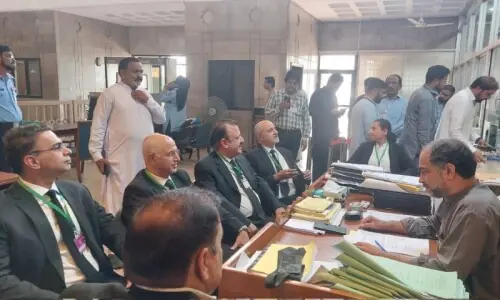
Images of the five justices, seated around a table, waiting — as ordinary petitioners do — while court staff processed their paperwork quickly made their way to social media. They were shared widely as the nation processed with growing trepidation the most visible symptom yet of what seems to be the judiciary’s hastening collapse. The petitioner judges themselves framed it in similar terms: “The demolition of the IHC and its independence, that is being witnessed today, is only because the petitioner judges dared to object to the executive’s interference in their judicial work and uphold their oath as judges of the IHC.”
This is an alarming development. The judiciary, one of the pillars of the state, has signalled that it may be too divided to be able to keep the constitutional order stable. The implications of this will not be lost on the public. Nor should they be lost on the powerful. The authorities should not need reminding that the Constitution envisions a tripartite separation of powers whereby each branch of the state is supposed to be independent.
The doctrine is meant to keep any institution from accumulating so much power that the prospect of political tyranny becomes a possibility. Worryingly, Pakistan seems to be making itself quite comfortable with absolutism. Where once ideals like civil liberties and independent institutions found spirited champions willing to fight for them, one now sees a complacency that too often resembles complete surrender.
Perhaps it was frustration with the status quo that pushed five serving judges to take such an extreme step. When justice becomes hard to come by, it must be fought for. That this fight has been taken to a court is a sign that, perhaps, not all is lost. As long as the courts can be expected to do justice, there is hope for course correction. It is when hope is lost that anarchy takes over.
Other countries in this corner of the world have seen violent upheavals in recent years over different strains of state dysfunction. All those with power, political or any other kind, must therefore work to prevent any such crisis from unfolding in Pakistan. The constitutional order and the boundaries it demarcates must be respected, and the law should remain above all other considerations. It is time justice is done, and is seen to be done.
Published in Dawn, September 21st, 2025