Nato deploys ‘eyes in sky’ to scour its eastern flank for Russian threats
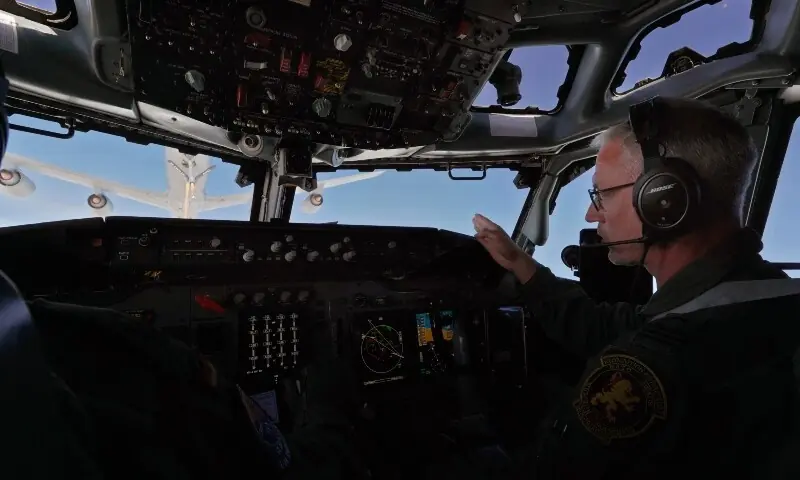


ABOARD AIRCRAFT: In a Nato surveillance plane some 10,000 metres above eastern Poland, air force officers from a half dozen countries scanned screens for any sign of Russian aircraft breaching the alliance’s borders.
The threat was laid bare on Friday when two Russian fighters violated Estonian airspace for 12 minutes, forcing Nato to scramble jets and sparking consternation across Europe. Now the skies appeared calmer — but the crew remained attentive. “If there is any air threat to Nato we want to make sure we detect it as quickly as possible,” Lieutenant Colonel Mike Belizaire, a German officer, said.
“Our mission is to provide an early warning so it gives more time to the authorised commanders to decide how they choose to respond.” The intrusion in Estonia was the latest in a spike of incidents that has ramped up fears that the war in Ukraine could spill over the alliance’s frontier.
Days earlier Nato jets had shot down Russian drones over Poland in a watershed first for the Western military alliance. In response Nato’s top commander ordered a new mission, Eastern Sentry, to reinforce eastern flank defences that have already been built up since the Kremlin’s 2022 invasion of Ukraine. Fighter jets from countries including France and Germany were rushed to Poland.
“We have been doing missions in Poland for a couple of years now to protect the Nato countries,” said the surveillance plane’s Belgian lead pilot, Captain-Commandant Joel, giving only his first name according to his homeland’s military regulations.
“But what happened in Poland reminds everybody actually, that something can happen and that is why we are here again today to, have a look of what’s going on, to make sure that the Nato sky is protected.” The eight-hour flight from a base in Germany to circle over eastern Poland was the first made by one of Nato’s 14 centrally-owned AWACS airborne early warning and control aircraft under the umbrella of Eastern Sentry.
The hulking radar atop the plane — dubbed Nato’s “eyes in the sky” — has a range of some 500 kilometres, giving the crew the ability to peer across the hostile territory of Belarus and Russia’s Kaliningrad region. The plane can spot objects the size of a big bird. “It’s physics basically, when you’re up higher you can see further,” said Joel.
“That means we can add far more than systems on the ground.” Dozens of flashing blips dotted the screens on board showing the air activity in an area stretching all the way from southern Sweden down to western Ukraine.
Surveillance operator Aaron Peace of the US air force said it takes him under 30 seconds to assess if an unknown object on the radar represents a potential threat.
If a looming menace is detected the warning is transmitted to Nato commanders on the ground to decide how to react. With its AWACS planes and other intelligence capabilities, Nato says it has a clear picture over the east. But the low-cost drones that have become prevalent in the Ukraine war and recently crossed into Poland pose a problem. “They do fly differently,” Staff Sergeant Peace, who comes from the US state of New Mexico, said.
“The AWACS was built to track planes that fly higher and faster so these smaller, slower moving objects definitely pose a bigger challenge to track and identify. But we can see them.” While Nato may be able to monitor what’s happening — questions have been asked if it has the right equipment to counter the drones dominating the battlefield in Ukraine.
In Poland it used its most modern F-35 jets firing costly missiles to take out the drones. “We of course, recognise that the best way to defeat drones is not with a very expensive missile fired from a very, very expensive plane,” said a Nato official, talking on condition of anonymity.
Published in Dawn, September 21st, 2025