• NICVD, AKUH collaborate to save child from a type of inherited arrhythmia syndrome
• Expert says rare surgical procedure is carried out by a few centres in US, Canada
KARACHI: Amidst a constant flow of distressing news emerging from their hometown in flood-hit Multan, Sajid Hussain and his wife Samina find some solace when they look at their son Ayan today without feeling a surge of anxiety.
The five-year-old suffering from a potentially life-threatening heart condition has recently undergone a highly specialised surgery, brightening his chances to live a normal life.
The successful procedure — performed for the first time in Pakistan — was nothing less than a miracle for the family that has lost four children to the same illness before.
“After a long time, my heart is at peace; he hasn’t fallen ill even for once after the operation,” his mother Samina says, recalling that Ayan earlier used to react to any unpleasant thing by holding his breath, turning pale, and then fainting.
Married to her cousin, 30-something Samina had three stillbirths, too. With three surviving children including Ayan, the family is devastated by the ongoing floods that swept away their house and forced all loved ones to take shelter in relief camps.
“In these desperate times, Ayan gives us hope. We are too happy to see him, without a fear of losing him to the sudden illness,” she says.
While Sajid has been working in Karachi as a labourer since 2009, the family finally moved from their village in Multan to the city in 2023 when someone told them that Ayan could be treated for fainting free of cost here.
Ayan was initially treated at a public sector hospital from where he was referred to the National Institute of Cardiovascular Diseases (NICVD).
Life with disabilities
At the NICVD, Ayan was diagnosed to have a severe type of heart rhythm disorder that causes fast, chaotic heartbeats.
“He presented to us when he was three-and-a-half-year-old with multiple episodes of fainting and seizures. He has a severe type of Long QT Syndrome (LQTS), a type of inherited arrhythmia syndrome,” shares Dr Muhammad Mohsin, who initiated and heads the inherited arrhythmia clinic at NICVD, the first of its kind in the country.
He explains that the heart is otherwise normal (in individuals with heartbeat disorders) but the heartbeat at times becomes fast and irregular and presents with either seizures or sudden cardiac death in young healthy individuals less than 30 years old.
“These are rare conditions but not that rare. For instance, the incidence of LQTS is estimated to be 1:2,500 live births. Consanguinity not only increases the risk (for these disorders) but also can cause the most severe phenotypes of disease as is in Ayan’s case. He is deaf and dumb that is part of the severe phenotype of LQTS.”
According to Dr Mohsin, also part of the team that conducted the surgery, the usual treatment of the heartbeat disorders is medication but if patient has cardiac arrest despite medication than implantable cardiac defibrillator (ICD) — a battery-powered device that detects and corrects abnormal heart rhythm — and/or surgery is needed.
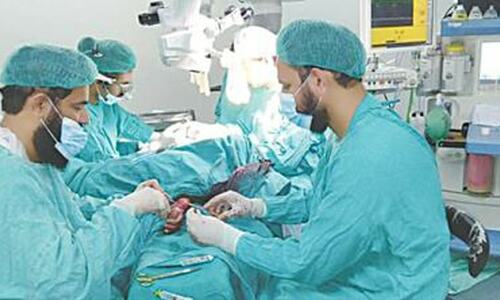
“Initially, we put the device in but he had recurrent shocks every time his heartbeat became life threatening so we decided to proceed for the surgery known as left cardiac sympathetic denervation (LCSD), which was not done before in Pakistan,” he said.
The surgery, Dr Mohsin pointed out, was considered because Ayan had very frequent shocks from ICD (almost every week up to four shocks in a day) and LCSD would help in reducing the frequency of those shocks.
Uniting for a cause
The LCSD, experts say, aims at reducing the overstimulation of the heart by removing specific nerves on the left side of the spine to reduce the risk of sudden cardiac death.
The NICVD collaborated with the Aga Khan University Hospital (AKUH) for the specialised minimally invasive heart surgery costing around Rs600,000. The much-needed financial assistance was met through the AKUH’s patients’ welfare programme and a donor’s support, ensuring that the family didn’t bear the burden.
“The operation went very well. It took us 21 minutes to carry out the procedure for which three incisions were made. The biggest one was 5mm and the other two were 3mm each. A camera was inserted through the [5mm] incision and the other two were used to insert the [surgical] equipment,” says Dr Saleem Islam, senior Paediatric Surgeon and Chair, Department of Surgery at Aga Khan University.
Few centres in the US and Canada, he says, carry out the rare surgical procedure and a lot of homework was done prior to the surgery to ensure its success.
Asked about the challenges faced, Dr Islam said: “The most difficult part was the patient selection. We knew we had to have the right family as this was the first time that we were doing the case anywhere.
“After that, it was the organisation with our anaesthesia colleagues because the anaesthesia part was the challenge too. Overall, what this case represents is how complex medical care has to be delivered by teams of experts in this day and age as no physician or surgeon can provide everything for everybody,” he said.
Published in Dawn, September 14th, 2025