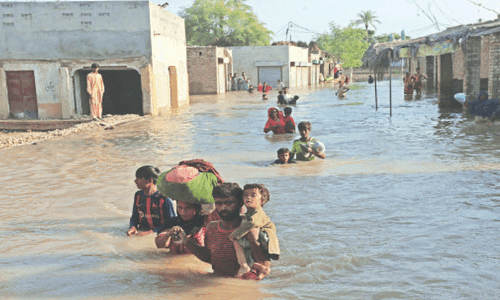
No respite for south Punjab as ‘high flood’ returns to Sutlej


 0
0

• Water levels rise at Harike and Ferozepur after India releases more water
• Jalalpur Pirwala, Alipur and Rahim Yar Khan at risk amid rising river levels
• Over 4.2m affected, 2.19m relocated as floods hit 4,400 Punjab villages
• Guddu Barrage fluctuates between medium and high flood
• Five dead, hundreds rescued in Karachi after Lyari and Malir rivers swell
LAHORE/GUDDU: With South Punjab still in the throes of a devastating flood crisis, the Provincial Disaster Management Authority (PDMA) has confirmed a high-level flood situation, particularly in the Sutlej River, after India released more water on Wednesday.
All barrages in south Punjab on the Sutlej, Chenab and Ravi rivers are flowing at extremely dangerous levels, submerging vast swathes of low-lying areas and posing a severe threat to urban centres, such as Jalalpur, Alipur and Rahim Yar Khan tehsils.
Flood conditions in Jalalpur Pirwala, one of the most badly affected areas, intensified again after the Sutlej started rising and increased pressure on a major embankment.
On Wednesday, a rescue boat carrying 19 people overturned in the area, leading to the death of a child. All others were safely rescued, officials said.
Seven villages in Liaquatpur have been submerged due to the floods. In Alipur, a child died and five people went missing after a boat capsized.
The situation has worsened further due to the breach of the Azmatpur embankment in the Alipur tehsil of Muzaffargarh district.
The ancient city of Seetpur is now at severe risk from floodwaters. Dozens of settlements, including Khairpur Sadat, Khan Garh Doma, Azmatpur, Kundarala and Sultanpur, have been inundated.
Water flow
According to Flood Forecasting Data released at 11pm on Wednesday, the water flow at Ganda Singh Wala headworks on the Sutlej River was 182,188 cusecs (steady trend) and was classified as “very high flood”.
Downstream, the flow was steady at 121,698 cusecs (high flood) at Sulemanki headworks and 121,010 (high flood) at Islam headworks.
On the Ravi River, the water flow was normal at both Jassar and Shahdara headworks and was in low flood at Balloki. However, at Sidhnai headworks, the flow was categorised as “very high” at 94,556 cusecs (falling trend).
On the Chenab River, the flow at Panjnad was “very high” at 598,731 cusecs (rising) and “medium” at Trimmu at 231,154 cusecs (steady). The flow at other headworks on the river — Marala, Khanki, Qadirabad and Chiniot — was normal.
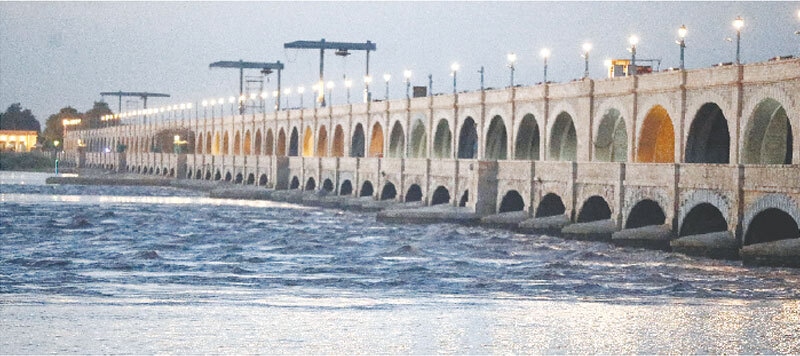
Meanwhile, Guddu Barrage recorded a brief spell of high flood on Wednesday morning before returning to medium flood levels by the afternoon, leaving officials puzzled as the anticipated peak has yet to arrive fully.
The barrage reached high flood stage at 6am with an upstream inflow of 502,844 cusecs and downstream discharge of 492,443 cusecs. “This indicated a high flood when the barrage passed a flow of 500,000 cusecs,” an official said.
Guddu Barrage Chief Engineer Sardar Shah said that following the morning surge, about 10,000 cusecs were diverted into the Begar Sindh Feeder canal on the right bank, which irrigates rice-growing districts in the command area.
Soon after, flows at Guddu fell to 493,281 cusecs upstream and 471,549 cusecs downstream by 1pm. By 11pm on Wednesday, the inflow was 495,509 cusecs, and the outflow was 472,094.
A gauge at Chachran also showed a decline, dropping from 10.5 feet to 10.3 feet by afternoon, indicating the Indus rise had been short-lived.
Mr Shah noted that with a 48-hour time lag between Panjnad and Guddu, the peak recorded at Panjnad on the evening of Sept 7 should have reached Guddu by Tuesday night. Instead, the rise was observed on Sept 10. He said if another peak is building upstream, it could arrive late Wednesday night or early Thursday morning.
Meanwhile, authorities at Sukkur Barrage said they were monitoring the situation closely. Upstream discharge at Sukkur was recorded at 405,665 cusecs and downstream at 382,355 cusecs, with officials watching for the expected peak.
Evacuations accelerated
Meanwhile, Punjab’s Relief Commissioner Nabil Javaid said that over 4,400 villages have been affected due to severe flooding in the Ravi, Sutlej and Chenab rivers.
He said that 2,190 villages were affected due to flooding in the Chenab River, 651 villages in the Sutlej River and 1,495 villages in the Ravi River.
More than 4.2 million people have been affected due to the flood situation in the rivers, while 2.19m people trapped in the floods have been relocated to safe locations.
He said that 404 relief camps and 488 medical camps were established in districts severely affected by floods.
Besides, 421 veterinary camps have been established to provide treatment facilities for livestock. In the affected districts, 1.581m animals have been relocated to safe locations during rescue and relief activities.
Mr Javaid said that Mangla Dam is 90 per cent full, while Tarbela Dam is 100pc full, India’s Bhakra Dam on the Sutlej River is 90pc full, Pong Dam is 99pc full and Thein Dam is 97pc full. He said that 76 citizens lost their lives in various incidents.
PDMA DG Irfan Ali Kathia said that the intensity of monsoon rains has decreased and no further increase in river flows was expected.
However, a Met office forecast indicated that isolated showers were expected in parts of Khyber Pakhtunkhwa, Azad Kashmir and the Pothohar region.
Five dead in Karachi
In Karachi, five people were killed and hundreds rescued as heavy downpours and hill torrents from the Kirthar range swelled the Lyari and Malir rivers to record levels, inundating low-lying neighbourhoods and damaging infrastructure.
Floodwaters submerged homes in Gadap, Scheme 33 and along the M-9 motorway, with major relief operations carried out by Edhi Foundation, Rescue 1122, security forces and civic agencies.
A 20-metre section of the Hub Canal and a gas pipeline were damaged, while part of the under-construction Malir Expressway collapsed. Authorities suspended heavy traffic on the M-9 amid fears of further inflows from Balochistan.
Sindh Senior Minister Sharjeel Memon said more than 400 people were rescued in the city, while 172 people stranded on the motorway were evacuated.
Separately, four bodies were recovered from a flash flood incident in Gadap Town and a teenage boy died of electrocution in North Nazimabad.
Schools were closed on Wednesday but are set to reopen today (Thursday) as the weather system has moved away from the area.
Published in Dawn, September 11th, 2025