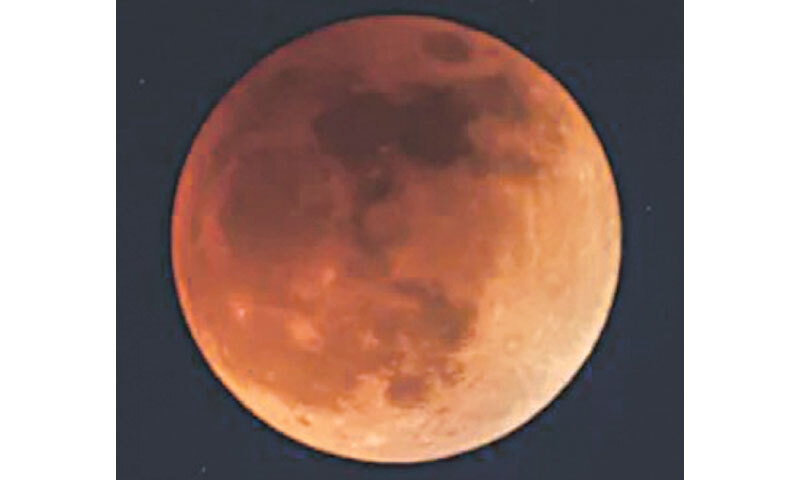
Tonight, on the night of September 7, the Moon will pass through the shadow of the Earth. It would appear that the Moon is blushing, with its copper red colour. Some will say not to look up. But that will be a mistake.
This is a lunar eclipse. It is rare to see this type of a beautiful celestial phenomenon, where you don’t even need a binocular or a telescope to enjoy it. All you need is a relatively clear sky and a strong will to direct your attention away from your phone and up towards the Moon.
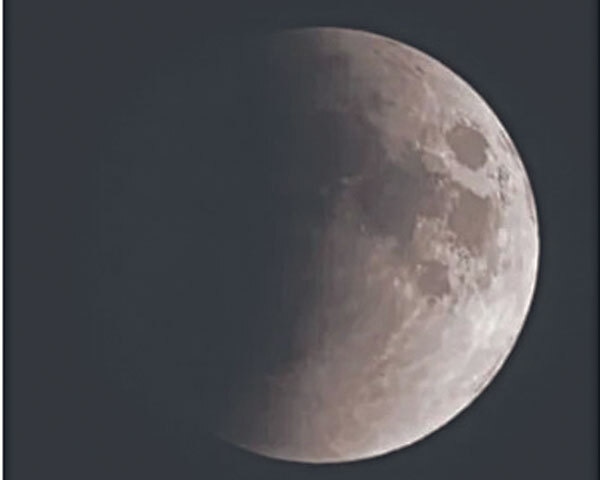
The Moon will start getting into the shadow at 8:28pm on Sunday, known as the penumbral phase, with the total eclipse (when the Moon is completely in Earth’s shadow) will start around 10:30pm. This total eclipse will end at 11:52pm, with the Moon completely out of the shadow by 1:55am on Monday, September 8.
Eclipses are a result of the orbital dance between the Earth, the Sun and the Moon. This has been going on for billions of years. Sometimes, the Moon comes in between the Earth and the Sun, briefly blocking the light of the Sun from reaching our planet. This is called a total solar eclipse. This happens during the day time and leads to a stunning darkness for a few minutes.
The Moon will pass into the Earth’s shadow tonight, turning a stunning copper-red. This is a brilliant time for Pakistanis, like billions of others, to observe the wonder of a total lunar eclipse...
The next total solar eclipse in Pakistan will happen on March 20, 2034, precisely at 4:49pm and will last five minutes! The precision betrays our superb understanding of the orbits of bodies in the solar system.
THE COPPER MOON
The event on the night of September 7 is different. The Earth will come in between the Moon and the Sun, blocking the light reaching our satellite. In other words, the Moon will pass through the shadow of the Earth. Here is the cool part: in the shadow, the Moon will turn copper-red (astronomer Prajval Shastri has dubbed it a ‘Copper Moon’).
This is surprising. You would expect the Moon to just become dark. Instead, during the total lunar eclipse, some of the sunlight passes through the Earth’s atmosphere and reaches the Moon. Just like the beautiful sunsets on Earth, the light bends in a way that allows the reddish colours to preferentially reach the Moon. When you see the eclipse, note the change of colour when the Moon goes from partial to total eclipse, and appreciate the role of our own thin atmosphere in creating this magic.
Some people worry about going outside and watching the lunar eclipse. There are eclipse-related myths associated with pregnancy, blindness, and sometimes just evil. There are indeed a lot of uncertainties in life. But a lunar eclipse is not to blame. During a total lunar eclipse, the Moon is simply getting a brief respite from the Sun in the shade of the Earth. We can look at the lunar eclipse without any danger whatsoever to our health.
In fact, historically, lunar eclipses have provided important scientific information. For example, Greek astronomer Aristarchus, in the third century BCE, used the position of the Moon at the start and the end of the eclipse to estimate that 3.5 Moons would fit in the Earth’s shadow. This suggested that the Earth is 3.5 times bigger than the Moon, an astonishingly close estimate to the modern value of 3.67.
Similarly, between 997 and 1018 CE, Muslim astronomer and polymath Rehan Al Biruni made note of the precise timings of at least four lunar eclipses in different locations to determine the difference in longitudes of multiple cities. I am glad that none of these scholars succumbed to the negative myths around the eclipses, and we are all beneficiaries of that.
UNITED IN WONDER
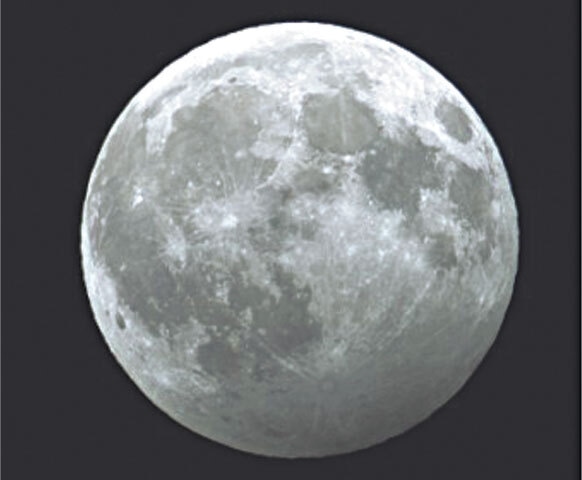
Lunar eclipses happen relatively frequently. However, what is incredible about this eclipse is that the totality will be visible to over seven billion people of the world! It is a reminder that we may be divided by politics and culture, and we may speak different languages, but we all share the same sky. The eclipse tonight will provide us with a reason to take a little break to look up and to be a part of an experience shared by millions of our fellow beings on this fragile planet.
We are also using this eclipse to centre Pakistan, South Asia and the broader Global South in the narratives of science. Usually, it is the American National Aeronautical Space Agency (Nasa) or the European Science Agency (Esa) that provides basic information about the scientific and cultural contexts of such events. The information, while useful, is often geared towards audiences in the US and in Western Europe.
This doesn’t have to be the case. Through the non-profit organisation, Kainaat Studios, we have created a resource site aimed at audiences in the Global South. We appreciate the fact that this awe-inspiring lunar eclipse will be visible to billions of people spread across four continents, including Asia, offering a moment for collective wonder that transcends boundaries.
We are calling this ‘Eclipse in Our Shared Sky’ to underscore our common humanity and our innate sense of wonder. We have created eclipse activities for schools, but presented in our own cultural context, with the information — including all the activities and the videos — available in English, Urdu and Hindi.
At a time when science at Nasa is itself facing an eclipse, we want to use the September 7 eclipse to begin centring curiosity and wonder in and from the Global South. And what better way to do this than with seven billion people experiencing the lunar eclipse in our shared sky.
In case you are wondering, the next total lunar eclipse will be visible in Pakistan on December 31 (New Year’s Eve), 2028. But you have tonight. Please go out and look up and appreciate the beautiful copper-red Moon in the night sky!
The writer is Professor of Integrated Science & Humanities at Hampshire College, US.
He is also an astronomer affiliated with the Five College Astronomy Department in Massachusetts and hosts an Urdu language YouTube channel, Kainaat Astronomy
Published in Dawn, EOS, September 6th, 2025