0
0

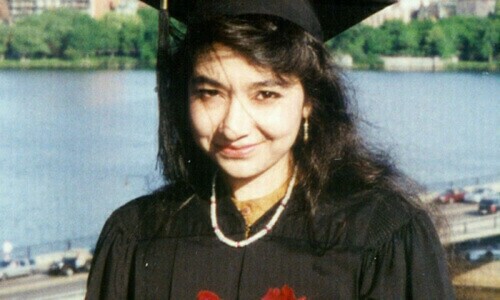
ISLAMABAD: A four-judge larger bench of the Islamabad High Court (IHC) has been formed to deliberate on three key questions raised by the registrar’s office while transferring Dr Aafia Siddiqui’s case.
The transfer came after Justice Sardar Ejaz Ishaq Khan initiated contempt proceedings against Prime Minister Shehbaz Sharif and the federal cabinet.
The larger bench, comprising Justice Arbab Mohammad Tahir, Justice Khadim Hussain Soomro, Justice Mohammad Azam Khan and Justice Raja Inaam Ameen Minhas, will hear on Sept 10 a petition filed by Dr Fowzia Siddiqui seeking the release of her sister, Dr Aafia Siddiqui, from a US prison.
On July 21, Justice Sardar Ejaz had issued contempt notices to the prime minister and the entire cabinet over non-compliance with the court’s directions. However, the registrar’s office did not execute the notices because the judge was not included in the duty roster approved by the chief justice.
Subsequently, the IHC reconstituted its benches and formed four specialised division benches, including one to hear tax references comprising Justice Babar Sattar and Justice Sardar Ejaz. As a result, the cases pending before both judges were reassigned to other judges.
Four judges to consider three key questions raised by registrar’s office while transferring the case
On Sept 1, Justice Raja Inaam Ameen Minhas took up Dr Fowzia’s petition. However, as the registrar’s report had recommended that a larger bench should address questions concerning the validity of the July 21 hearing, Justice Minhas referred the matter to the chief justice.
The central issue identified was that Justice Sardar Ejaz’s bench was not authorised to hear cases on July 21. The weekly roster approved by the chief justice had not assigned him any bench duties that day, and the official summer vacation roster also listed him as being on leave.
The registrar’s report noted that the IHC itself has previously held that determination of benches is the “exclusive administrative prerogative of the Hon’ble Chief Justice”.
It further cited rulings of the Supreme Court of India, which has held that no judge can direct listing of cases in conflict with the chief justice’s orders, and of the Supreme Court of Pakistan, which has ruled that benches may only hear cases formally fixed before them and cannot self-select matters.
The report suggested placing before a larger bench three questions: whether a judge can self-assign a case; whether an approved sitting roster can be violated by a judge; and whether the chief justice must obtain consent from benches before consolidating identical petitions.
Acting on these recommendations and the serious questions raised, the IHC chief justice constituted the four-judge larger bench now tasked with hearing the matter.
Published in Dawn, September 5th, 2025