ISLAMABAD: Despite strong reservations from the ministries of finance and power, the government has approved a dollar-based guaranteed return on the transportation of petroleum products through the 477-kilometre Machike-Thallian-Tarujabba White Oil Pipeline, estimated to cost $300 million.
The project will be executed on a government-to-government basis by a joint venture comprising Azerbaijan’s state-owned oil company SOCAR, Pakistan State Oil (PSO), and the Frontier Works Organisation (FWO). Positioned as a strategic investment from Azerbaijan, the project had long been advocated by the FWO using local resources.
At a recent meeting, the Economic Coordination Committee (ECC) of the Cabinet approved the terms and conditions proposed by the Petroleum Division to launch the project, citing its potential to enhance bilateral ties with Azerbaijan and attract future investment.
However, official documents reviewed by Dawn reveal that Power Minister Sardar Awais Leghari cautioned against offering guaranteed dollar returns. He noted that lessons should have been learned from the experience with Independent Power Producers (IPPs). He urged a detailed assessment of costs and internal rate of return (IRR) before proceeding.
ECC clears $300m oil pipeline project with Azerbaijan amid ministries’ concerns
SOCAR had conditioned its investment on a “ship-or-pay” model — similar to the “take-or-pay” model used in IPP agreements — requiring full payment for the pipeline’s annual capacity of 7-8 million tonnes, regardless of actual throughput.
The Ministry of Finance also raised objections, warning that dollar-based returns should be linked strictly to foreign investment. It stressed that such returns should not apply if local financing is used. The ministry also recommended extending the payback period from four to seven years to mitigate the early-stage tariff impacts and called for more realistic assumptions regarding interest rates and the weighted average cost of capital (WACC).
Despite these concerns, the Petroleum Division argued that the proposed changes would render the project unattractive to investors. The ECC, siding with the Petroleum Division, overruled both ministries’ objections, terming the pipeline a strategic opportunity that could unlock further foreign investment.
The FWO had initially proposed a 14.6pc IRR and a 25pc equity IRR. The Oil and Gas Regulatory Authority (Ogra) noted that the project’s final cost would depend on the adopted financing and operational model. The ECC partially addressed concerns by deciding that dollarised returns would apply only if foreign investment is involved.
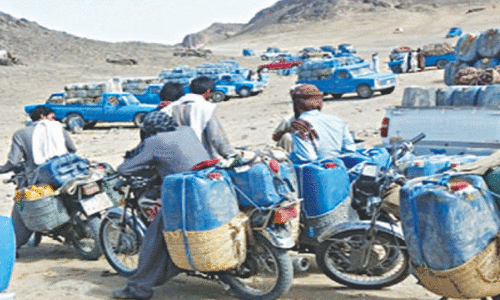
Currently, about 70pc of petroleum products in Pakistan are transported by road, 28pc through an existing pipeline from Karachi to Machike, and only 2pc by rail. The new pipeline aims to shift a greater share of oil transport to pipeline infrastructure, reducing costs and inefficiencies.
As part of the approved framework, Ogra will allow transportation tariffs to be denominated in US dollars and will declare the pipeline as the default mode of oil transport.
Oil Marketing Companies will be required to commit to minimum annual pipeline volumes. Any shortfall will be adjusted through their existing Inland Freight Equalisation Margin (IFEM). If collective commitments fall below the threshold, the shortfall will be covered through the national IFEM mechanism.
The FWO has already submitted a revised tariff petition for the Machike–Thallian section, which Ogra has accepted. A separate petition for the Thallian–Tarujabba section is under review. Although Ogra has determined a provisional dollar-based tariff, the details remain confidential.
Published in Dawn, September 2nd, 2025