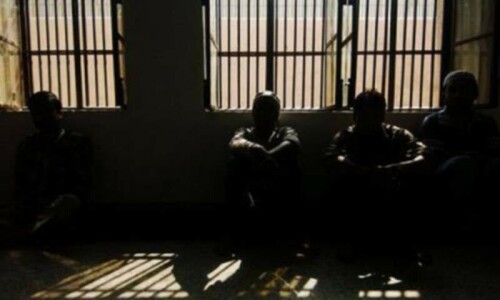
WHEN one thinks of Rawalpindi’s Adiala Jail, one thinks of overcrowding and misery. Unbeknownst to many, the facility also has the dubious honour of holding the highest number of HIV-positive inmates in Punjab, as revealed recently by the Punjab Aids Control Programme.
Figures show 148 prisoners are infected in the detention centre, built for fewer than 2,000, but crammed with over 4,300. The outbreak not only highlights the dangers of neglecting healthcare in closed institutions, it also reminds us of our failed response to HIV.
Overcrowded prisons are the perfect incubators for disease, especially given the inadequate attention to health and risky inmate behaviour. The dangers in Pakistan are amplified by a history of unsafe practices — unsterile injections, lax blood-banking and rampant syringe sharing. Ratodero in 2019, where hundreds of children contracted HIV from a single doctor’s reused syringes, was the most notorious case. Unprotected sex among high-risk groups and migrant workers bringing infections home are two more contributing factors.
The statistics speak for themselves: nearly 40pc of those who inject drugs are HIV-positive, and almost three-quarters admit to reusing syringes. The kind of behaviours that drive transmission in communities find their way into jails. Although prevalence in the general population remains officially low at 0.1pc, UNAIDS modelling suggests that over 230,000 Pakistanis were living with the virus in 2022 — a three-and-a-half-fold increase since 2010.
Pakistan’s response to the virus has been weak. Recent commentary in The Lancet accused the state of outsourcing much of the HIV effort to NGOs sustained by foreign donors, leaving the government with little incentive to take ownership. Services remain siloed in stand-alone clinics that are easy to spot; with their bold signage, patients are inclined to avoid stepping in for fear of stigma. Only a third of those infected are on antiretroviral therapy. Spending on prevention has fallen, while international funding, on which Pakistan is dependent, is shrinking. The Global Fund, citing both belt-tightening and mismanagement, has slashed its support by $27m.
As with other health challenges, Pakistan has strategies on paper. Its latest AIDS plan aspires to slash new infections by nearly two-thirds by 2026. Yet provincial health departments often fail to spend the money already allocated, while screening and treatment targets remain a fantasy. In some provinces, less than a quarter of those infected even know their status. Also, while improving prison health is imperative, the government must realise it is not just about inmate welfare. Untreated infections spill back into communities when prisoners are released. The authorities must invest in prison healthcare, enforce safe medical practices, and above all, integrate HIV prevention and treatment into the wider health system. The virus is relentless and so must the country’s response be.
Published in Dawn, September 1st, 2025