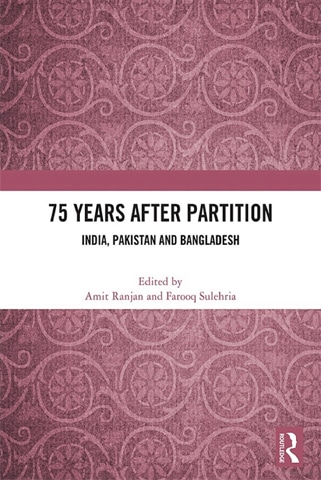
75 Years After Partition | India, Pakistan and Bangladesh
Edited by Amit Ranjan and Farooq Sulehria
Routledge
ISBN: 978-1041035909
208pp.
It is through memory, language and stories that South Asia’s history lives on. And the most significant, horrifying, yet grand event that changed the trajectory of the region is the Subcontinent’s partition of 1947.
The newly published book 75 Years After Partition: India, Pakistan and Bangladesh, edited by Amit Ranjan and Farooq Sulehria, brings together essays that were first published as a special issue of India Review. This book traces the aftershocks of the Partition, in both cultural and ideological senses, and brings to light its impact and influence on the language we speak, the text we read and the movies we watch.
Although the book also ranges across India and Bangladesh, I shall focus on the Pakistan-centred chapters.
In the chapter ‘Building an Ideological Nation-State: Migrancy and Patriarchy in Khadija Mastoor’s Zameen’, media scholar Qaisar Abbas analyses migrancy in the Urdu novel in a compelling way and highlights how the text refuses to romanticise the refugee experience. The turmoil migrants have to go through is often celebrated as some sort of heroic resilience in state narratives. Moreover, the novel’s post-Partition Pakistan is not the promised sanctuary for Indian Muslims but a society quick to normalise deceit, false property claims and bribery.
Additionally, in Zameen, women’s place is strictly policed by cultural, legal and economic structures. The metaphor of land in the novel is not incidental; it is gendered. As Daisy Rockwell’s 2019 English translation highlights, women in this new Pakistan are valued less than the acres men so greedily count.
A collection of essays traces the repercussions of Partition that carry an impact on the Subcontinent’s language, culture and thinking
Abbas turns the novel into a lens to look at almost eight decades of institutionalised inequity, by placing Zameen alongside Pakistan’s real-world gender politics (legal codifications of male privilege and cultural policing of women’s bodies).
The most valuable contribution of academic Farooq Sulehria’s chapter, ‘Lollywood on Partition: Surprise Departures, Anticipated Arrivals’, lies in its insistence that Partition must be theorised not as a one-off tragedy, but as a three-stage process — context, event and memorialisation. This framing, borrowed partly from Indian political scientist Ranabir Samaddar’s notion of “partitioned times”, is more than an abstract academic exercise.
Sulehria demonstrates how this model clarifies the role of what French philosopher Louis Althusser called the “Ideological State Apparatuses” (ISAs). Pakistani scholarship, as Sulehria notes, has lagged behind its Indian counterpart in theorising Partition as a structural, ongoing phenomenon, preferring to characterise it as “founding trauma”, instead of acknowledging its constant reanimation in political, cultural and gendered spheres. The chapter’s refusal to see 1947 as a historical full-stop is one of its great strengths.
Sulehria’s readings of the films Kartar Singh (1959), Jinnah (1998) and Khamosh Pani (2003) show that, even within the constraints of censorship, certain films have disrupted the official logic of Muslim victimhood and Hindu/Sikh villainy. The insight here is not simply that counter-narratives exist, but that they survive in a cinematic tradition otherwise leaning toward the ‘us vs them’ narrative (Lakhon Mein Aik (1967) serving as his example of ‘otherification’ that aligns with post-1965 jingoism).
What emerges from all these chapters is a portrait of Partition as an idea that continues to reinvent itself to serve present needs (needs of the state), whether through distortion of official histories, selective nostalgia of popular cinema, or biased, heavily censored school syllabi.
From a gendered perspective, which Sulehria also highlights, Khamosh Pani is the standout. In Kartar Singh and Lakhon Mein Aik, women’s suffering is subsumed under the register of male honour. Khamosh Pani, by contrast, relocates Partition in the body and psyche of the woman: her trauma continuous, unhealed and linked to the later ‘Islamisation’ project. Sulehria is right to note that this breaks from even left-wing nostalgia that frames Pakistan as ‘Partition betrayed’ rather than ‘Partition fulfilled.’ Partition worked exactly as intended, and the result is what we see in Pakistan today.
A very remarkable factor is that the chapter situates these films in a wider theoretical and historical frame. Sulehria’s engagement with scholars like Joe Cleary, Yasmin Khan and Radha Kumar situates Pakistan’s Partition within decolonial exit strategies, resisting the temptation to treat 1947 as a unique event. This comparative lens, distinguishing between partitions imposed by departing colonial empires and those emerging from the collapse of pre-capitalist empires, allows him to identify a structural logic to imperial “exits” that unites cases as disparate as Ireland, India and Palestine.
If there is a lesson to be drawn from ‘Lollywood on Partition’, it is that silence, too, is a discourse. The absence of Partition from most of Pakistani cinema is not an accident; it is an ideological choice. Side note: For those who have yet to see Kartar Singh, Jinnah, Lakhon Mein Aik or Khamosh Pani, the richness of his description leaves little room for cinematic surprise (in other words, spoiler alert).
Lastly, in ‘Reimagining and Reproducing the Partitions (of 1947 and 1971) in Textbooks in Pakistan: A Comparative Analysis of the Zia and Musharraf Regimes’, historian Mazhar Abbas highlights how the state narrates its own birth and, in the case of 1971, its own fracture, to generations of schoolchildren. Both regimes relied on selective memory to tell two radically different stories of the two partitions. As Abbas notes, 1947 fits the “emergent state” narrative; 1971, the “parent state” narrative. One fuels pride; the other demands amnesia.
Abbas brilliantly challenges the usual excuse for state-controlled textbooks, which is the idea that every country teaches a patriotic version of history to unite its people. He points out that this claim falls apart when we remember 1971: if nationalist history were meant to keep the country together, the break-up of Pakistan should be the loudest cautionary tale in the syllabus. Instead, it is barely mentioned.
This chapter reminds us that, until curricula embrace reflective, fact-based history over political agendas, Pakistan will keep producing citizens fluent in slogans but strangers to their past.
What emerges from all these chapters is a portrait of Partition as an idea that continues to reinvent itself to serve present needs (needs of the state), whether through distortion of official histories, selective nostalgia of popular cinema, or biased, heavily censored school syllabi. It exposes the dynamic between history and power, where memory is trimmed to fit the nation’s preferred silhouette.
This anthology invites an unsettling reflection: if we continue to inherit the past only in its most convenient form, are we learning history, or rehearsing amnesia?
The reviewer is visiting faculty at Beaconhouse National University
Published in Dawn, Books & Authors, August 31st, 2025