When I first came across resin art, I honestly thought it was just another internet trend. Shiny coasters, glossy tables, jewellery, keychains and a lot of things that I just wonder if those were real.
However, soon I found myself drawn to it, and I thought why not I give it a try? And when I did, I realised it was nothing like I imagined.
Resin art literally surprised me. Just like an artist makes sketches, I was exploring it with my imagination and creativity, and only then I realised why it’s just so much these days.
Unlike sketches or digital work where results appear instantly, resin needs one to wait. For beginners, waiting is frustrating, but resin needs time to cure, sometimes 24 hours, sometimes longer.
Resin art blends creativity with precision, transforming simple materials into striking, glass-like creations
Those of you who want to explore this art, let me give a brief introduction in simple words that resin art is created with two components: resin and hardener. Resin is a thick, clear liquid and the hardener is used to transform it into a solid, glass-like finish. The trickiest part is to mix them in the exact ratio recommended by the manufacturer, usually one-to-one or two-to-one, depending on the brand.
If you add too much hardener, it will crack or overheat and if you add too little, it will stay sticky forever. The right way is to either use a digital scale or mixing cups with markings while stirring slowly (to avoid bubbles), and then pour in the mould before it starts thickening. You have to be quick as well as observant. This simple step; mixing correctly is what separates successful projects from failed ones.
Resin doesn’t ‘dry’ like paint. Instead, it ‘cures’. Drying means liquid evaporates (like paint or glue), while curing is a chemical reaction between the resin and the hardener, that turns the mixture into a hard, solid form.
The word “resin” originally meant the sticky sap of pines. The resin we use in art is man-made (synthetic). It’s created from petroleum by-products in factories, designed first for industries as a strong adhesive and coating, but later adopted by artists because of its glass-like clarity and durability. The hardener, which we mix with resin to solidify it, is another chemical compound that triggers the curing process.
But what most people don’t know, and I learnt after making several mistakes, is that the temperature in which we are working with the resin. For example, if your room is cold, the resin might stay sticky forever; if it’s too warm, it cures too quickly and doesn’t give you time to create the patterns you imagined. In fact, dust, too, is a hidden enemy. I can’t count how many times I thought I had made the perfect piece, only to find little dust particles laying strong on the shiny surface the next morning. I eventually learned to protect my work by simply covering it with a cardboard box while it cured. Such small details, which no one really tells you in the beginning, are essential in creating your product.
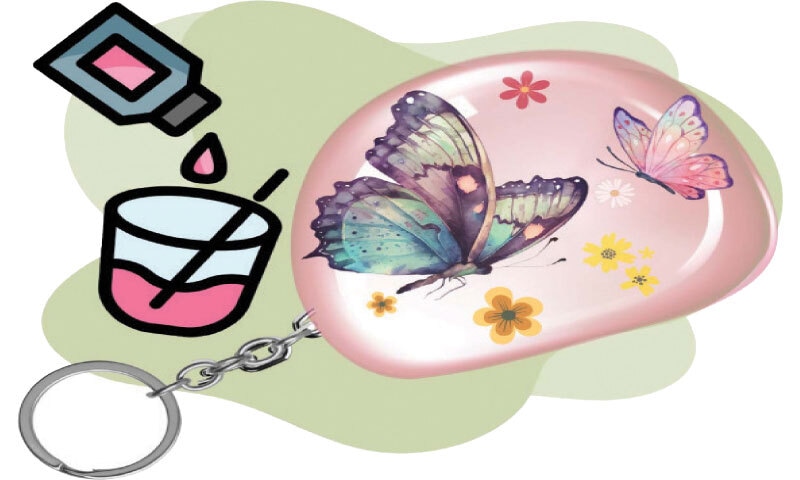
Not all resins are the same, this also I discovered after wasting a few batches. The resin you use for making keyrings, jewellery items, or small personal articles is not the same as that used for furniture. Casting resin, for instance, is designed for deep moulds, while epoxy resin (we commonly use) works beautifully for coatings and thinner layers.
Then comes the colour selection. There is no doubt that expensive pigments give incredible effects, sometimes the simplest materials create the most beautiful results; for example, I’ve used common inks, acrylic paints, even spices like cinnamon to bring earthy tones in my art.
As far as safety is concerned, resin looks harmless, but its fumes and direct contact can be harmful over time. I used to think gloves and masks were optional, until I realised they aren’t. They are what keep you healthy enough to enjoy this art for years, not just for a quick project.
Resin art has huge potential beyond being just a hobby. People value it because it looks luxurious and lasts for years. Whether it’s jewellery, wall art or furniture, resin creations have a strong market these days. Many artists have turned it into a small business, selling handmade coasters, trays and even large statement tables.
If you’ve been thinking of trying resin art, my advice is simple: just start. Don’t wait until you feel ready or you have all the right tools. We often insist on the right time or perfect tools; this is where we often end up not trying new things.
Remember, failures are part of the process, you don’t have to give up. As a beginner, I made plenty of mistakes but I didn’t give up. Instead kept a notebook where I wrote down the resin brand, the ratios I used, the pigments, the curing times, even the mistakes. It made everything clear to me.
Resin art is as beautiful to explore as the final product. It’s an art not only about what you create, it’s also about what it creates within you.
Published in Dawn, Young World, August 30th, 2025