Xi makes second-ever visit to Tibet as president


 0
0
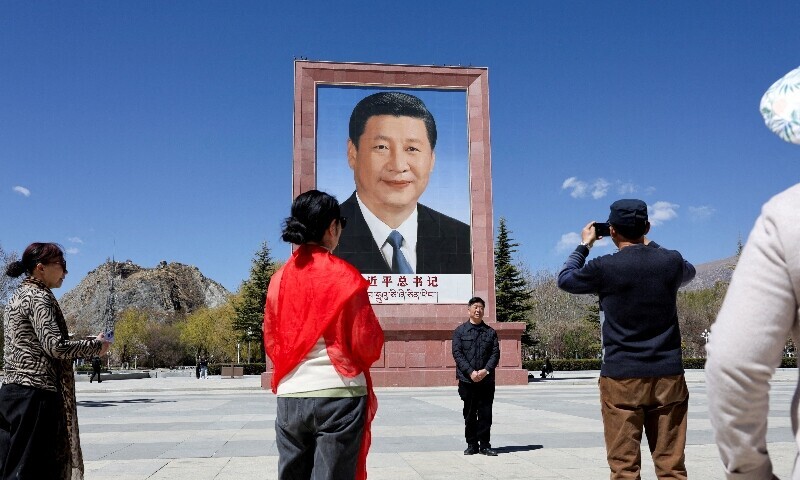

BEIJING: Chinese President Xi Jinping arrived in Lhasa, the Tibetan capital, on Wednesday for his second-ever visit as his country’s leader to mark the 60th anniversary of Tibet’s founding as an autonomous region.
Six years after the 14th Dalai Lama fled into exile in India following a failed uprising in 1959, China’s ruling Communist Party established the Tibet Autonomous Region in 1965 - the country’s fifth and final autonomous region after Inner Mongolia, Xinjiang, Guangxi and Ningxia.
The designation was meant to offer local ethnic minority groups such as the Tibetans greater say over policy matters, including freedom of religious belief.
“To govern, stabilise and develop Tibet, the first thing is to maintain political stability, social stability, ethnic unity and religious harmony,” state media cited Xi as saying to senior Tibetan officials.
Xi last flew to Tibet in July 2021 where he urged people there to “follow the party” in a visit largely perceived by outside observers to signal the Communist Party’s confidence that order had finally been established in a region with a long history of protest against Chinese rule.
“Tibetan Buddhism must be guided to adapt to China’s socialist system,” Xi Jinping said. Prior to 2021, the last Chinese leader to visit Tibet was Jiang Zemin in 1990.
More broadly, Tibet is a highly strategic region for China due to its border with India. Troops from both sides had clashed at their border over the years. The Himalayan region also possesses abundant natural resources, including immense hydropower potential.
Xi’s arrival in Tibet coincided with a rare trip this week by China’s Foreign Minister Wang Yi to India, where both countries pledged to rebuild ties damaged by a deadly 2020 border skirmish. China’s latest mega hydropower project in Tibet has also unsettled India downstream.
Published in Dawn, August 21st, 2025