Situationer: Mass funeral amid rubble and grief in Buner

AT BATAI, a couple of kilometres upstream of Pir Baba Bazaar in Buner, hundreds of mourners gathered on the bank of the Pachay stream under the blazing Saturday morning sun to offer a mass funeral for more than 40 people who had perished in the devastating floods a day earlier.
Locals from nearby villages thronged the makeshift funeral ground, set up on flood-flattened cornfields now covered with a thick layer of alluvial deposits left in the deluge’s wake. The bodies were laid in two rows, with some cots carrying two corpses, blood stains still visible on the shrouds. Villagers jostled to get a final glimpse as elders tried to restrain mobile-wielding youths.
Suddenly, the restless calm was broken by a group of wailing women arriving to say goodbye to their relatives. “Stop filming, stop filming,” some among the crowd shouted, while others muttered, “What are the women doing here? They should not be here.”
Jehan Bar, a bulky local elder, addressed the mourners, urging them not to return home after the burial. “Our family members and friends’ bodies are still lying beneath rubble and sand from Qadir Nagar to Daggar, and we should not leave them this way,” he bellowed. “We will continue the search and give them the proper burial they deserve.”
Before the funeral prayers, I met a shell-shocked Mukhtiar Khan standing beside the rows of bodies. Mukhtiar, a resident of Qadir Nagar — a hamlet a few kilometres further upstream of Batai, one of the worst-affected areas — said he had lost 11 family members, including nephews, nieces and a daughter-in-law.
Along with his extended family, 35 people were either dead or missing. “The bodies of seven of my family members are here for their final rites,” he said quietly, adding that it was Allah’s will, and as a Muslim he bowed before whatever the Almighty had fated for him.
The mourners later resolved the dispute over women’s presence, and after the funeral prayers, the bodies were carried aside to where the women waited, saying their final goodbyes away from the prying male gaze.
We walked along the Batai Kalay road after the prayers until an Al-Khidmat Foundation volunteer offered us a ride across the Pachay stream to Malik Pur, through a detour. From there, it was still an hour-and-a-half walk to reach Beshonai, the worst-hit village in the district.
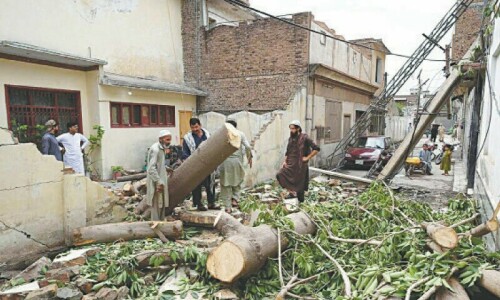
Driving through Narbatwal and other hamlets, the devastation was everywhere: several feet of mud and debris filled once-bustling shops, snapped power lines and uprooted pylons lay scattered, and people gathered their ruined possessions into piles in front of damaged homes. Wrecked cars were strewn along the roadside.
At the entrance to Malik Pur, police had set up barricades, allowing only pedestrians to proceed as crews cleared the upstream road. The uphill walk along the Kawga stream was filled with locals — volunteers, survivors and onlookers.
Beshonai, once a vibrant village straddling the stream of the same name, now lay buried under massive boulders. Only fragments of houses stood in eerie silence. At three sites, villagers clawed at the rocks with bare hands and whatever tools they could find. “We start digging whenever we smell decomposing bodies,” said Kamran Khan, a resident who had lost several relatives.
By Saturday afternoon — more than 24 hours after the disaster — no government machinery had reached Beshonai. Kamran said from his house on a higher slope he had watched the village disappear in minutes. “It was raining heavily on Friday morning, then suddenly darkness fell, followed by a rumble. Within minutes, the village was gone.”
The village, home to no more than 120 houses, had lost over 80 lives, he said. “Many still do not know if their relatives are dead or alive.”
Anwar Khan, another resident, said at least 12 of his family members were missing. He recalled locals talking about heavy flooding in the stream on Aug 14, 1995, but even the oldest villagers did not remember anything close to Friday’s catastrophe.
Haider Ali, another resident, told Dawn that the people wandering among the boulders and ruins were in shock. “This was a bustling village. People may still be buried beneath our feet. How can anyone be normal here?”
He explained that the floods appeared to have started from Naray Ghar to the north, thundering down the slopes with unstoppable force. Teachers Irshad Ali and Akbar Zada, furious at the official absence, said: “Locals are working on a self-help basis, welfare organisations are helping, but the government is nowhere. They can have dozens of helicopters for military operations but not one for relief.”
Rizwan Bacha, a resident of Pir Baba, said he had spent the previous night searching for bodies along streams and under debris. “We collected 27 bodies of people from Qadir Nagar.”
Pir Baba Bazaar, the district’s busiest commercial centre, was nearly destroyed when the Pachay nullah burst its banks. Shops and markets were filled with several feet of alluvium, destroying all goods. Mobile signals dropped even at the entrance to Pir Baba Road, while only official and rescue vehicles were allowed to pass the police barricade. Walking through the bazaar felt like wading in sludge.
Jamroz Ali, who ran a juice shop there, recalled: “We were having breakfast when the water rushed in. It came too quickly and filled everything with sand and debris.” He and his family had climbed to the roof and remained there for several hours.
Pir Baba Bazaar is named after one of the most revered saints of the region, Syed Ali Tirmizi — lovingly called Pir Baba. His shrine, on the bank of the Pachay nullah, attracts devotees from across Pakistan. On Friday morning, floodwaters entered the mosque adjacent to Pir Baba’s shrine.
Published in Dawn, August 17th, 2025