HERE are two things to beware: billionaires in politics and government officials who publicly praise the ‘resilience’ of the people. These two may seem unrelated but they share a devastating quality: they mask the failure of governance and distort the public’s understanding of power, responsibility and survival.
Let’s begin with the billionaires.
In recent months, Rahul Gandhi’s sharpened attacks on Narendra Modi have reignited a debate that India’s ruling class would prefer to bury. At the centre of his criticism is not ideology, not even electoral promises, but a relationship. The relationship between Prime Minister Modi and Gautam Adani.
Gandhi has been unflinching in what he calls a “symbiotic” arrangement between political power and corporate interest. In speech after speech, he has laid out how Adani’s businesses ballooned after Modi came to power, often expanding into sectors — airports, defence, energy — where government clearances and public assets were key to growth. Gandhi’s central point is blunt: Modi governs for Adani, not for India.
We are not resilient because we choose to be. We are resilient because we have to be.
Adani’s rise was greased by access — access to land, licences, loans and, above all, impunity. This is not business. It is cronyism par excellence, and a cautionary tale for the rest of us. It shows billionaires in politics are usually there for themselves only. They use their wealth to buy themselves a country, and use the country to increase their wealth.
In Pakistan, we’ve had our own versions of this playbook. One example would be Jehangir Tareen, who bankrolled Imran Khan’s rise, shuttled independents into the PTI camp, and carried the party through its early years in power. And what did he get in return? Sugar — and a lot of it. Subsidies flowed, prices were manipulated, and regulatory oversight vanished. When the sugar inquiry report finally came out, it laid bare the scale of profiteering. Tareen’s political investment paid off handsomely till he was caught with his hand in the jar and, mercifully for the rest of us, was turfed out of the game that he thought he had bought.
Then there’s Elon Musk in America. Though not a politician in the formal sense, Musk now wields political power in all but name. From manipulating markets with tweets to controlling public infrastructure — satellite internet in war zones, electric vehicles on government subsidies — Musk has blurred the line between private ambition and public consequence. His public behaviour, particularly since acquiring Twitter (now X), reveals not a disrupter of elites but a billionaire deeply committed to reshaping the rules in his favour. He demands tax breaks, moves factories when displeased, and openly flirts with political candidates who will leave him alone. His influence is not democratic. It is imperial.
Whether it’s Adani, Tareen, or Musk, the pattern holds: billionaires do not enter or shape politics out of civic duty. They do it to protect and expand their empires. They present their wealth as a marker of success. ‘My wealth is evidence of my success. Give me control of the state, and I will operate it successfully too,’ they say.
But it’s a lie. In truth, they ask for control only to increase their wealth and nothing more.
Now to the second thing to beware: the myth of the ‘resilient’ Pakistani.
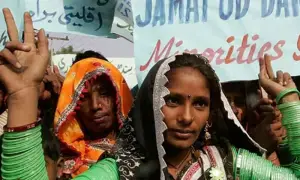
You’ve heard it before — usually from a government official at a conference, a donor event or a television interview. ‘The people of Pakistan are incredibly resilient.’ It sounds flattering. It sounds noble. But it’s neither. It’s a euphemism for abandonment.
We are not resilient because we choose to be. We are resilient because we have to be.
Because when inflation ravages the monthly wage, life must go on. Because resilience is what it takes when the roads are flooded after the slightest rain, crime is rampant, public service non-existent, property rights hard to come by and justice elusive, and education a luxury. Let’s be clear. This is not resilience. It is endurance. It is a forced adaptation to failure.
And when officials celebrate this they are not saluting the people. They are excusing themselves. Every time they praise our ‘strength’ they are also admitting their own weakness. Their inability to provide the basics of governance becomes, in their narrative, proof of our heroism.
But there is no dignity in being told you are brave for surviving conditions that should not exist in the first place. The woman who walks five kilometres for clean water does not want to be called strong. She wants water. The child studying by candlelight is not doing it for the applause.
And here’s the real danger: once ‘resilience’ becomes the official line, it lets the state off the hook. It becomes a substitute for service delivery. ‘Look how resilient they are,’ they say — so why fix anything?
Let’s retire this fiction. Let’s stop romanticising suffering. The people of this country do not want to be resilient. They want to be safe, fed, housed and heard. And if there is any role for government in this country, it is to build a society where nobody needs to be resilient just to survive.
So beware the billionaire who seeks to ‘serve’. He’s likely here to collect.
And beware the official who praises your ‘resilience’. They are telling you not that you are strong — but that they are absent.
Because in both cases, the real message is the same: ‘you’re on your own, kid.’
The writer is a business and economy journalist.
Published in Dawn, August 7th, 2025