

NEVER throw away a diary. It is like burying your past prematurely.
In 1980, I worked in Dubai for a while and then for the next nine years in the Abu Dhabi National Oil Co. Both sheikhdoms were emerging from the chrysalis of their sandy past to become modern Eldorados.
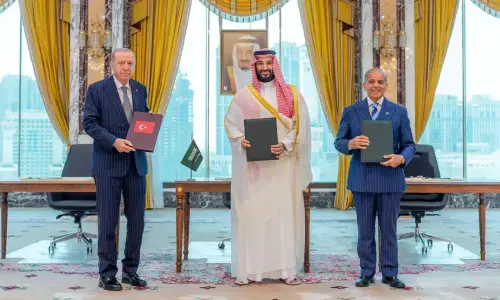
C. Davidson’s recent book From Sheikhs to Sultanism (2021) encouraged me to re-read my early diaries. Davidson focuses on the rise of two modern Arab rulers — Saudi Arabia’s Crown Prince Muhammad bin Salman al-Saud (MBS) and the UAE’s President Mohamed bin Zayed Al Nahyan (MBZ). MBZ (born in 1961) is older than MBS by 24 years. MBS defers to MBZ as his ‘wise uncle’. The enormous disparity in their wealth, however, makes MBS far more important.
Both rulers govern through layered control — using what Davidson defines as ‘patrimonialism’ (governance dominated by the ruler, his family and friends) and ‘neo-patrimonialism’ (in which modern-looking institutions and rules are the veneer for patrimonialism). The ADNOC I joined in May 1980 fell into the second category.
Few could compare with Dr Krouha for vision and dynamism.
From ADNOC’s inception in 1971, Sheikh Zayed bin Sultan had been keen that it should be run on professional lines. He did not trust the Western oil giants. He was suspicious of Egyptians and other Arabs. He turned instead to Algeria, where, after the peremptory departure of the colonising French, young Algerian executives in its national oil company Sonatrach stepped into the vacuum.
The man sent by Sonatrach to head ADNOC was a 31-year-old Sorbonne-trained economist, Dr Mahmoud Hamra Krouha. An FT profile described him as “a slightly-built man, neatly dressed in western suits, with an easy smile and an Indira Gandhi-style streak of white in his hair”. A formidable linguist, he was fluent in Arabic (including the local Bedu dialect), French and English. He took with him about a dozen Algerians (not all properly qualified) to help him run ADNOC.
I had the privilege of working with Dr Krouha for seven years, between 1980 and 1987. Over my long professional career, I have encountered many chief executives, each a giant in his own field. None — except for our Syed Babar Ali — could compare with Krouha for vision, dynamism, and competence.
Dr Krouha exercised an unshared grip over ADNOC’s 10 directorates — exploration & production (E&P), hydrocarbon processing, marketing, etc — and its 18 subsidiaries and affiliates. He knew everything about them and expected his staff to be as well informed. Every paper requiring his approval went up to his Spartan 12th-floor office in ADNOC’s headquarters. (Its replacement is a 65-floor skyscraper, costing $316 million.)
He chaired the board meetings of each of ADNOC’s subsidiaries, usually in the afternoons (ADNOC closed at 2:30pm.) All too often, underprepared CEOs would find themselves outgunned by him. On one occasion, I witnessed him take on Dr Mana bin Said Al-Otaiba, then UAE’s minister of petroleum and mineral resources. A new general manager had to be appointed in a company of which Dr Otaiba was the chairman. British Petroleum proposed a candidate. Dr Otaiba welcomed him. Dr Krouha objected: “It is ADNOC’s right as the majority shareholder to nominate the GM.” BP and other foreign shareholders had to agree. The minister left the room, but returned. Dr Krouha had made his point.
Inevitably, as young watanis or locals returned from their training abroad, they eyed the top posts in ADNOC. In January 1981, ADNOC’s board instructed Dr Krouha to appoint Abu Dhabians as deputy directors. The first happened to be Suhail Al-Mazrui. I know the exact date — Jan 25 — from my diary. I was in the room of the Algerian director (E&P) when Suhail was ushered in. I wrote in my diary: “He is a young mild-looking engineer who has recently returned from the US.” His salary I noted was in Grade 12, mine Grade 15.
I suspected that he had been chosen by Sheikh Zayed to take over from Dr Krouha. That took another six years. In 1987, during a routine majlis, Dr Krouha attended on Sheikh Zayed. Zayed asked Sheikh Tahnoun (his son-in-law and chairman, ADNOC): “Is he still here?” Before Dr Krouha could return to his office in ADNOC, it had been sealed and he was escorted to his villa. A BP representative commented afterwards, “We were there before, and we are here now. How long did he think he would last?”
Suhail Al-Mazrui took ad hoc charge of ADNOC. With the sustained patronage of MBZ, in time he rose to become minister of energy & infrastructure.
Davidson’s detailed book mentions ADNOC only three times, Dr Krouha not once. Broken by the death of a son, Krouha died in Paris in 1997, unsung, but not forgotten.
The writer is an author.
Published in Dawn, August 7th, 2025