THIS refers to the article ‘South Asian Quad?’ (July 8), which talked of a possible joining of forces in South Asia, led by Pakistan and China, and excluding India, along the line of the Quadrilateral Security Dialogue — commonly referred to as Quad — which is quintessentially a naval military alliance with spotlight on the Indo-Pacific region, an integrated maritime construct of the Indian and Pacific oceans.
Scholars in the West often term Quad an alliance of four ‘maritime democracies’. Accordingly, it is the navies of the member states — Australia, India, Japan and the United States — that fundamentally shape and promote the Quad agenda.
The principal goal, though not the only one, is to promote regional stability through naval collaboration, thus aug-menting maritime security. This, in turn, underwrites what is called ‘free and open Indo-Pacific’ (FOIP).
The FOIP concept practically translates into freedom of navigation, overflight rights, and a common approach to the task of curbing the twin menace of piracy and terrorism. Arguably, FOIP is executed under the rubric of now much discredited international rules-based order.
Rather than directly targeting China, the Quad navies have been conducting regular high-intensity naval exercises in the wider Indo-Pacific region since 2015. These large-scale exercises augment maritime cooperation, promote inter-
operability, and boost capacity-building. The former Malabar series of joint naval exercises, originally conceived in 1992 between the US and Indian navies, now embrace the Quad member forces of Japan and Australia.
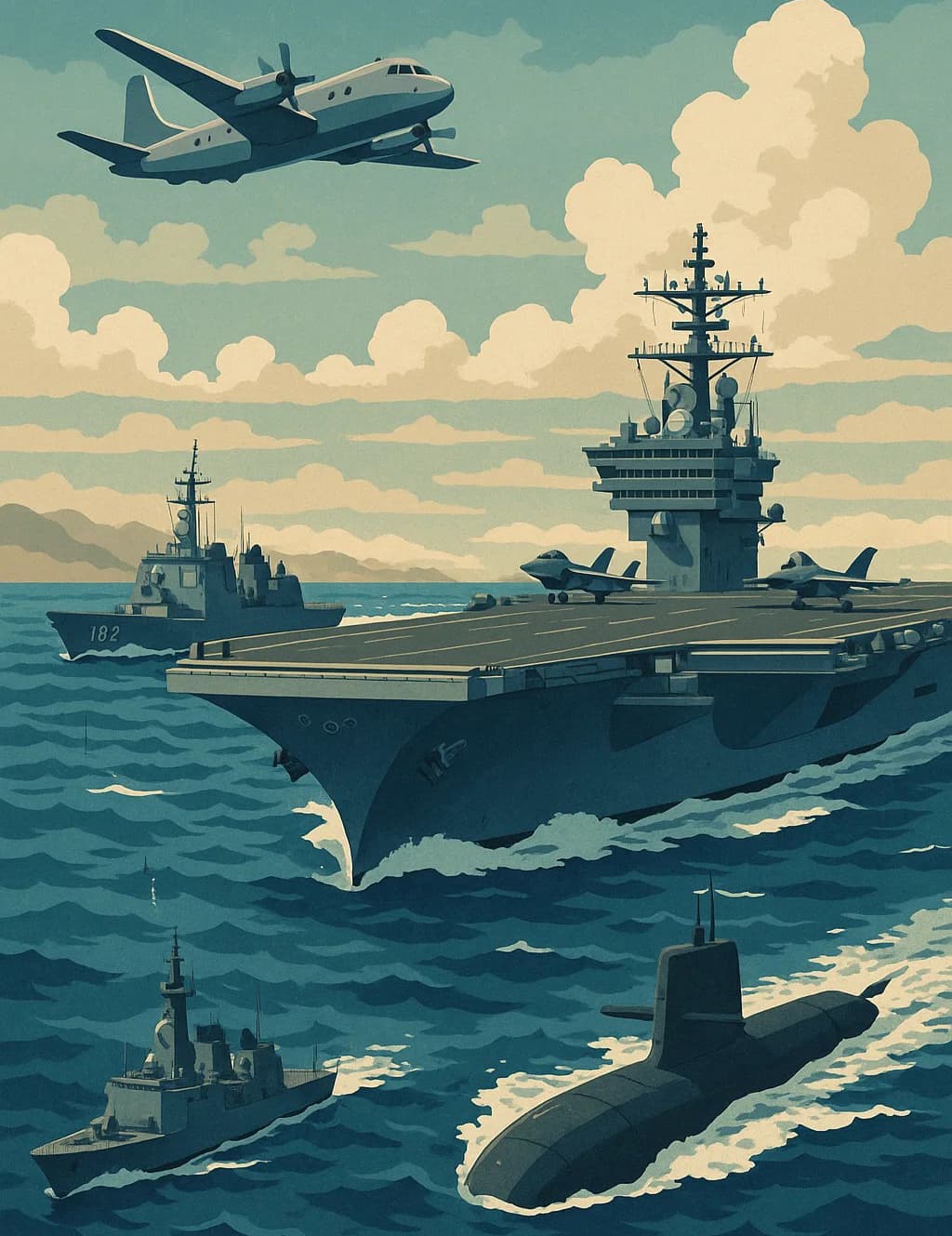
The participation of aircraft carriers, guided-missile destroyers, frigates, corvettes, submarines, helicopters and long-range maritime patrol aircraft is a strategic messaging of sorts. Equipped with a formidable and numerically the world’s largest navy, China, however, rejects the Indo-Pacific construct as an attempt to contain its rise. The maritime domain, or the global maritime commons, is the largest manoeuvre space on the planet, covering 71 per cent of Earth’s surface and constantly increasing. This domain exhibits manifestly different characteristics compared to land.
Oceans provide a frictionless, continuous, unbroken and unobstructed view and openness. It is this medium that connects the world and facilitates over 90pc of global trade.
Naval armed forces, with their peculiar attributes, like the ability to operate in strategic maritime spaces and contested regions, mobility, rapid deployment and manoeuvre, serve the cause of a country’s national security as well as of foreign policy. As warfare stands today, future wars are set to be fought in the air or at sea. Emerging technologies, driven by artificial intelligence (AI), precision-guided munitions, beyond visual range (BVR) weapons, drones and space warfare, now put a question mark on manpower-intensive armies and large formations.
What exactly the proposed South Asian Quad, or the establishment of a ‘strategic dialogue forum’, without India will likely have on its charter or agenda is debatable. China is fundamentally in East Asia, and Afghanistan is still in need of international recognition beyond Russia. The suggested title regardless seemed rather ill-chosen.
Cdr (retd) Muhammad Azam Khan
Lahore
Published in Dawn, July 26th, 2025