Israeli president hints at ‘good news’ soon during Gaza visit


 0
0


• Hamas responds to Tel Aviv’s ceasefire proposal
• Journalist, family among 100 more killed in strikes
• Over 100 aid, rights groups say mass starvation is spreading in Gaza
GAZA: Israel’s President Isaac Herzog visited the Gaza Strip on Wednesday and told soldiers that there were “intensive negotiations about returning” the Israeli prisoners in Gaza, adding that he hopes that they will soon “hear good news”, a statement from the Israeli president’s spokesperson reported.
In a related development, the Palestinian group Hamas submitted its response to an Israeli proposal for a 60-day Gaza ceasefire on Wednesday, according to two Palestinian sources familiar with ongoing talks in Doha.
The response included proposed amendments to clauses on the entry of aid, maps of areas from which the Israeli army should withdraw, and guarantees on securing a permanent end to the war.
Negotiators from both sides have been holding indirect talks in Qatar with mediators in an attempt to reach an agreement on a truce deal.
But the talks have dragged on for more than two weeks without a breakthrough, with each side blaming the other for refusing to budge on their key demands.
For Israel, dismantling Hamas’s military and governing capabilities is non-negotiable, while Hamas demands firm guarantees on a lasting truce, a full withdrawal of Israeli troops and the free flow of aid into Gaza.
The United States said special envoy Steve Witkoff would head to Europe this week for talks on Gaza, and might visit the Middle East afterwards.
Witkoff was departing with the “strong hope that we will come forward with another ceasefire as well as a humanitarian corridor for aid to flow, that both sides have in fact agreed to”, State Department spokeswoman Tammy Bruce said.
Journalist among 100 killed
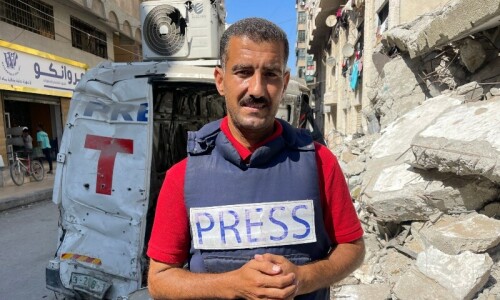
Meanwhile, freelance journalist Wala al-Jaabari, her husband and their five children, were among more than 100 people killed in 24 hours of Israeli strikes or gunfire. The journalist’s family went to bed hungry at their home in Gaza City. Their corpses lay in white shrouds outside their bombed home on Wednesday with their names scribbled in pen. Blood seeped through the shrouds as they lay there, staining them red.
“This is my cousin. He was 10. We dug them out of the rubble,” said Amr al-Shaer, holding one of the bodies after retrieving it.
Iman al-Shaer, another relative who lives nearby, said the family had not eaten anything before the bombs came down. “The children slept without food,” he said.
Relatives said some neighbours were spared only because they had been out searching for food at the time of the strike.
More die of starvation
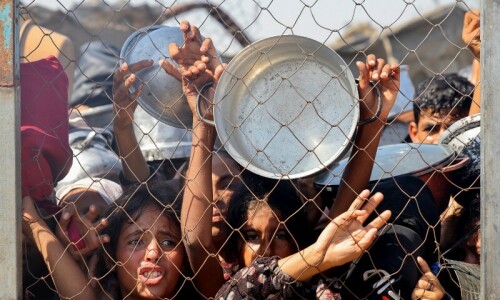
Ten more Palestinians died overnight from starvation, the Gaza health ministry said, bringing the total number of people who have starved to death to 111, most of them in recent weeks as a wave of hunger crashes on the Palestinian enclave.
In a statement on Wednesday, 111 organisations, including Mercy Corps, the Norwegian Refugee Council and Refugees International, said mass starvation was spreading even as tons of food, clean water and medical supplies sit untouched just outside Gaza, where aid groups are blocked from accessing them.
Israel has cut off all supplies to Gaza from the start of March and reopened it with new restrictions in May.
The United Nations and aid groups trying to deliver food to Gaza say Israel, which controls everything that comes in and out, is choking delivery, and Israeli troops have shot hundreds of Palestinians dead seeking aid at aid collection points since May.
“We have a minimum set of requirements to be able to operate inside Gaza,” Ross Smith, the director of emergencies at the UN World Food Programme.
Published in Dawn, July 24th, 2025