FM Dar urges cooperative diplomacy over confrontation amid growing global turbulence
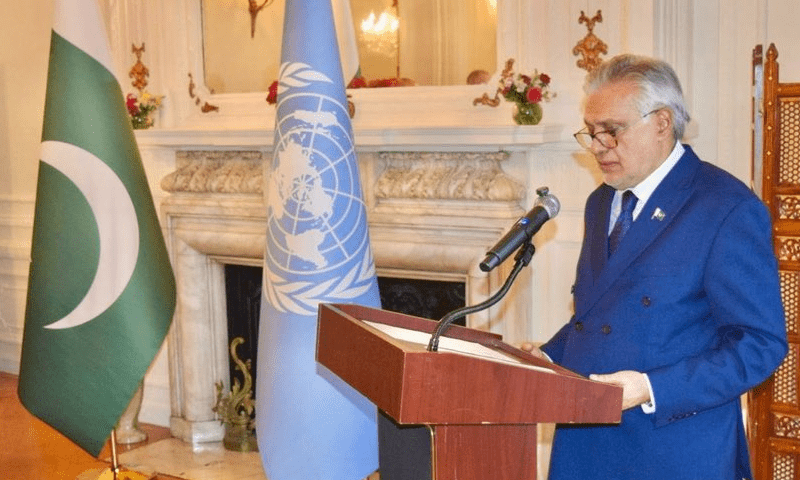


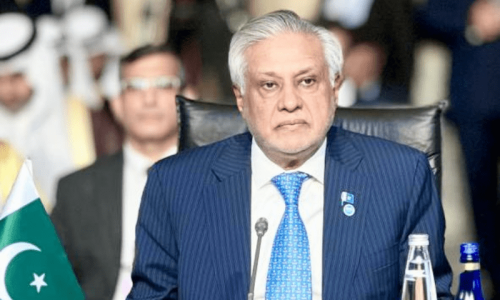
Deputy Prime Minister and Foreign Minister Ishaq Dar called for an inclusive dialogue and cooperative diplomacy over confrontation amid growing turbulence across the world during his United States visit on Wednesday.
Dar arrived in New York on Monday to attend “high-level signature events” of Pakistan’s United Nations Security Council (UNSC) presidency, including a conference on Palestine.
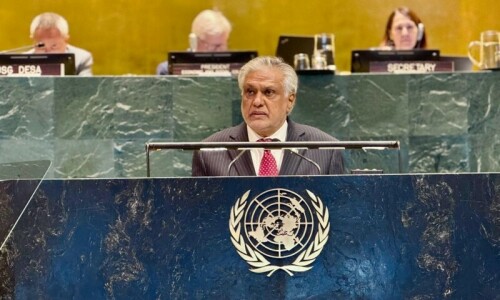
Addressing a reception today hosted by Pakistan’s Mission in New York on the occasion of Pakistan’s UNSC presidency, Dar stressed: “We believe that global peace and security can only be achieved through multilateralism, peaceful settlement of disputes, inclusive dialogue, and respect for international law.”
The deputy PM pointed out: “At the core of Pakistan’s foreign policy is our firm commitment to multilateralism and the United Nations.
“The purposes and principles enshrined in the UN Charter, especially peaceful settlement of disputes and non-use or threat of force are foundational to the UN. They are indispensable for a just international order,” he added.
The deputy PM asserted that Pakistan’s leadership has been guided by “these very principles in both deliberations and concrete actions taken during its tenure”.
“This is a time of growing turbulence in the world, where the costs of unresolved disputes, long-running conflicts, unilateral actions, and disregard for international law are being felt in every region of the world,” Dar noted.
Dar’s remarks came as Pakistan holds the presidency of the UNSC this month. Pakistan assumed the UNSC presidency for July, marking its first presidency since 2013. Islamabad began its current two-year term as a non-permanent member in January 2025 and will serve through the end of 2026.
The UNSC unanimously adopted Pakistan-sponsored Resolution 2788 yesterday, calling for the strengthening of international mechanisms to settle disputes through peaceful means.
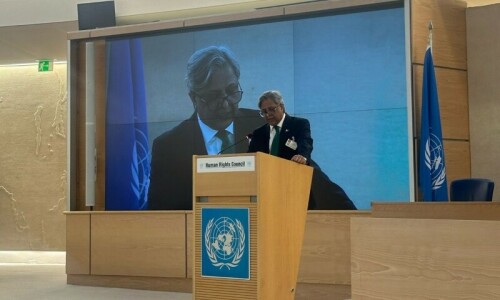
Dar also announced Pakistan was seeking a seat at the UN Human Rights Council (UNHRC) for the 2026-2028 term, with the Asia-Pacific Group endorsing its candidacy. Pakistan last held the membership from 2020 to 2023.
“Our engagement with the Human Rights Council is guided by the values of truth, tolerance, mutual respect, consensus-building, and engagement,” he said, expressing the hope for broad international support.
Speaking to diplomats, UN officials and representatives of member states at the Pakistan Mission, Dar outlined three priorities that Pakistan will focus on during its UNSC presidency.
He described the peaceful settlement of disputes, a core principle of the UN Charter, as “too often sidelined” and highlighted the need to bring it back to the centre of the council’s work.
He stressed the importance of revitalising “We see multilateralism not as a slogan, but as a necessity,” Dar said.
“The Security Council must be seen not only as a chamber of reaction but as a forum of prevention, problem-solving, and principled leadership,” he asserted.
He then detailed Pakistan’s third priority — enhancing cooperation between the UN and regional organisations, particularly the Organisation of Islamic Cooperation (OIC).
Dar stated that a UNSC briefing with the OIC was scheduled for July 24, highlighting the 57-member body’s vital role in global peacebuilding.
Reaffirming Pakistan’s active diplomatic engagement, the deputy PM said the country remained committed to working with partners around the world to advance the shared goals of peace, development, and human rights.
“Pakistan is a leading voice in the global climate and development discourse — from the General Assembly to the UN Ecosoc (Economic and Social Council) and elsewhere,” he noted.
He highlighted Pakistan’s leadership in global climate and development discourse and reiterated its support for strengthening the UN’s three pillars: peace and security, development, and human rights.
Concluding his address, Dar urged the global community to rise above divisions. “In a world facing deepening divides and mounting challenges, we must choose cooperation over confrontation, and diplomacy over force.
“Pakistan stands ready to work with all of you to advance these common goals,” he affirmed.